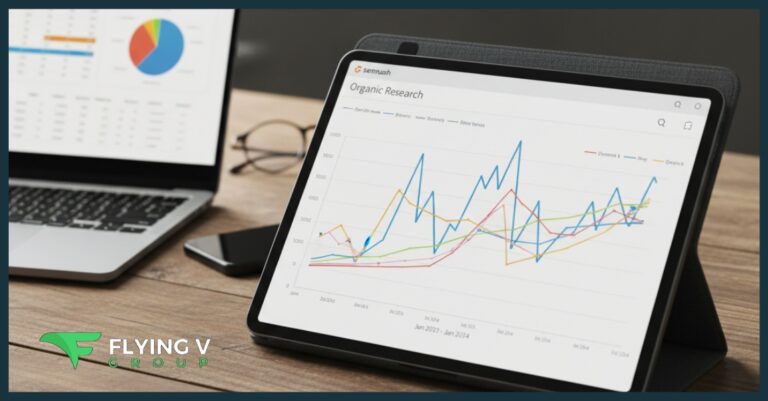

Most people using Semrush Traffic Analytics make the same mistake: they treat competitor traffic estimates as exact figures. A competitor’s dashboard showing 840,000 monthly visits doesn’t mean that’s how many people visited their site. It means that’s Semrush’s modeled estimate, generated from clickstream data and algorithmic modeling. Understanding that distinction changes how you interpret every report in the tool.
Semrush’s Traffic Analytics knowledge base states explicitly that this data is based on clickstream behavior from 200M+ internet users, proprietary and third-party sources, and AI/ML modeling. Semrush also notes that figures may differ from a website’s internal Google Analytics data. That’s not a flaw to work around. It’s a design choice that makes Traffic Analytics genuinely useful for competitive intelligence and largely unsuitable as a replacement for your own first-party data.
Where Flying V Group Fits
Flying V Group’s SEO services and Semrush SEO audit work applies these competitive analysis principles to real client campaigns. The workflow below reflects how the tool is used when the goal is optimization, not just data collection.
What Semrush Traffic Analytics Actually Is — and What It Isn’t
Semrush Traffic Analytics provides domain-level traffic estimates, acquisition channel breakdowns, engagement data, and geographic distribution for any website (including your competitors’). For your own domain, GA4 remains the primary source of truth. For competitors, Traffic Analytics is the only practical window into how they appear to acquire and retain traffic.
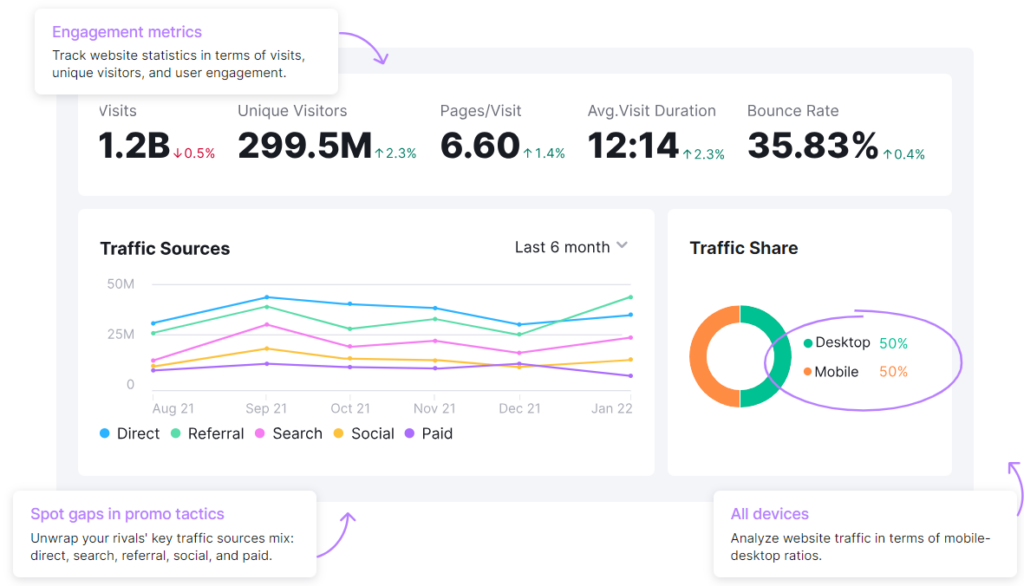
The core value is comparative and directional, not absolute. Is a competitor growing faster than you? Which channels appear strongest? Which pages are gaining momentum? Those are the questions Traffic Analytics can help answer reliably.
Semrush Traffic Analytics vs. GA4 vs. Search Console
| Tool | Primary Use |
| Semrush Traffic Analytics | Competitor traffic estimates and channel benchmarking |
| Google Analytics 4 | Actual on-site session and user behavior (your site) |
| Google Search Console | Google Search clicks, impressions, rankings (your site) |
| Semrush Organic Research | Estimated organic keyword and ranking competitor data |
Google’s documentation on using Search Console with GA4 explicitly notes that Search Console clicks and GA4 sessions will not match exactly because both systems measure differently. A deeper look at how Google Search Console and GA4 differ clarifies why each tool is suited to different questions. If Google’s own tools don’t agree on your own traffic, expecting Semrush’s modeled competitive estimates to match GA4 is even less realistic.
How to Set Up a Competitive Benchmark
Start by entering your domain into Traffic Analytics, then add three to five real competitors in the same comparison view. Choose competitors whose customers overlap substantially with yours, not simply the biggest names in the industry. Pick the sites competing for the same specific queries and buyers.
Look at the overview metrics across all domains: total visits, unique visitors, visit duration, pages per visit, and bounce rate. The goal at this stage is not to find one metric where you win. It’s to identify where the largest relative gaps exist, because those gaps point toward the channels or content types worth investigating first.
Analyze Traffic Trends, Not Just Traffic Totals
A competitor with 500,000 monthly visits and flat growth is a different problem from one with 200,000 visits and 40% year-over-year growth. The growing competitor is building acquisition momentum. Investigating what they’ve launched, published, or changed in the past 12 months produces more useful intelligence than analyzing the static total.
Use the timeline view to compare trend lines rather than point-in-time snapshots. Your traffic up 8% while a competitor is up 35% in the same period is a signal worth investigating regardless of whether your absolute numbers are higher.
Analyze Competitor Traffic Channels
The channel breakdown inside Traffic Analytics shows the estimated proportion of traffic coming from organic search, direct, referral, paid search, social, and email. These proportions reveal the acquisition model the competitor appears to have built.
A competitor deriving 70% of traffic from organic search has built a fundamentally different business than one running 60% paid search. Neither is universally better, but the channel concentration tells you where they’ve invested and where they’re exposed.
Identify Your Biggest Acquisition Gap
Compare your channel mix to your strongest competitor’s. The gap that matters most is not always the channel where you’re smallest in absolute terms. It’s the channel where the gap is widest and where building strength is realistic given your market position.
| If the gap is here | Investigate |
| Organic search | Content strategy, keyword coverage, topical authority |
| Referral | Partnerships, link acquisition, press coverage |
| Direct | Brand strength, returning audience, CRM |
| Paid | Campaign structure, landing pages, targeting |
| Social | Content distribution, platform presence |
Find Competitors’ Growing and Declining Pages
Semrush’s Top Pages dashboard categorizes pages into Growing, Declining, and Newly Detected views. This is one of the most underused features in Traffic Analytics and often the most actionable.
Growing pages show what’s gaining traction right now. These are worth examining for topic relevance, content format, channel source, and what intent they serve. If a competitor’s product comparison page has grown 300% in three months, that’s a demand signal, though it doesn’t tell you whether you should build the same thing until you investigate whether the intent is relevant to your buyers.
Declining pages show the other side. A historically strong competitor page that’s losing traffic may have become outdated, may no longer match how search intent has shifted, or may have been effectively replaced by AI-generated answers for that query. Those gaps are worth evaluating before building new content, because updating is often faster and higher-leverage than creating from scratch.
AI Traffic and AI-Visible Pages in 2026
Semrush’s cross-channel Top Pages report now tracks URL visibility across organic search, AI Overviews, Google AI Mode, ChatGPT, and Gemini, including the prompts that surface each page. This is the clearest signal available in 2026 for understanding which content is being cited in AI-generated answers rather than just ranked in traditional results.
If a competitor page appears across both organic search and multiple AI platforms, examine what makes it citation-worthy: whether it contains a direct, structured answer to a specific question, original data or examples not available elsewhere, clear entity definitions, and attribution to primary sources. That structure is replicable in your own content if the topic is genuinely relevant to your audience.
Turning Traffic Intelligence Into Site Changes
Traffic Analytics identifies opportunities. Validating those opportunities requires your own first-party data. If Semrush suggests a competitor gains substantial traffic from comparison content, check Google Search Console to see whether comparison-intent queries are generating impressions for your site. If they are, investigate whether existing pages convert those impressions at an acceptable rate in GA4 before building more.
Google Analytics 4’s Lead Acquisition reporting can distinguish new leads, qualified leads, and converted leads when the corresponding events are configured. The goal of this workflow is not more traffic. It’s more qualified leads and revenue. A Semrush Traffic Analytics opportunity that increases sessions without improving lead quality is not a successful optimization.
The Evidence Triangulation Workflow
Semrush identifies a competitor traffic gap or content opportunity. Search Console confirms whether the related queries generate impressions for your domain. GA4 shows whether existing related pages drive engagement, lead generation, and conversion. Revenue data confirms whether the effort produced commercial value. Each tool answers a question the others cannot.
Common Mistakes When Using Traffic Analytics
Treating estimated traffic as an exact count is the most frequent error. Related: comparing data across different geographic or device filters without realising the scope has changed, which produces misleading conclusions.
Other mistakes worth avoiding: copying competitor content purely because it appears to attract traffic without understanding why the topic is relevant to your specific buyers; making strategy changes based on a single month of data rather than trends; ignoring declining competitor pages as optimization opportunities; and using Traffic Analytics as your primary source for analysing your own site traffic when GA4 provides first-party accuracy.
Putting Traffic Analytics to Work
Semrush Traffic Analytics is most useful as a starting point for questions, not a final source of answers. Use it to identify where competitors appear to be winning, which pages are gaining or losing ground, and which channels produce acquisition you don’t have. Then validate each signal with Search Console, GA4, and business outcome data before committing resources.
Contact Flying V Group to see how keyword research tools and competitive SEO analysis translate into measurable improvements in qualified traffic and pipeline.
Frequently Asked Questions
What is Semrush Traffic Analytics and how accurate is it?
Semrush Traffic Analytics provides modeled estimates of website traffic, channel distribution, and engagement metrics for any domain. The data comes from clickstream behavior across 200M+ internet users and algorithmic modeling, not from a website’s internal analytics. It’s reliable for competitive benchmarking and trend analysis, not for exact traffic counts.
Why doesn’t Semrush Traffic data match Google Analytics?
Because both systems measure traffic differently. Semrush uses modeled clickstream data to estimate competitor traffic. Google Analytics measures sessions from your own configured website implementation. Even GA4 and Search Console don’t match each other exactly. Use each tool for what it’s designed to measure.
What is Semrush traffic cost?
Semrush traffic cost estimates the monetary value of a site’s organic search traffic by calculating what equivalent traffic would cost through paid search. It’s useful for benchmarking the value of SEO investment relative to paid acquisition, not a figure representing actual revenue or ad spend.
How do I find a competitor’s fastest-growing pages in Semrush?
Open Traffic Analytics, enter a competitor’s domain, and navigate to the Top Pages report. Filter for Growing pages to see which URLs have recently gained traffic. For each growing page, examine the channel driving growth and the content format before deciding whether the topic is relevant to your audience.
Should I use Semrush Traffic Analytics or Google Analytics for my own site?
Use Google Analytics for your own site’s traffic, behavior, and conversions since it runs on first-party instrumented data. Use Semrush Traffic Analytics for competitive analysis, where GA4 access to competitor data doesn’t exist. Both answer different questions and work best together.
What do growing and declining pages in Traffic Analytics tell me?
Growing pages signal content gaining momentum, which can indicate emerging demand or effective new content. Declining pages show previously strong content losing traction, possibly due to outdated information or changed search intent. Both categories identify opportunities to investigate before committing resources to new content.
How does AI traffic appear in Semrush Traffic Analytics in 2026?
Semrush’s cross-channel Top Pages report tracks URL visibility across organic search, AI Overviews, Google AI Mode, ChatGPT, and Gemini. Pages appearing across multiple AI platforms tend to share direct structured answers, original data, clear entity definitions, and attribution to primary sources — structural patterns worth studying for your own content.