

When Google’s algorithm shifts, rankings move. The businesses that recover fastest aren’t the ones with the best content or the strongest backlinks — they’re the ones that noticed the change first and understood what it meant before their competitors did.
Semrush Sensor tracks daily SERP volatility across industries, devices, and geographic markets, giving SEO teams a real-time read on whether ranking changes are site-specific problems or market-wide fluctuations. This guide covers how it works, how to interpret what it’s telling you, and how to avoid the most common mistake practitioners make when volatility spikes.
At Flying V Group, our SEO team uses Semrush Sensor as part of a broader monitoring workflow to protect client rankings during algorithm updates and identify opportunities when competitors are slow to respond. If you want to see how that works in practice, reach out to our team for a free consultation.
What is Semrush Sensor?
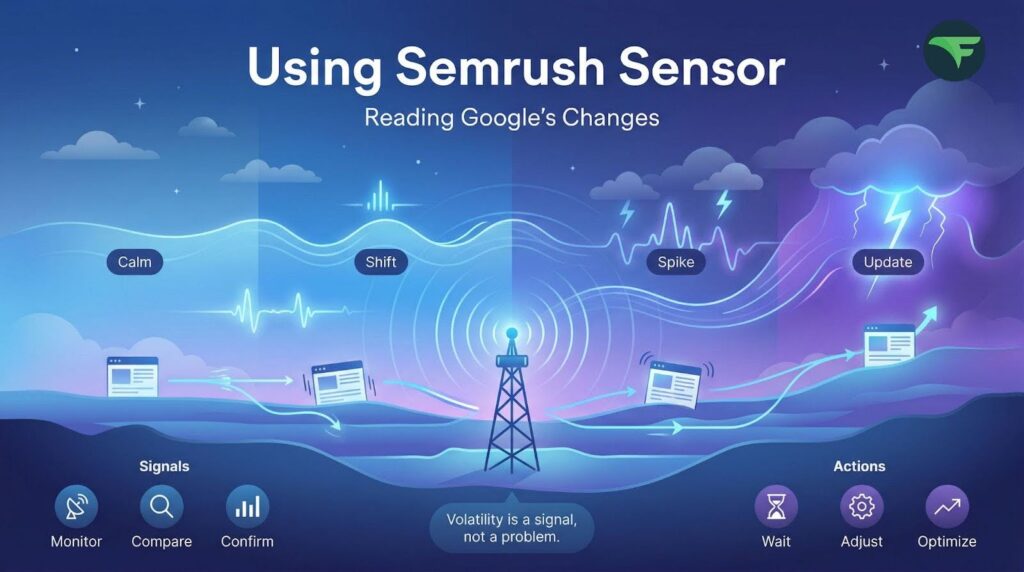
Semrush Sensor tracks how much Google search results fluctuate on a given day, giving you a real-time signal of whether ranking changes are isolated or affecting the broader market.
It provides real-time information and analytics to SEO experts and digital marketers, which helps them stay up-to-date with the latest trends and algorithm updates.
By analyzing the ups and downs of search rankings, Semrush Sensor helps identify potential changes in Google’s algorithm and guides how to adjust SEO strategies accordingly.
It’s an essential part of any SEO toolkit, as it provides insights into how Google’s search algorithm works and helps businesses stay competitive in the digital world.
How Semrush Sensor Works
Semrush Sensor is a tool that helps SEO professionals track and analyze changes in Google’s search results.
Let’s say you own an ecommerce business selling shoes. Here is how Semrush Sensor would work:
- Data Collection: Semrush Sensor gathers search result data from various regions and sectors, including the retail and footwear industry, to provide a broad view of the search landscape.
- Volatility Analysis: The tool then analyzes this data to assess the level of fluctuation in search rankings, crucial for understanding market dynamics.
- Highlighting Impacts: It pinpoints which shoe-related domains and keywords are experiencing the most significant changes. This step is vital for e-commerce store owners to see how these fluctuations might affect their online visibility.
- Algorithm Detection: By monitoring changes in rankings for shoe-related queries, Semrush Sensor identifies potential shifts in Google’s algorithm that could affect the store’s search position.
- Volatility Score: A volatility score is calculated, offering a clear indicator of the current volatility in the shoe market’s search rankings.
- Score Interpretation: For the shoe store owner, a high volatility score signals major changes in search rankings, possibly due to an algorithm update or a trending style. This insight allows the owner to adjust SEO and marketing strategies, ensuring the store remains competitive and visible to potential customers.
By following these steps, the e-commerce shoe store owner can effectively use Semrush Sensor to navigate the complexities of search engine fluctuations, optimizing their online presence and strategy in response to the ever-changing digital marketplace.
Key Features of Semrush Sensor
Semrush Sensor boasts features that make it a powerhouse for SEO professionals. Here are some key aspects:
SERP Volatility Tracking
At its heart, Semrush Sensor is designed to track volatility in search rankings. The overview dashboard shows a rolling 30-day volatility chart so you can see whether current fluctuations are unusually high relative to recent history or just normal variation. This context matters — a score of 7 during a typically stable period is more significant than a 7 during a month that’s already been volatile.
Device and Location-Specific Data
Sensor offers insights tailored to different devices and geographical locations. This is particularly useful for diagnosing whether a ranking shift is affecting desktop and mobile equally or hitting one more than the other. A drop concentrated on mobile points to a different problem than one affecting both, and Sensor surfaces that distinction immediately.
Industry-Specific Breakdowns
Semrush Sensor segments data by industry, covering categories from healthcare and finance to ecommerce and news. If your rankings drop on a day when only your industry shows high volatility while everything else is stable, that’s a strong indicator of a targeted update rather than a broad core update. Knowing the difference shapes your response — targeted updates typically reward specific signals like E-E-A-T or content depth in that vertical.
Historical Data Analysis
Users can access historical volatility data going back months, which is invaluable for pattern recognition. Certain times of year see predictably higher volatility, and knowing that helps you avoid misreading seasonal fluctuation as an algorithm event. Historical data also lets you correlate past volatility spikes with confirmed Google updates to build a clearer picture of how your site responds to different update types.
Algorithm Update Alerts
Sensor alerts users when volatility crosses into high or very high territory. Enabling notifications means you find out about significant SERP shifts as they happen rather than discovering them retrospectively when you notice a traffic drop. For businesses where organic search is a primary revenue channel, that lead time is worth a significant amount. If you’re not sure whether your current setup would catch an algorithm shift before it affects revenue, our team can walk you through a monitoring workflow built around your specific situation.
Analyzing Google Algorithm Updates with Semrush Sensor
Understanding Google’s algorithm updates is one of the most practical applications of Semrush Sensor. When volatility scores spike above 7 or 8 across multiple categories simultaneously, that’s a strong signal that a broad core update is in progress rather than a niche or industry-specific shift.
Here’s a practical workflow for using Sensor during a suspected update:
- Check the overall volatility score first. A spike confined to one or two categories suggests a targeted update affecting specific content types. A spike across eight or more categories simultaneously points to a broad core update.
- Cross-reference with your Google Search Console data. If your impressions and clicks are moving in the same direction as the volatility spike, your site is being directly affected. If your data is stable while Sensor shows high volatility, your competitors are absorbing the impact, which may create ranking opportunities.
- Check the Winners and Losers tab inside Sensor. This shows which domains gained and lost visibility during the volatility period. Analysing which types of sites are winning tells you what the update is rewarding — whether that’s E-E-A-T signals, content depth, technical performance, or something else.
- Wait before making major changes. Most broad core updates take 1-2 weeks to fully roll out. Reacting to day-one data often means optimising against an incomplete picture.
How to Read Semrush Sensor Without Overreacting
Semrush Sensor scores range from 0 to 10, with higher scores indicating more significant fluctuations in search rankings. The most common mistake practitioners make is treating every spike as a crisis requiring an immediate response. Most high-volatility days are noise. Google runs thousands of experiments continuously, and many produce temporary ranking fluctuations that correct themselves within 48-72 hours without any intervention.
A practical framework for staying calibrated:
Score below 5: Normal fluctuation. Monitor but don’t act. Rankings move daily and this range is expected background noise.
Score 5-7: Elevated volatility. Check whether the spike is industry-specific or broad. Cross-reference with Search Console to see if your own traffic is affected before drawing any conclusions.
Score 7-9: Significant volatility. A confirmed algorithm update is likely. Check the Winners and Losers tab, identify what’s being rewarded, and document your current rankings before making changes.
Score 9-10: Major update underway. Hold off on large-scale content changes or site restructuring until the update fully rolls out. Focus on monitoring and documentation rather than reactive fixes that could compound the problem.
The sites that handle algorithm updates best are typically those with clean technical foundations and consistent E-E-A-T signals already in place. Flying V Group’s SEO team monitors Sensor scores daily across all client accounts, which means algorithm shifts get diagnosed before they turn into prolonged ranking drops. Semrush Sensor tells you when something is happening. The underlying site quality determines how badly it affects you.
Comparing Semrush Sensor with Other SEO Tools
While Semrush Sensor is a robust tool, it’s essential to understand how it compares with other SEO monitoring tools in the market. Tools like Moz’s MozCast and Ahrefs’ Rank Tracker also offer insights into SERP volatility and algorithm changes.
However, Semrush Sensor stands out for its real-time updates, comprehensive industry-specific data, and user-friendly interface.
Its ability to provide detailed historical data and device-specific insights offers a unique advantage. This makes it the preferred choice for many SEO professionals.
Maximizing Semrush Sensor for SEO Success
Semrush Sensor is most valuable when it’s part of a broader monitoring system rather than a standalone tool. Knowing volatility is high is only useful if you have the technical foundations, content quality, and competitive intelligence to act on that information quickly and correctly.
At Flying V Group, we integrate Semrush Sensor into a full SEO monitoring workflow alongside Google Search Console, crawl data, and competitive analysis. When volatility spikes, we know within hours whether our clients are being affected, why, and what the appropriate response is. That speed of diagnosis is often the difference between a temporary rankings dip and a prolonged recovery.
Ready to build an SEO strategy that holds up when the algorithm moves? Contact our team for a free strategy consultation.
FAQs
What does a high Semrush Sensor score actually mean for my site?
A high score tells you the SERPs are volatile, but it doesn’t automatically mean your site is affected. Cross-reference Sensor data with your own Google Search Console impressions and clicks. If your traffic is stable during a high-volatility period, your site may be holding its ground while competitors absorb ranking changes. If your traffic is dropping in line with the volatility spike, you’re directly in the update’s path and should begin the diagnostic process described above.
How often should I check Semrush Sensor?
For most businesses, a daily check during stable periods is sufficient. During confirmed algorithm updates, check twice daily and monitor the Winners and Losers tab closely. The goal isn’t to react to every data point but to spot meaningful patterns early enough to respond strategically rather than reactively.
Can Semrush Sensor tell me why my rankings dropped?
Not directly. Sensor tells you whether your rankings dropped as part of a broader market shift or in isolation. If volatility is low on the day your rankings drop, the problem is site-specific rather than algorithmic, and a technical audit is a more appropriate next step than waiting for an update to roll back. If volatility is high, your drop is likely part of a wider update and the Winners and Losers tab can help you understand what Google is rewarding.
How does Semrush Sensor compare to MozCast?
Both track SERP volatility but with different interfaces and data sources. MozCast uses a weather metaphor and tracks a fixed set of keywords, making it useful as a quick gut-check. Semrush Sensor offers more granular controls: industry segmentation, device-specific data, geographic filtering, and a Personal Score feature that tracks volatility specifically for your own tracked keywords. For practitioners running active SEO programs, Sensor provides more actionable data.
Is Semrush Sensor useful for local SEO?
Yes. Sensor includes geographic filtering that lets you monitor volatility at a country level, which is useful for identifying whether an update is affecting specific markets. For local SEO specifically, pairing Sensor with Google Business Profile Insights and Search Console’s geographic performance data gives you a more complete picture of how algorithm changes are affecting local search visibility in your target markets.