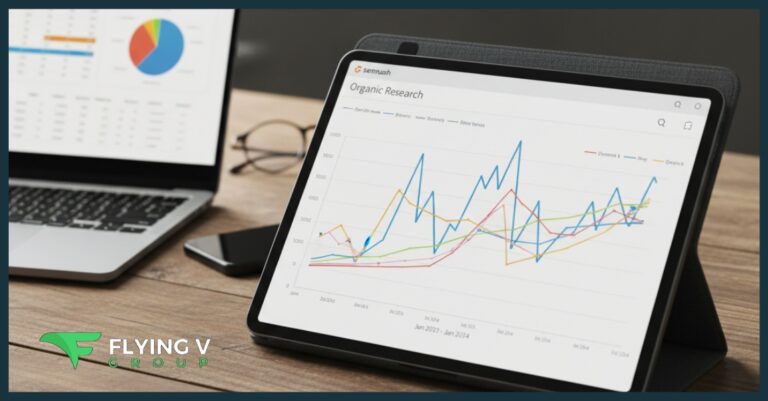

Semrush doesn’t update its competitor lists on a single universal schedule — different databases refresh at different rates, and the answer to “how often” depends entirely on which report you’re looking at. Position Tracking updates daily. Organic Research refreshes monthly. The Backlink database operates on its own crawl cycle. Most users treat these as one unified system, which leads to misreading normal data behavior as errors or sudden competitive shifts.
The more important point, one that most Semrush tutorials skip entirely, is that competitor lists can change substantially even when Semrush hasn’t refreshed its database at all. Google’s ranking systems update constantly, and when rankings shift, keyword overlap between your site and others shifts with it. Understanding the difference between a Semrush update and a Google update is what separates analysts who act on real intelligence from those chasing statistical noise.
Why Update Frequency Is a Strategic Question
Flying V Group applies Semrush’s update rhythms as part of keyword research and competitive analysis workflows — reading data directionally over time rather than reacting to individual exports. If your team is treating every competitor list refresh as a signal to act, the update schedule itself is working against you.
Not All Semrush Data Updates at the Same Speed
Semrush’s data documentation confirms that the platform operates across 142 geographic databases containing more than 26.7 billion keywords and 808 million domains. Keeping that volume current requires different crawl and refresh architectures for different data types — which is why the update frequency varies by report.
A common misconception is that checking Semrush today gives you the same freshness across all reports. It doesn’t. The data behind your competitor list in Organic Research was collected at a different time than what’s driving your Position Tracking dashboard.
Position Tracking: Daily
Position Tracking updates daily. This tool monitors a defined set of keywords you’ve configured, pulling fresh ranking data each day for those specific terms. It’s the most current view Semrush offers and the one most useful for detecting near-term competitive movement.
The tradeoff is scope: Position Tracking is only as complete as the keyword list you’ve configured. It doesn’t surface new competitors who’ve started ranking for keywords you haven’t tracked.
Organic Research and Backlink Data
Organic Research — which drives the competitor reports most users are asking about — updates on a monthly database refresh cycle. This means the competitor overlap analysis you’re looking at could reflect rankings from several weeks ago, depending on where you are in the refresh window.
The Backlink database operates on independent crawl cycles. Semrush’s crawlers continuously discover new links, and the median detection time for a new backlink is under 20 minutes based on Semrush’s own published data. Full coverage, however, isn’t instantaneous — the complete picture builds as crawling expands across the web.
Why Your Competitor List Changes Without Semrush Refreshing Anything
This is the part most articles miss. Semrush builds competitor lists by identifying domains with overlapping keyword rankings. When Google’s ranking systems shift a site up or down — whether from a core update, a freshness signal, or user behavior data — the keyword overlap between your site and others changes. Your competitor list updates to reflect that new overlap, even if Semrush’s underlying database hasn’t been refreshed.
The result: two consecutive Semrush reports can show different competitors with identical database refresh dates. What changed isn’t Semrush’s data — it’s the rankings themselves.
When Google Updates, Semrush Lists Follow
Google’s ranking systems evaluate content quality, relevance, authority, and user experience signals continuously. Google’s own content guidance emphasizes that rankings are not static outputs — they reflect ongoing assessments of whether a given page continues to serve search intent well.
Practically, this means a competitor can disappear from your Semrush report because they lost 30 rankings in a core update — not because Semrush removed them. New competitors can surface because a publisher entered the SERP for terms you share, not because they were previously hidden in Semrush’s database. Treating these ranking-driven changes as data errors produces the wrong response.
Search Competitors Are Not Always Business Competitors
Semrush identifies competitors based on keyword overlap, not on whether two businesses actually compete for the same customers. StatCounter’s global search market data shows Google holding roughly 90% of global search share — which means the ranking data driving Semrush’s competitor identification is almost entirely Google-based, and Google’s index includes publishers, news sites, aggregators, and informational resources alongside actual service competitors.
This is why Semrush competitor reports frequently include Wikipedia, major news outlets, and industry publications alongside businesses that actually compete for your customers. A law firm’s Semrush competitor list might show a legal news site outranking them for informational queries — accurate from a keyword-overlap standpoint, irrelevant from a business strategy standpoint.
Filtering the List That Actually Matters
Separating competitors by commercial keyword overlap from those appearing only on informational queries is the practical step most Semrush users skip. Domains with commercial overlap represent actual competitive threats worth studying. Informational SERP fixtures — large publishers and aggregators ranking for educational queries — are unlikely to be displaced and typically shouldn’t drive content or link strategy.
Why Semrush and Ahrefs Show Different Competitors
If you run competitor analysis in both tools and get different results, that isn’t a data error — it’s a reflection of different methodologies. Semrush and Ahrefs use different web crawlers, different keyword databases, different traffic estimation models, and different refresh cycles. Each tool identifies competitors based on its own crawled index, which means the keyword overlap it detects will differ based on what each crawler has covered and when.
Neither tool is “right.” They’re producing different but complementary views of the same competitive landscape. The practical implication: if a competitor appears in both tools, treat that as a high-confidence signal. Competitors that appear in only one tool warrant verification before acting on them.
How to Read Semrush Updates Without Getting Misled
Single Semrush exports are point-in-time snapshots with inherent freshness limitations. The monthly refresh cycle on Organic Research means any given export reflects a window of historical data, not current rankings. Acting on a single snapshot — hiring for new keyword targets, restructuring content, or pivoting strategy — based on one report introduces significant noise into the decision.
The more reliable pattern is month-over-month comparison across at least three to four consecutive reporting periods. Competitors that appear consistently across multiple cycles represent structural overlap. Competitors that appear and disappear are likely reflecting normal ranking volatility rather than meaningful competitive shifts.
Building a Monitoring Workflow That Accounts for Update Cycles
Run Position Tracking for your highest-priority keywords daily — this is where actual near-term intelligence lives. Review Organic Research competitor reports monthly, aligned to Semrush’s refresh cycle. Compare each month’s output against the prior two months before drawing conclusions. Flag competitors that hold positions across all three periods; deprioritize those that appear only once.
Applying this framework consistently across technical SEO audits and content strategy planning means treating Semrush as a directional signal system rather than a real-time scorecard — which is how the data is actually designed to be used.
Putting Semrush to Work With a Strategy Behind It
Understanding Semrush’s update architecture is only useful if it’s connected to a competitive strategy that knows what to do with the data. Knowing when competitor lists refresh tells you when to pull reports. It doesn’t tell you which competitors to prioritize, which keywords represent recoverable ground, or how to close the content and authority gaps that are producing the ranking differences in the first place.
Contact Flying V Group to see how an SEO strategy built around competitive intelligence — not just tool outputs — actually changes your rankings.
Frequently Asked Questions
How does Semrush identify competitors in its reports?
Semrush identifies competitors by measuring keyword ranking overlap between domains. If your website and another domain both rank for a substantial number of the same keywords, Semrush flags that domain as a competitor. The more keywords two domains share in common rankings, the higher the competitor relevance score. This methodology means any site ranking for your keywords — including publishers, aggregators, and informational resources — can appear as a “competitor” even if they don’t compete for your customers.
Can I manually force Semrush to refresh competitor data?
No. Organic Research competitor data updates on Semrush’s database refresh cycle and cannot be manually triggered. Position Tracking updates on its own daily schedule for keywords you’ve configured. If you need more current data than a monthly database cycle provides, Position Tracking is the only Semrush report that delivers daily freshness for a defined keyword set.
Why did a competitor suddenly disappear from my Semrush report?
A competitor disappears from your Semrush list when keyword overlap between your domain and theirs drops below the threshold Semrush uses for identification. This happens most often when the other domain loses rankings from a Google algorithm update, when your own content gains rankings that shift your keyword footprint, or when Semrush’s monthly database refresh reflects a different snapshot of the SERP. It’s not a data error — it reflects a real change in ranking overlap.
Is Semrush competitor data real-time?
No. Organic Research and competitor list data updates on a monthly database refresh cycle. Position Tracking is Semrush’s most current data source, updating daily, but only covers keywords you’ve manually configured to track. The backlink database operates on continuous crawl cycles with fast individual link detection, but full coverage is not instantaneous. For real-time ranking information, the most accurate source remains Google Search Console.
Why does Semrush show different competitors than Ahrefs?
Semrush and Ahrefs use different proprietary web crawlers, different keyword databases, and different traffic estimation models. Because competitor identification is based on keyword overlap within each tool’s own database, different coverage produces different overlap calculations. This isn’t a flaw in either tool — it’s an expected outcome of different data architectures. Competitors that appear consistently across both tools represent higher-confidence signals than those appearing in only one.
How accurate are Semrush’s traffic estimates for competitors?
Semrush estimates traffic by combining keyword ranking positions with average click-through rate data and keyword search volume estimates — all of which carry their own margins of error. The resulting traffic figures are directional estimates, not precise measurements. They’re useful for comparing relative performance between competitors and identifying trends over time, but they will diverge from actual traffic figures in Google Analytics. Semrush’s own documentation positions these as estimated ranges rather than exact values.
Which Semrush report updates most frequently?
Position Tracking updates daily and is Semrush’s most current data source. The Backlink database uses continuous crawling with fast individual link detection. Organic Research — which drives most competitor list data — operates on a monthly database refresh cycle. Keyword Overview and Domain Analytics update in alignment with the underlying database refresh rather than on independent daily schedules.