

Choosing the wrong Semrush plan is a more expensive mistake than most people realise — not because of the sticker price, but because of what you lose by under-investing or overpaying for limits you’ll never hit. The SEO software market reached $74.6 billion in 2024 and is projected to exceed $150 billion by 2030, reflecting how central these platforms have become to competitive digital strategy.
Semrush sits at the premium end of that market for a reason. This guide breaks down every plan, the limits that matter, the costs most reviews don’t mention, and how it stacks up against the main alternatives — so you can make the call with actual information rather than a pricing page screenshot.
If you’re still figuring out what your SEO strategy needs before committing to a tool, Flying V Group’s keyword research tools guide is a useful benchmark for what a well-equipped setup looks like.
Why SEO Platforms Are Worth the Investment
A meta-analysis of SEO research published on ResearchGate found that SEO consistently improves online visibility, traffic, and conversions across industries — making the case for tooling investment fairly straightforward. The question isn’t whether an SEO platform is worth it. It’s whether you’re on the right plan for how you actually work.
Semrush has also expanded significantly into AI-powered search visibility. According to Semrush’s own AI SEO statistics research, traffic from AI search platforms grew over 500% year-over-year — and the platform now includes AI tracking tools that most competitors haven’t built yet.
Semrush Pricing Plans at a Glance
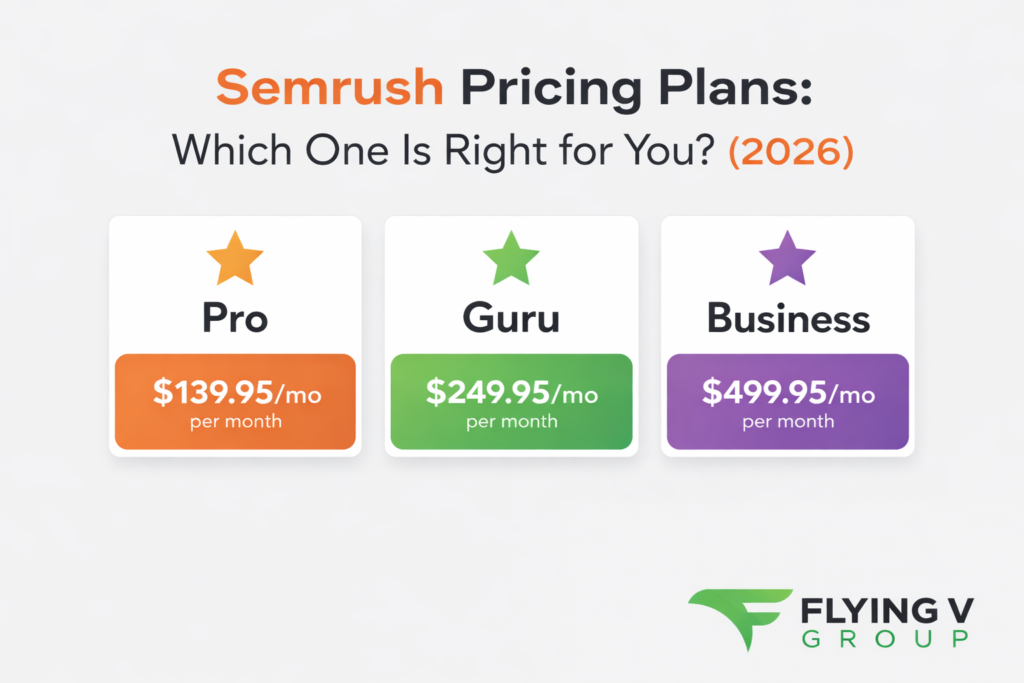
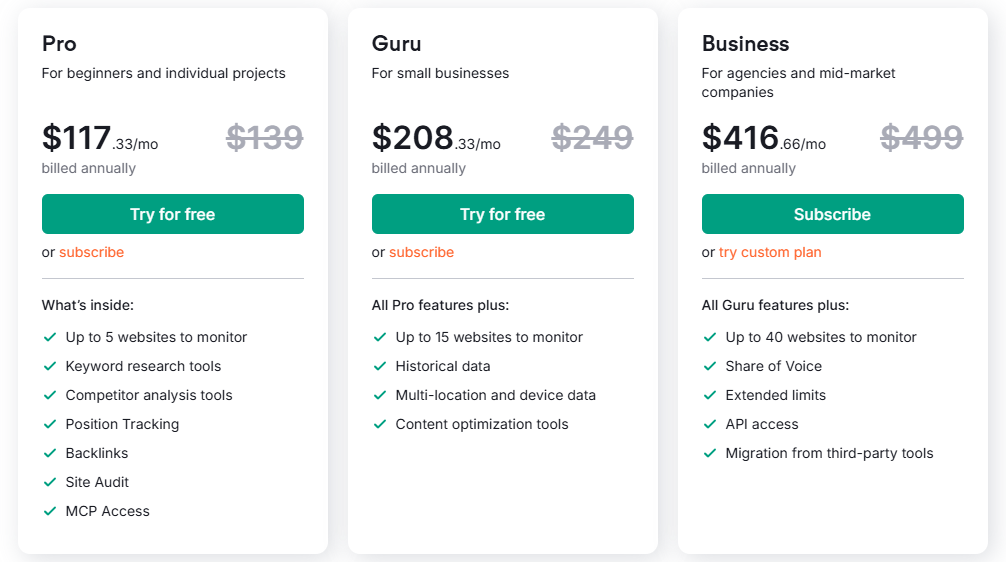
Semrush currently offers three core subscription tiers, with meaningful differences in limits, features, and target user types. Annual billing reduces each plan by roughly 17%.
| Plan | Monthly Price | Annual Equivalent | Best For |
| Pro | $139.95/month | ~$117.33/month | Freelancers, small sites, startups |
| Guru | $249.95/month | ~$208.33/month | Agencies, growing teams, content marketers |
| Business | $499.95/month | ~$416.66/month | Large agencies, enterprises, high-volume SEO |
Breaking Down Each Semrush Plan
Pro Plan — $139.95/month
The Pro plan covers the core SEO toolkit: keyword research, site audits, rank tracking, backlink analysis, competitor analysis, and basic PPC tools. It supports 5 projects and 500 tracked keywords — sufficient for a single-site operator or a freelancer managing a small portfolio.
What it doesn’t include: historical keyword data, the content marketing toolkit, or Looker Studio integration. For anyone running content strategy alongside SEO, those absences are felt quickly.
Guru Plan — $249.95/month
The Guru plan expands to 15 projects and 1,500 tracked keywords, and adds the features the Pro plan is missing: historical data, the content marketing platform, multilocation tracking, and Looker Studio integration. It’s the most practical tier for agencies managing multiple clients or in-house teams running content-heavy strategies.
The jump from Pro to Guru is where most growing teams end up — the content marketing toolkit alone justifies the difference for anyone producing articles at scale.
Business Plan — $499.95/month
The Business plan supports 40 projects and 5,000 tracked keywords, and adds API access, Share of Voice metrics, extended reporting limits, and PLA analytics. It’s built for large agencies running enterprise accounts or internal teams with custom data infrastructure requirements.
API access is the primary differentiator at this tier — it allows custom data pulls into proprietary dashboards and reporting workflows. One important caveat: the Business plan enables API access but includes zero API units. Units are purchased separately on top of the plan price, which adds meaningfully to the total cost for teams with high-volume data requirements.
What You Actually Get: Feature Limits by Plan
Semrush’s official feature limits documentation provides the full breakdown. The table below covers the metrics most buyers actually care about.
| Feature | Pro | Guru | Business |
| Projects | 5 | 15 | 40 |
| Tracked Keywords | 500 | 1,500 | 5,000 |
| Results per Report | 10,000 | 30,000 | 50,000 |
| Site Crawl Pages/Month | 100,000 | 300,000 | 1,000,000 |
| Historical Data | ✗ | ✓ | ✓ |
| Content Marketing Toolkit | ✗ | ✓ | ✓ |
| Looker Studio Integration | ✗ | ✓ | ✓ |
| API Access | ✗ | ✗ | ✓ |
| Share of Voice | ✗ | ✗ | ✓ |
| Annual Discount | 17% | 17% | 17% |
Cost Per Tracked Keyword: The Metric Most Reviews Skip
Comparing plan prices in isolation misses the more useful number: what you’re actually paying per tracked keyword. The efficiency gap between tiers is significant.
| Plan | Monthly Price | Tracked Keywords | Cost Per Keyword |
| Pro | $139.95 | 500 | $0.28/keyword |
| Guru | $249.95 | 1,500 | $0.17/keyword |
| Business | $499.95 | 5,000 | $0.10/keyword |
The Guru plan costs 79% more than Pro but delivers keywords at 39% less per unit. For anyone tracking more than 500 keywords — which most active SEO campaigns require — the Guru plan produces better cost efficiency, not just more data. The Business plan takes that further, but only pays off if you’re actually running campaigns at 5,000+ keyword scale.
Semrush vs Ahrefs: A Real Feature Comparison
Pricing tables tell you what each tool costs. They don’t tell you what you’re actually getting for that money. The two platforms have genuinely different strengths, and the right choice depends on what your workflow prioritises.
Ahrefs’ 15–30 minute backlink data refresh rate remains unmatched — competitors typically update daily — which matters for anyone monitoring link velocity or active campaigns. Semrush counters with broader coverage: PPC data, content marketing tools, social media tracking, and AI search visibility — features Ahrefs doesn’t include at any tier.
| Feature | Semrush Guru ($249.95/mo) | Ahrefs Standard ($249/mo) |
| Tracked Keywords | 1,500 | 2,000 |
| Projects | 15 | 20 |
| Backlink Data Refresh | Daily | 15–30 minutes |
| Historical Data | ✓ | ✓ (2 years) |
| Content Marketing Toolkit | ✓ | ✗ |
| PPC Analysis | ✓ | ✗ |
| AI Search Visibility Tracking | ✓ | Add-on ($50–$200/mo) |
| Free Trial | ✓ | ✗ |
| API Access | Business plan only | Advanced plan ($449/mo) |
| Extra User Cost | ~$45–$100/mo | ~$40–$80/mo |
Ahrefs is consistently 20–40% more expensive than Semrush for comparable feature sets — though its advocates argue the backlink data quality and refresh speed justify the premium. For teams whose primary use case is link analysis and competitor backlink research, Ahrefs has a genuine edge. For teams running content strategy, PPC research, and keyword tracking alongside backlink work, Semrush delivers more within a single subscription.
Hidden Costs Most Buyers Miss
The plan price is not the total cost. Additional user seats on Semrush run $45–$100 per month per user depending on the plan — a cost that adds up fast for teams where more than one person needs full access.
Add-Ons Worth Knowing About
Semrush also sells optional modules outside the core plans. Semrush Local (listing and review management) is available in Basic and Premium tiers. Semrush Trends adds competitive traffic analytics and market explorer data. Agency Growth Kit covers client management and professional reporting tools.
None of these are included in the base subscription price. If your use case requires them, factor the additional monthly cost into your comparison before committing to a tier.
How Semrush Compares to Ahrefs and Moz
TechRadar’s independent review of Semrush describes it as an AI-driven marketing platform that has expanded well beyond traditional SEO — covering PPC, content, social, and now generative search tracking. That breadth is the core differentiator against Ahrefs and Moz, which remain more narrowly focused on organic search.
| Tool | Entry Plan | Mid Plan | Top Plan | Notable Strength |
| Semrush | $139.95/mo | $249.95/mo | $499.95/mo | Broadest feature set; AI search tracking |
| Ahrefs | $129/mo | $249/mo | $449/mo | Strongest backlink database |
| Moz | $79/mo | $143/mo | $239/mo | Most accessible interface; MozBar extension |
Moz wins on price at entry level. Ahrefs wins on backlink data depth. Semrush wins on breadth — if you need keyword research, content tools, PPC analysis, and AI visibility tracking from one platform, there’s no direct equivalent at a comparable price point.
Which Plan Is Right for You?
Choose Pro if you are…
A freelancer, blogger, or startup managing one to three sites with straightforward keyword tracking and competitor research needs. The Pro plan covers the fundamentals without the content marketing infrastructure you won’t use yet.
Choose Guru if you are…
A growing agency, marketing team, or content-focused business that needs historical data and the content marketing toolkit. Most teams that outgrow Pro end up here — the project and keyword limits are workable for accounts under 10–15 clients.
Choose Business if you are…
A large agency or enterprise team with API requirements, high-volume keyword tracking, or custom reporting infrastructure. If you don’t need API access and aren’t tracking 5,000+ keywords, this tier is over-specified for most use cases.
Get More From Your SEO Investment
Semrush is a capable platform at every tier — but a tool is only as effective as the strategy it’s built around. Flying V Group’s 7-day SEO strategy course covers how to build a keyword and content framework that makes full use of what Semrush surfaces.
If you’re evaluating whether your current SEO services setup is producing the returns it should — regardless of which tools are in the stack — contact Flying V Group to review what’s working and where the gaps are.
Frequently Asked Questions
Does Semrush offer a free trial, and what does it include?
Semrush’s free account provides limited access to core tools — a small number of keyword queries per day, basic site audit functionality, and restricted reporting. It’s useful for evaluating the interface but insufficient for any sustained SEO work. Free trials for paid plans are offered periodically, typically for seven days.
Is Semrush worth the price for a small business on a tight budget?
For small businesses running active SEO campaigns, the Pro plan at ~$117/month annually is cost-effective relative to what equivalent data would cost to gather manually. The ROI calculation changes if you’re only running occasional keyword checks — in that case, a cheaper tool with narrower functionality may be more appropriate.
What’s the actual difference between Semrush Pro and Guru?
The two most meaningful differences are historical keyword data and the content marketing toolkit — both exclusive to Guru. Historical data lets you analyse ranking trends over time rather than seeing only current snapshots. The content marketing toolkit supports topic research, content briefs, and SEO writing assistance. Teams doing content-led SEO hit the Pro plan’s ceiling relatively quickly.
Can multiple people use one Semrush account?
Yes, but additional users cost extra. Each extra seat runs $45–$100 per month depending on your plan tier, and is not included in the base subscription. Teams evaluating the total cost of a Semrush rollout should factor in user seats from the beginning, as the cost per user at higher team sizes adds up significantly.
How does Semrush handle AI search visibility?
Semrush has built AI search tracking into its platform in response to the growth of generative search. Their research on AI search and SEO traffic documents how traditional organic traffic is shifting as AI Overviews and answer engines capture more query responses. The platform now tracks entity visibility and citation presence in AI-generated results alongside traditional rank tracking.
Is Semrush the right tool for a technical SEO audit?
Semrush’s site audit tool is solid for identifying crawl errors, duplicate content, internal linking issues, and Core Web Vitals problems. It does not replace a specialist technical SEO audit for complex sites — it identifies issues but doesn’t diagnose root causes or prioritise fixes based on business impact. Use it as a detection layer, not a full diagnostic.
Does paying annually make a meaningful difference to the cost?
Yes — annual billing reduces each plan by approximately 17%, which translates to roughly $270/year saved on Pro, $500/year on Guru, and $990/year on Business. If you’re confident in the plan tier after a trial period, annual billing is worth the commitment for the savings alone.