

Most SEO professionals focus on the wrong metric. They chase UR scores when what actually matters is whether those scores translate to traffic and rankings. Here’s what you need to know—and how to actually use UR to improve your business outcomes.
What is UR in Ahrefs?

URL Rating (UR) measures a specific page’s backlink strength on a scale from 0 to 100. Think of it as a page-level authority score based on the quality and quantity of backlinks pointing to that URL.
The higher your UR, the stronger your page’s link profile. But—and this is critical—UR doesn’t guarantee rankings. Google’s ranking systems consider dozens of factors beyond backlinks, including content quality, user experience, and topical relevance.
UR is calculated on a logarithmic scale, meaning it’s easier to move from UR 10 to 20 than from 70 to 80. This matters for your strategy: quick wins are possible early, but diminishing returns kick in fast.
UR vs DR Ahrefs: What’s the Difference?
Two metrics, two levels:
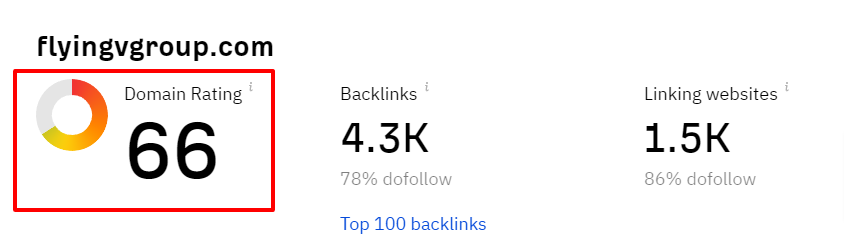
Domain Rating (DR) measures your entire website’s backlink strength. It’s the authority of your whole domain.
URL Rating (UR) measures a single page’s authority. Your homepage might have UR 45 while a blog post has UR 12—completely different scores because each page has its own link profile.
Domain Authority works similarly to DR, but the calculation differs. Ahrefs‘ metrics are based on their own crawl data and algorithm.
The key insight: Don’t confuse domain-level authority with page-level authority. A high-DR domain can have low-UR pages, and vice versa.
Why UR Matters (But Isn’t Everything)
Here’s the honest truth: UR correlates with rankings, but it’s not a ranking guarantee.
A page with UR 35 can rank above a competitor’s UR 45 page. Why? Because Google’s systems prioritize content quality and relevance over raw link metrics. The Search Quality Rater Guidelines emphasize E-E-A-T (Experience, Expertise, Authoritativeness, Trustworthiness)—which backlinks alone don’t prove.
What UR actually tells you: This page has strong link support, which gives it potential to rank well. But potential isn’t guaranteed.
Use UR to identify which of your pages have the strongest link foundation, then invest in content improvements there. Link a weak-UR page from a strong-UR page to distribute authority. Build links to high-intent pages strategically.
How to Calculate UR in Ahrefs
UR is calculated using principles similar to Google’s original PageRank algorithm. Here’s the simplified version:
Quality matters more than quantity. A backlink from a high-authority site (like TechCrunch or HubSpot) passes more UR than 10 links from low-authority blogs.
Relevance counts. A link from a topically related site is more valuable. A fitness blog linking to another fitness article passes more UR than a random tech site linking to that same article.
The domain authority of linkers affects your page. If Ahrefs (DR 93) links to your page, you get a bigger UR boost than if a small blog (DR 15) links to you.
Internal links matter too. When a high-UR page links to a low-UR page internally, it can boost that page’s score.
Ahrefs factors in both dofollow and internal links when calculating UR. Nofollow links, sponsored links, and user-generated content don’t pass UR.
One more thing: Ahrefs updated their UR calculation in August 2022. The old metric had drawbacks; the new one is more accurate. If you see old data, the UR numbers won’t match current calculations.
How to Improve Your UR Score
In practice, this is where strategy separates theory from results.
Improving UR isn’t about chasing a number—it’s about building legitimate link authority where it matters. Most agencies treat UR as a vanity metric. At Flying V Group, we treat it as a strategic lever: which UR improvements actually drive traffic and leads.
Step 1: Identify your strongest pages. Open Ahrefs Site Explorer, enter your domain, and look at your top pages by UR. Which are getting traffic? Which are underperforming?
Step 2: Find your quick wins. Pages with UR 15-30 are often easier to push higher than trying to move UR 60+ pages. Low-hanging fruit exists.
Step 3: Analyze your competition. For keywords you want to rank for, check the top-ranking pages’ UR scores. If they’re UR 25-35, you have a realistic target. If they’re all UR 60+, you’re in a heavily-linked niche—plan accordingly. This is where competitor analysis becomes critical to your strategy.
Step 4: Build relevant backlinks strategically. This is where link building strategy matters. Don’t chase every backlink opportunity. Focus on links from:
- Topically relevant websites
- Sites with higher authority than your current UR
- Pages that actually get traffic (not just high UR)
We’ve helped 400+ clients improve their UR scores on high-intent pages—the ones that actually convert. See 4 Tips to Build Backlinks for Your Online Store for practical strategies. The same principles apply whether you’re in ecommerce, SaaS, or professional services.
Step 5: Improve your anchor text strategy. Internal links with keyword-rich anchor text help. External links should look natural—don’t over-optimize.
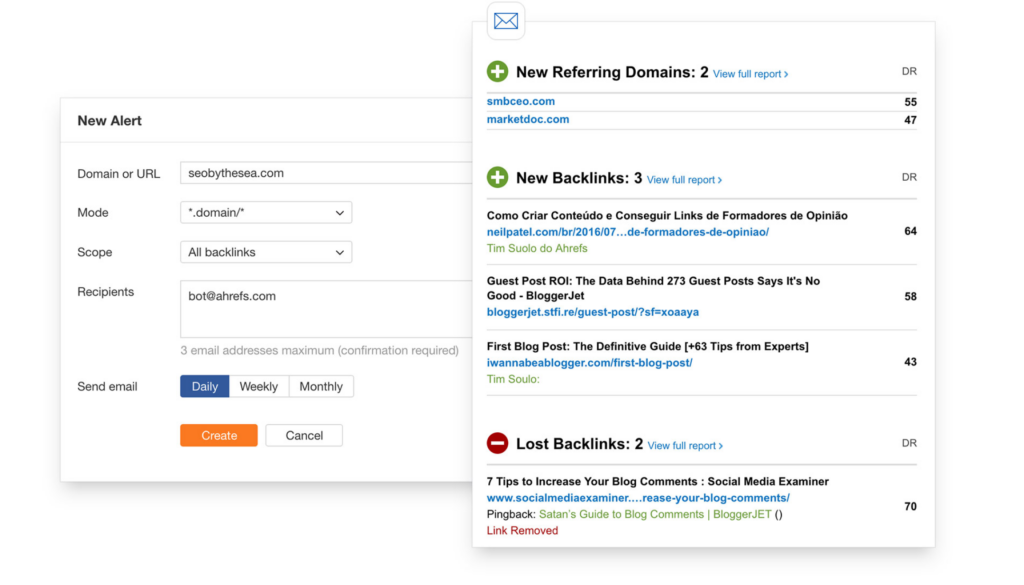
Step 6: Monitor progress with Ahrefs Alerts. Set alerts for your top pages. When UR moves, you’ll know immediately. Track what changed (new links, lost links, linking domain authority changes).
Common Mistakes People Make With UR
Mistake 1: Assuming high UR means high ranking potential.
It doesn’t. How Google actually ranks pages depends on much more than backlinks. Content quality, keyword relevance, user experience, and freshness all matter. A newer article with lower UR can outrank an older piece with higher UR if the content is better.
Mistake 2: Building links to every page.
Focus your efforts. Competitor Analysis shows that some pages deserve investment, others don’t. Target high-intent pages that convert or drive significant traffic. Low-traffic pages with high UR effort often break even on ROI.
Mistake 3: Ignoring link spam and quality signals.
Google penalizes unnatural link patterns. Ahrefs’ algorithm accounts for this too. Build links the right way, or don’t build them at all.
Mistake 4: Obsessing over UR and ignoring content quality.
A page with UR 20 and excellent content beats a page with UR 40 and thin, outdated content. Invest in both equally. Content quality is your floor; links are your leverage.
Tools to Monitor Your UR
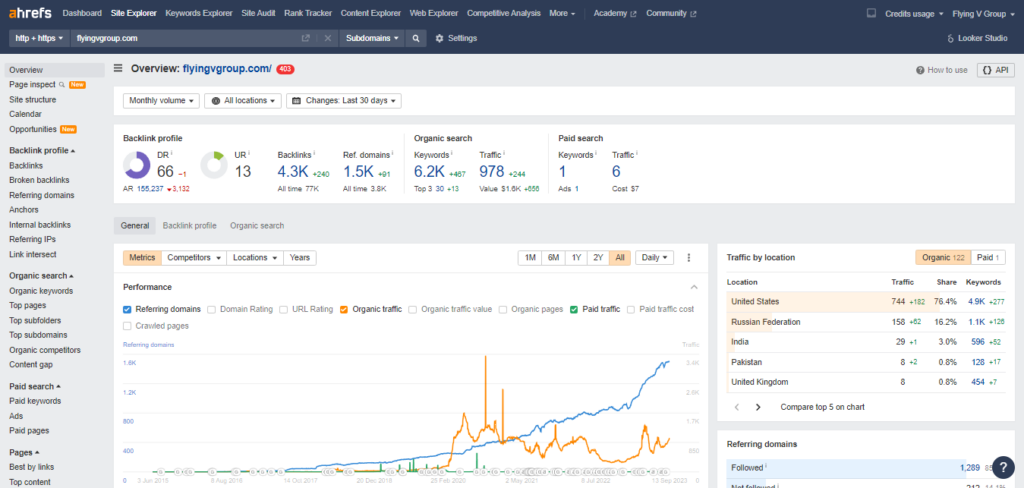
Ahrefs Site Explorer – Check your current UR, see your best pages, analyze competitor profiles. Free to try with limited data.
Ahrefs Alerts – Get notified when your page’s UR changes or when you gain/lose backlinks. Essential for tracking progress without manual checking.
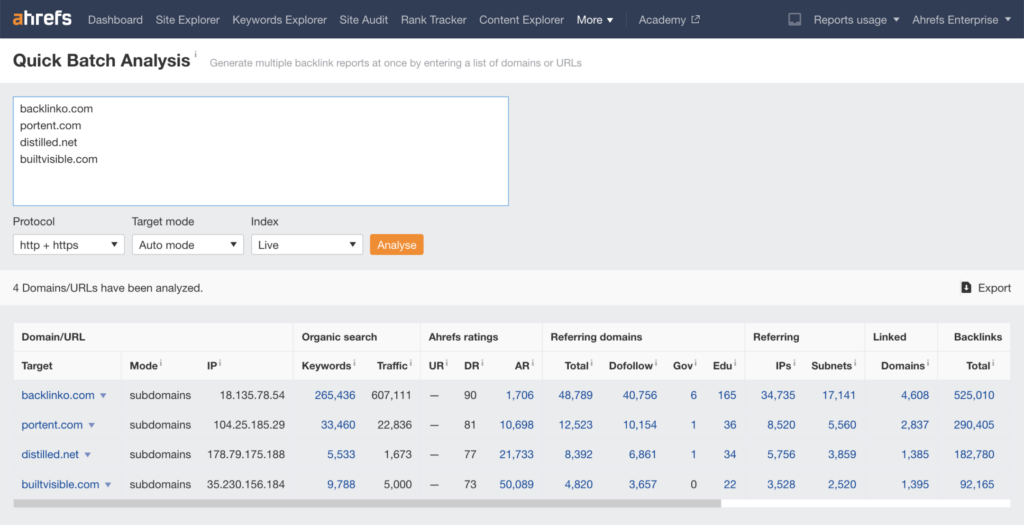
Batch Analysis – Analyze up to 200 URLs at once. Useful for auditing your entire site’s UR distribution or comparing against competitors quickly.
Rank Tracker – Monitor keyword rankings over time. Combine this with UR changes to understand how link improvements affect actual positions.
How to Improve Search Rankings Beyond UR
UR is one ranking factor among many. Here’s what else matters.
Content quality affects everything. A comprehensive, well-researched article ranks better than a thin one, even with fewer backlinks.
Topical authority—covering a topic deeply with interconnected content—signals expertise to Google. Blogging consistently builds this over time.
Technical SEO ensures Google can crawl and index your content properly.
User experience signals (how long people stay, bounce rate, CTR) influence rankings.
Your UR is a tool in the larger toolkit. It’s valuable, but it’s not the whole picture.
UR is One Metric, Not the Whole Picture
UR matters because backlink quality correlates with ranking ability. But UR isn’t destiny. Content quality, relevance, and user experience matter equally or more.
Track your UR as one health metric among many. Use it to identify your strongest pages and prioritize link-building efforts there. Build links strategically, not desperately. And always remember: UR is a tool, not a goal.
Here’s the thing most agencies miss: They optimize for UR improvement without connecting it to actual business outcomes. At Flying V Group, we’ve worked with over 400 clients on SEO—and the ones who win are the ones who ask, “Which UR improvements will actually generate more leads?” Not, “How do I get UR 50 on every page?”
That’s the difference between ranking and revenue.
If you want a strategic UR audit specific to your business, we can help identify which pages deserve link-building investment and which won’t move the needle. Contact Flying V Group today to discuss your SEO strategy.
Frequently Asked Questions
Is UR the same as PageRank?
Not exactly. UR is Ahrefs’ page-level metric modeled after Google’s PageRank algorithm, but they’re calculated differently. PageRank is Google’s internal metric (no longer public), while UR uses Ahrefs’ crawl data. Treat any authority metric as a relative benchmarking tool, not an actual ranking factor.
Does losing one backlink hurt my UR?
Usually not—unless it was from a high-authority page with few outbound links. Losing a low-authority link has minimal impact. Losing a link from a strong domain linking to only 5 other sites? That could drop your UR noticeably due to how link equity distributes.
Can I improve UR without building backlinks?
Somewhat. Internal linking redistributes authority from high-UR to low-UR pages. You can also earn passive links through great content. But external links create new authority—internal links just move it around.
Why does my UR keep changing without new links?
Because UR is relative. When sites linking to you gain or lose backlinks, the authority they pass changes. Plus, Ahrefs updates its index constantly, shifting your page’s position on their scale even if nothing changed on your end.
Should I focus on UR or rankings and traffic?
Prioritize rankings and traffic. UR is diagnostic, not a KPI. Google doesn’t use UR, and high-UR pages fail to rank if content quality is weak. Relevance and user satisfaction outweigh raw link metrics.
Is there a difference between UR and “page authority”?
Yes. UR is Ahrefs’ metric. Page Authority (PA) is Moz’s metric. Each tool uses different crawlers and algorithms, so the same page gets different scores. Google doesn’t publish a public authority score—all numeric metrics are third-party abstractions.