
Ranking a law firm in San Francisco isn’t a matter of publishing a few optimized pages and waiting. The city’s legal market is one of the most contested search environments in the country — combining a high density of practicing attorneys, aggressive marketing spend from large firms, and search results pages where national legal directories claim multiple positions before any individual firm appears. The firms that break through do so through deliberate, niche-focused strategy, not broad optimization.
Flying V Group’s SEO services are built for exactly this kind of competitive market — high-value niches where generic approaches don’t move rankings and where the gap between page one and page two is measured in signed cases. If your firm is evaluating what a serious SEO investment looks like in San Francisco, understanding the market reality is the necessary starting point.
Why the San Francisco Legal Market Is One of the Most Competitive in the U.S.
U.S. Census data for San Francisco County reflects a high-income, high-density population with correspondingly strong demand for legal services across multiple practice areas. State Bar of California attorney demographics data shows the Bar licenses more than 225,000 attorneys statewide — the largest state bar in the country — with significant concentration in the Bay Area competing for the same high-intent searches.
Retainers in competitive SF practice areas typically range from $5,000 to $20,000 per month. Firms treating legal SEO as a low-cost experiment generally don’t see movement on contested terms — the competitive floor is too high. That isn’t a reason to avoid investing; it’s the context that explains why strategy matters more than spend.
How Google Ranks Law Firms in San Francisco
Google’s documentation on local ranking factors identifies the same three pillars for law firms as for any local business: relevance, distance, and prominence. In legal search, prominence is the decisive variable. Most SF law firms have addressed relevance to some degree — the right keywords in the right places. Distance is fixed. Prominence — authority signals, backlinks, reviews, and brand mentions — is where rankings diverge.
Why Technical SEO Is Non-Negotiable for Law Firms
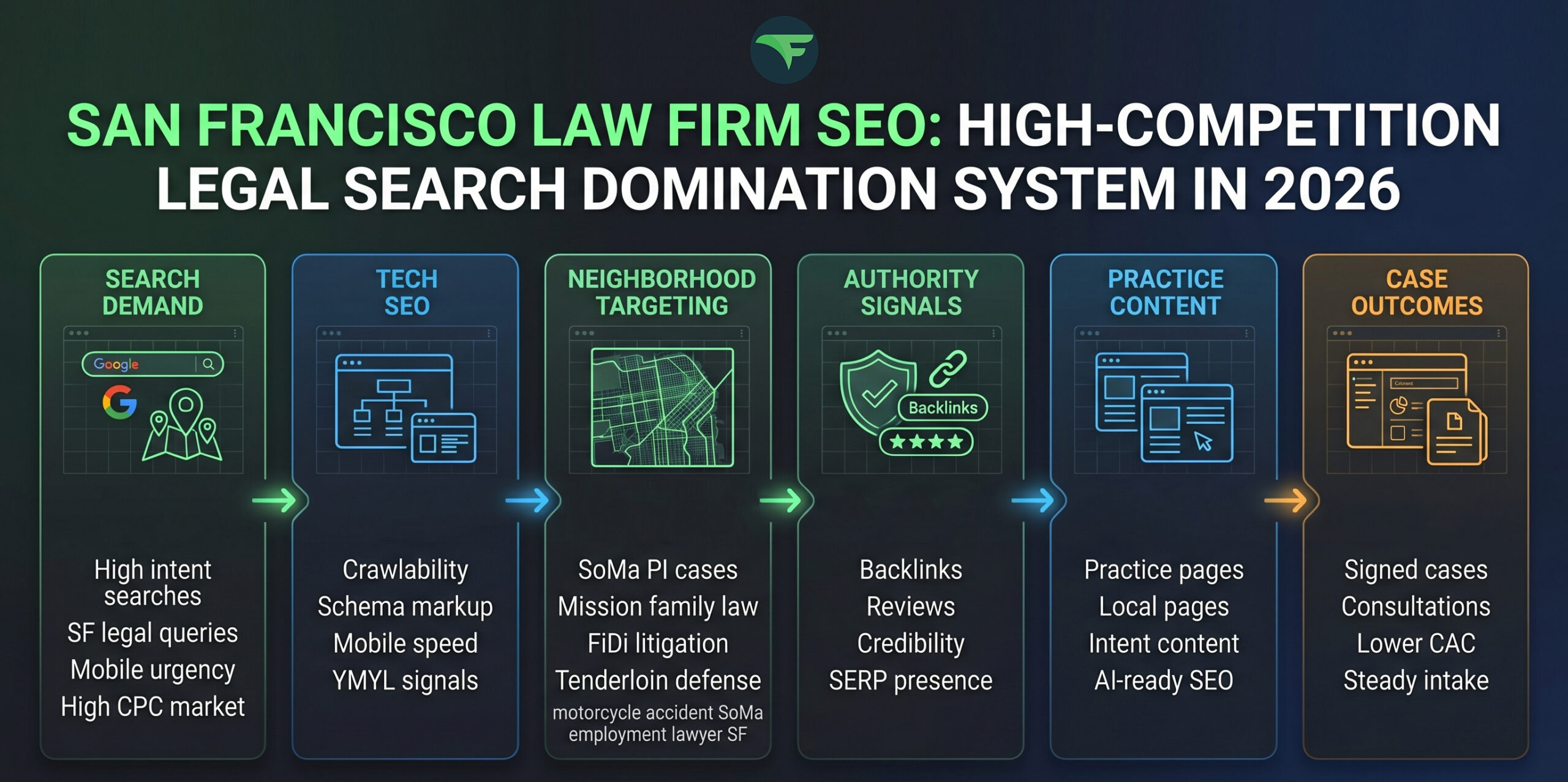
Google’s SEO Starter Guide establishes crawlability, mobile performance, and structured data as foundational requirements. For law firms, attorney schema, review schema, and local business markup help Google accurately categorize practice areas and geographic service areas. Flying V Group’s technical SEO work for legal clients addresses these before content or link work begins — because architectural gaps are the most consistent reason established firms plateau despite ongoing content investment.
The Strategy: Practice-Area and Neighborhood Domination
Ranking for “San Francisco lawyer” or “San Francisco attorney” is a long-term outcome, not a starting point. These terms are dominated by directories — Avvo, FindLaw, Justia — that have accumulated authority for years. The firms generating consistent inbound cases target what directories can’t: specific, high-intent, practice-area and neighborhood combinations.
Hyperlocal Targeting
San Francisco’s distinct neighborhoods create a keyword landscape most firms leave untapped. Searches like “personal injury attorney SoMa,” “family law attorney Mission District,” or “business litigation attorney Financial District” carry lower competition and higher purchase intent than broad city-level terms. Keyword research that maps practice areas to specific neighborhoods consistently outperforms generic city targeting in high-competition legal markets.
Practice-Area Content Depth
Each practice area a firm handles warrants its own dedicated, substantive content — not a paragraph on a general services page. Google evaluates legal content under YMYL (Your Money or Your Life) standards, meaning thin or generic pages carry real ranking risk. The pages that rank demonstrate genuine legal knowledge, cite authoritative sources, and address the specific questions clients ask at each stage of their search — not just the moment they’re ready to hire.
How Clients Search for Legal Services in San Francisco
FindLaw’s 2024 Consumer Legal Needs Survey — a poll of 2,000 U.S. adults with a legal need — found that 97% of those who searched for an attorney online used search engines. Legal searches tend to cluster into three intent types: urgent (“I need a lawyer now”), research (“how does a personal injury claim work”), and comparison (“best employment attorney San Francisco”). An effective content strategy addresses all three, not just the bottom-funnel terms most competitors fight over.
Where Personal Injury Demand Originates
California Office of Traffic Safety crash data shows San Francisco ranking consistently among the state’s highest-traffic-incident counties — a volume that maps directly to search demand. Accident victims typically begin searching for legal representation within 24–72 hours of an incident, predominantly on mobile.
California Courts’ self-help civil case documentation illustrates that clients search at multiple points throughout litigation, not just at intake. Content marketing that addresses each stage captures demand competitors miss by targeting only the initial hire query.
Why Trust Signals and Reviews Are Non-Negotiable in Legal SEO
Legal search operates under YMYL classification, meaning Google applies heightened scrutiny to the expertise, authoritativeness, and trustworthiness of legal content. Pew Research Center’s 2025 survey on AI summaries in search found that 65% of U.S. adults now encounter AI-generated answers at the top of search results. For law firms, this reinforces how both organic rankings and AI-featured positions function as visibility and trust signals before a client ever makes contact.
Authority Signals That Actually Drive Rankings
FTC guidance on endorsements, influencers, and reviews establishes both the influence of reviews on purchasing decisions and the compliance requirements for how firms can present them. A structured review acquisition strategy — combined with compliant use of testimonials — supports rankings and intake conversion simultaneously.
Google Search Central’s documentation on how links work in search explains why backlinks from bar association resources, legal publications, and local news sources carry disproportionate weight in YMYL niches. Link building in the legal vertical targets topically relevant, high-authority domains — not general directories that dilute rather than build ranking authority.
What Winning San Francisco Legal SEO Looks Like in 2026
AI-powered search results are reshaping how potential clients encounter legal information. AI Overviews and generative answers increasingly appear before traditional organic listings for research-intent legal queries — which means visibility now requires structuring content for both rankings and AI citation simultaneously.
Flying V Group’s Director of SEO Sean Fulford leads the firm’s Generative Engine Optimization (GEO) methodology, which structures legal content so AI models can parse, trust, and cite it accurately. In YMYL niches like law, GEO requires particular precision: clear entity identification, attributed claims, and content structured to signal expertise to both algorithmic and generative evaluation. Firms whose content strategies account only for traditional rankings are increasingly invisible to clients who encounter legal information through AI-generated responses first.
Ready to Build a Legal SEO Program That Generates Cases?
Flying V Group builds SEO programs for law firms competing in high-value, high-competition markets. Every optimization decision is connected to case generation — not traffic metrics that don’t translate to revenue. Reach out to our team to discuss what a targeted legal SEO strategy looks like for your firm’s practice areas and geographic targets.
Frequently Asked Questions
Can a small or solo law firm compete with BigLaw in San Francisco search results?
Small and solo firms can compete effectively in San Francisco legal search by targeting practice-area and neighborhood-specific queries rather than broad city-level terms that large firms and directories dominate. A personal injury firm ranking for “motorcycle accident attorney Tenderloin” or “rideshare accident lawyer SoMa” can generate consistent case flow without ever competing directly against firms with seven-figure marketing budgets. Strategic niche targeting is where smaller firms consistently outperform larger competitors.
How long does law firm SEO take to generate cases in San Francisco?
San Francisco’s competitive legal market typically requires 4–6 months before meaningful ranking movement on targeted practice-area terms, with consistent organic case generation usually appearing at the 6–9 month mark. Timeline varies significantly by practice area — personal injury and family law require longer lead times than more specialized niches. Firms should treat the first six months as infrastructure investment rather than expecting immediate case volume.
What practice areas are most competitive for San Francisco law firm SEO?
Personal injury, criminal defense, family law, and immigration are the highest-competition practice areas in SF legal search. Business litigation and employment law are competitive but slightly less saturated at the neighborhood level. Estate planning, IP, and startup law offer more accessible ranking opportunities because demand is strong but aggressive SEO investment is less common among firms in those categories.
How do legal directories like Avvo and FindLaw affect individual firm rankings?
Legal directories occupy significant page-one real estate for broad city-level legal queries, functioning as a de facto barrier for individual firm rankings on those terms. The strategic response isn’t to compete with directories directly — it’s to target the neighborhood-specific, practice-area-specific, and long-tail queries where directories have thinner coverage. A well-optimized Avvo or FindLaw profile also contributes to a firm’s prominence signals, making directory presence a supporting asset rather than a competing one.
Do law firms need a separate page for each practice area?
Yes — for any practice area a firm actively wants to rank for. A single services page covering multiple practice areas signals shallow expertise across all of them under Google’s YMYL evaluation. Dedicated practice area pages allow for the content depth, specific keyword targeting, and internal linking structure that competitive legal search requires. Each page should address the practice area substantively, answer specific client questions, and demonstrate the firm’s actual expertise rather than restating general descriptions.
What makes legal SEO different from standard local SEO?
Legal SEO operates under stricter algorithmic scrutiny because law falls under Google’s YMYL classification — content that influences significant financial and life decisions. Thin, generic, or unattributed content underperforms more dramatically in legal search than in standard local categories. Trust signals — reviews, authoritative backlinks, attorney bios with verifiable credentials, and bar association citations — carry more ranking weight in legal than in lower-stakes verticals.
How does Google evaluate law firm websites under YMYL standards?
Google’s YMYL framework applies elevated E-E-A-T standards to legal content, meaning a site must demonstrate genuine expertise through attorney credentials, professional background, and authoritative third-party references. Practically, attorney bio pages should include bar admission information, content should cite court decisions or bar resources where relevant, and review profiles should be actively maintained. Sites meeting these signals consistently outrank technically similar sites that don’t.