

Los Angeles is not a forgiving SEO market. Census Bureau business density data for LA County reflects one of the most saturated employer landscapes in the United States — almost every local search category is contested by multiple well-resourced competitors actively investing in digital visibility.
The question most LA business owners face isn’t whether to invest in SEO — it’s which model to invest in. A vendor relationship delivers deliverables. A partnership delivers strategy, accountability, and compounding results over time. Flying V Group works with Los Angeles businesses as the latter. Learn more about our approach and team if you’re evaluating what that kind of engagement looks like in practice.
Why Los Angeles SEO Is More Competitive Than Most Cities
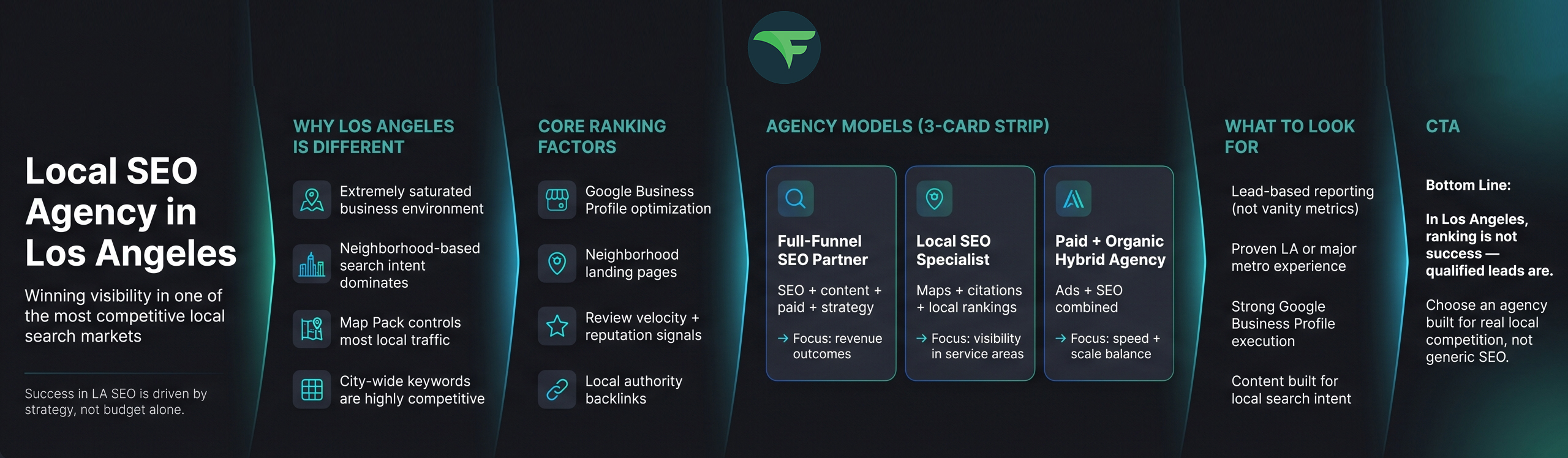
Los Angeles operates at a different competitive level than most U.S. markets, and that reality shapes how local SEO needs to be executed. Economic reporting from the Los Angeles Economic Development Corporation shows significant business concentration across technology, entertainment, logistics, and professional services — all sectors that compete aggressively for organic visibility.
The city’s geography compounds the challenge. LA’s neighborhood structure creates distinct micro-markets: a firm ranking well for “financial advisor Los Angeles” may be invisible in searches for “financial advisor Santa Monica” or “financial advisor Culver City.” Neighborhood-level targeting isn’t optional here — it’s frequently where the converting traffic actually originates.
Why Generic SEO Doesn’t Work Here
Google’s SEO Starter Guide establishes clear standards for how crawlability, structured data, and page experience factor into rankings. Most Los Angeles businesses are applying general SEO practices built for less competitive markets. The gap between what Google’s own documentation recommends and what the average agency delivers is where ranking opportunities sit — and where a structured partnership pays off.
What a Real SEO Partnership Looks Like
“Partnership” in this context isn’t a positioning phrase — it describes a working relationship with specific characteristics. A vendor delivers monthly reports. A partner delivers recommendations, explains the reasoning behind them, and adjusts strategy when results shift.
Strategy Alignment and Reporting
A well-structured partnership begins with goal alignment: which keywords drive revenue for your business model, which neighborhoods matter most, and what conversion metrics define success. Reporting should map SEO activity to business outcomes — not just ranking movement, but traffic from local intent queries, call and form submission volume, and attributed revenue where trackable.
What to Expect and When
| Phase | Timeline | What Changes |
| Foundation | Months 1–2 | Technical fixes, GBP optimization, citation audit |
| Traction | Months 3–4 | Ranking movement on target keywords, local pack entry |
| Growth | Months 5–6 | Traffic increase, lead volume growth |
| Compounding | Month 6+ | Consistent lead flow, authority accumulation |
Realistic timelines for competitive LA markets typically run 4–6 months before rankings stabilize meaningfully. Agencies promising faster outcomes are usually targeting low-volume keywords or using tactics that carry algorithmic risk.
How Google Ranks Local Businesses in Los Angeles
Google’s own documentation on local ranking factors identifies three pillars: relevance, distance, and prominence. Each requires a different set of actions, and the balance between them shifts depending on category competitiveness.
Prominence is where most LA businesses fall behind. It requires backlinks from relevant sources, consistent review acquisition, and brand mentions across authoritative platforms. Google’s original PageRank research explains the underlying mechanism: links function as signals of authority, and their value is determined by the quality and relevance of the linking source—not raw volume. This is why a single link from a trusted local publication can outweigh dozens of low-quality directory listings.
The GBP Compliance Gap
Google Business Profile guidelines are more specific than most businesses realize. Category selection, description formatting, photo standards, and spam protections each influence profile performance. An uncompliant or poorly configured GBP profile limits ranking potential regardless of how well the associated website performs — and in a city like LA, leaving that potential uncaptured is a recurring competitive disadvantage.
The Services That Drive Growth in LA’s Market
Effective local SEO in Los Angeles combines several services that compound when executed systematically. Deployed in isolation, each has limited impact.
- Local SEO and Google Business Profile optimization: Profile configuration, category selection, review acquisition strategy, and consistent posting cadence. This is the most direct path to Map Pack visibility for service-area businesses in the city.
- Technical SEO: Site speed, mobile performance, crawl accessibility, and structured data implementation. Google evaluates these before content quality factors. In a market where competitors are technically sound, this is the entry requirement.
- Content marketing and neighborhood targeting: Location-specific content addressing the micro-markets within LA — not just “Los Angeles” but the neighborhoods where your target clients search and convert.
- Link building and authority development: Earned links from relevant Los Angeles publications, business directories, and industry sources feed the prominence pillar directly and compound in value over time.
How LA Consumers Search and Buy
Think with Google research on local search behavior shows that “near me” searches carry unusually high purchase intent — users conducting local searches are measurably closer to a buying decision than those running broad informational queries. That same body of Google consumer insights reinforces the pattern: mobile-driven local searches lead to faster action and higher conversion intent compared to desktop, with the majority of local queries now happening on mobile devices.
Reviews are a direct input into that conversion process. FTC guidance on consumer reviews confirms that review volume and recency influence both rankings and on-profile conversion simultaneously — reputation management is part of the same acquisition funnel as SEO.
SEO in 2026: It’s Not Just Rankings Anymore
Pew Research data on evolving search engine use documents a shift toward AI-generated responses and featured snippets over traditional organic listings. A partnership worth investing in should be building visibility across both simultaneously.
Flying V Group’s SEO services, led by Director of SEO Sean Fulford, incorporate Generative Engine Optimization (GEO) — structuring content so AI models can parse, trust, and cite it alongside traditional rankings. In a city where every major industry category is well-represented, agencies still operating on a pre-2024 playbook are already losing ground.
How to Choose the Right SEO Partner in Los Angeles
The practical questions that separate strong candidates from weak ones: Can they show results in your specific industry category? Do they explain the reasoning behind their strategy, or just deliver monthly reports? How do they handle periods when rankings don’t move?
Red Flags Worth Identifying Early
Guarantees of specific ranking positions within short timeframes signal that an agency is either targeting uncompetitive keywords or misrepresenting what SEO can deliver. Agencies that outsource all content and link work to unvetted third parties carry quality risk that compounds over time. Agencies that don’t discuss Google Business Profile as part of local SEO are missing one of the highest-leverage channels in the LA market — and that gap reflects how they approach everything else.
Ready to Partner with a Los Angeles SEO Agency That Focuses on Growth?
Flying V Group works with Los Angeles businesses across professional services, technology, and e-commerce to build organic search programs that compound over time. Our approach starts with your revenue model — which customers, which neighborhoods, searching for what — and builds from there. Reach out to our team to discuss what the opportunity looks like in your market.
Frequently Asked Questions
What industries in Los Angeles benefit most from local SEO?
Professional services, home services, legal, and financial advisory are among the highest-converting categories for local SEO in Los Angeles. These categories combine high search volume with strong purchase intent — users searching for an attorney or a contractor in LA are typically ready to hire. E-commerce businesses with a physical presence also see strong returns, particularly for product categories with established “near me” search behavior.
How much should I budget for local SEO in Los Angeles?
Full-service local SEO in the LA market typically ranges from $2,000 to $7,500 per month, depending on competitive intensity, the number of neighborhoods being targeted, and the scope of technical and content work involved. Los Angeles’s competitive density places it at the higher end of major U.S. markets. Entry-level retainers below $1,500 per month rarely include the content production and link acquisition necessary to compete in contested categories.
What’s the difference between hiring an SEO vendor and an SEO partner?
An SEO vendor delivers predefined services on a schedule — audits, reports, a set number of content pieces or links per month. An SEO partner adjusts strategy based on results, flags new opportunities, and connects activities to business outcomes rather than deliverable counts. The distinction matters most in competitive markets like LA, where cookie-cutter execution produces cookie-cutter results.
Does neighborhood-level targeting matter for Los Angeles businesses?
It matters significantly. Los Angeles search behavior is highly localized — users frequently search for services within specific neighborhoods rather than the city broadly. A business optimizing only for “Los Angeles” keywords may rank for low-intent, high-competition terms while missing the neighborhood-specific searches where converting traffic originates. Effective LA SEO maps keyword and content strategy to the geographic areas that produce the highest-value leads.
How do I evaluate whether an SEO agency actually understands the LA market?
Ask for case studies from Los Angeles or comparable high-density urban markets. Ask which neighborhoods they’ve targeted and what the competitive landscape looked like. Ask how they distinguish between organic rankings and Map Pack visibility for LA-specific queries. Agencies with genuine LA market experience will give specific answers. Agencies applying generic local SEO frameworks will give general ones.
Can local SEO and paid search work together in Los Angeles?
They serve different parts of the acquisition timeline and work best when coordinated. Paid search produces immediate visibility for high-intent terms; local SEO builds compounding organic authority over time. The most effective approach uses paid search to capture near-term demand while SEO reduces cost-per-acquisition over a 12–18 month horizon.
What happens to my rankings if I stop working with an SEO agency?
Organic rankings built on legitimate foundations — technical improvements, authoritative content, earned links — are relatively durable and don’t disappear immediately when active optimization stops. In competitive markets like LA, however, rankings erode as competitors continue investing. The practical window before meaningful loss is typically 3–6 months for low-to-mid competition terms, faster for highly contested categories. An SEO partnership is most valuable when treated as ongoing maintenance of a competitive position, not a one-time project.