Facebook ads don’t just generate clicks — they create decisions. Industry benchmark data from Marketing LTB puts Facebook and Instagram CPC for restaurant campaigns at $0.40 to $1.50, with conversion rates reaching 6 to 12% for well-structured campaigns. For a restaurant, that’s one of the most favorable cost-per-acquisition ratios in paid media.
The businesses getting the most from Meta aren’t running generic “visit us” ads — they’re building layered campaigns that move people from passive scroll to booked table. Flying V Group builds pay-per-click advertising programs for restaurants that close the gap between ad spend and revenue outcomes. The strategies below reflect what actually works in current Meta campaigns.
Why Facebook Ads Work for Restaurants
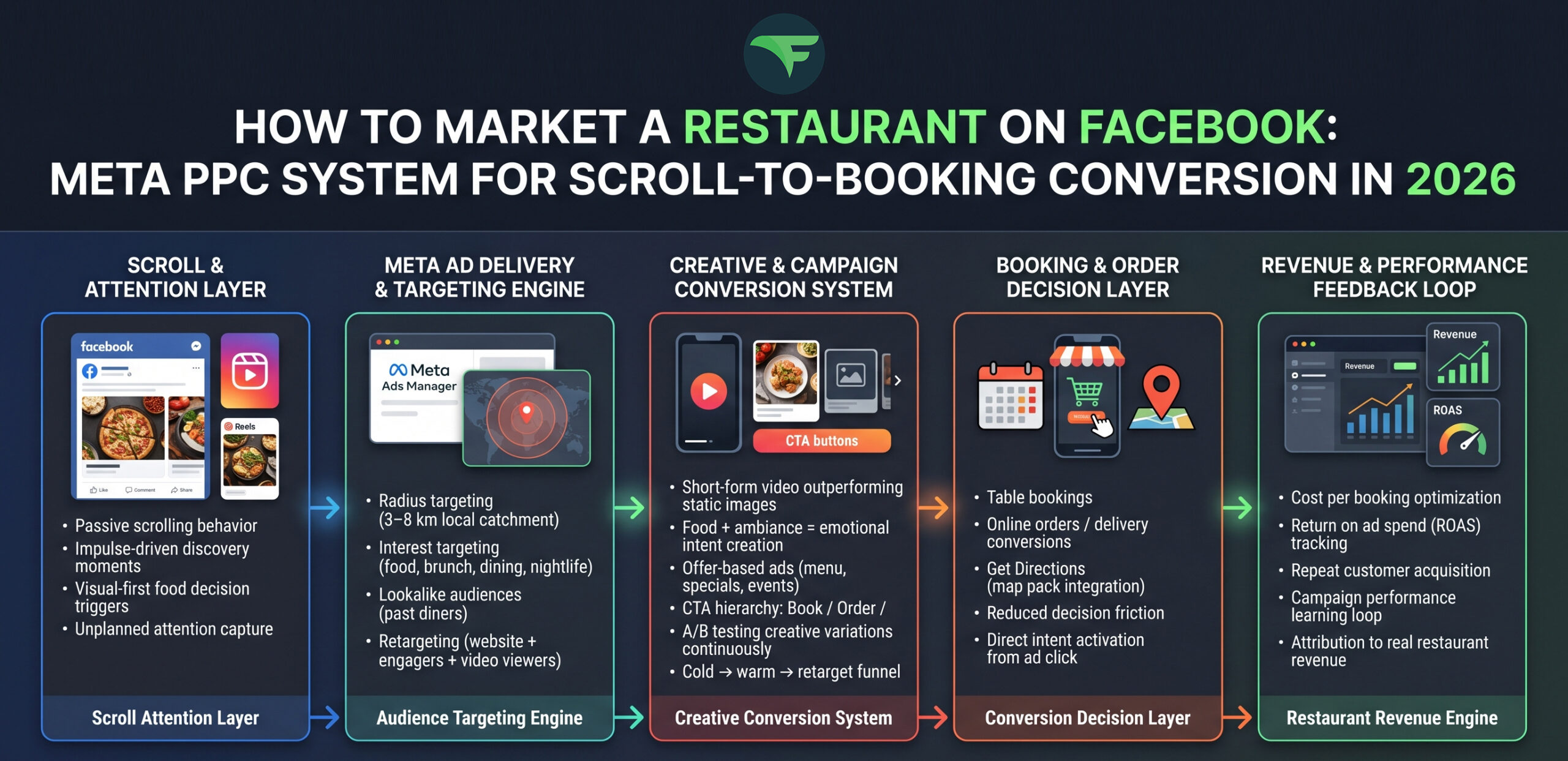
Meta’s platforms interrupt the scroll, not the search. A potential diner isn’t researching options — they’re passively browsing, and a compelling food visual or well-framed offer creates intent that didn’t exist 30 seconds earlier.
Bureau of Labor Statistics consumer expenditure data shows dining out represents one of the largest recurring discretionary categories in U.S. household budgets. Restaurants don’t need to convince people to eat out. They need to be the choice made in the moment of deciding where.
The Scroll-to-Table Decision
Research published in PMC on social media’s influence on food consumption behavior confirms that paid social media advertising directly influences food decision-making in ways that search advertising alone cannot replicate.
This is Meta’s structural advantage: it generates demand rather than simply capturing it. A well-placed ad creates a craving. A well-built campaign then converts that craving into a reservation.
Campaign Types That Actually Bring Diners
Not all campaign objectives produce the same outcome, and choosing the wrong one is one of the most common reasons restaurant ad budgets underperform. Awareness objectives maximize impressions; conversion objectives optimize for a specific action — a reservation, an online order, or a click to directions.
For most restaurants, the highest-return objective is traffic or conversions, directing users to a booking system, an ordering page, or a location landing page. Engagement campaigns build social proof over time but rarely translate directly to covers.
Matching Objective to Funnel Stage
A complete restaurant campaign runs in layers. Cold audiences — people who’ve never interacted with your brand — respond to awareness creative that communicates atmosphere and food quality. Warm audiences — past website visitors, Instagram engagers — respond to direct-response creative with a specific offer or CTA.
U.S. Census food service data shows restaurants depend on consistent, repeat foot traffic — which means campaigns need to work at both acquisition and retention simultaneously. Running a single campaign type at a single audience temperature leaves conversion on the table.
How to Target Local Customers on Meta
Radius targeting is the single most important lever for restaurant advertisers. Setting a delivery radius of three to eight kilometers around your location ensures ad spend reaches people who can actually visit — not users across the country who will never walk through your door.
Beyond radius, Meta’s interest and behavior targeting allows restaurants to layer in psychographic signals: people who engage with food content, dine out frequently, or have indicated interest in occasion categories like “date night” or “Sunday brunch.”
Lookalike Audiences and Retargeting
The highest-performing targeting strategies use first-party data. A lookalike audience built from your actual customer list — sourced from a POS system, a reservation platform, or a website pixel — finds new users who share behavioral patterns with people who’ve already chosen your restaurant.
Consumer psychology research on the mere-exposure effect supports the idea that repeated brand exposure lowers the barrier to conversion, which helps explain why retargeting campaigns often outperform cold-audience campaigns in cost per acquisition. Past visitors already recognize the brand. They need a reason to return, not a reason to trust.
Ad Creative That Drives Reservations
The quality of creative determines campaign performance more than any targeting parameter. Meta’s algorithm optimizes delivery toward ads that generate the most engagement — meaning a weak creative will underdeliver regardless of how precisely the audience is defined.
Food photography needs to communicate occasion. A plate shot in warm, low light reads “date night.” The same dish against a bright white background reads “delivery order.” The visual language does targeting work that no audience selector can replicate.
Video, Offers, and the CTA That Converts
Short-form video consistently outperforms static images for restaurant campaigns. A 10 to 15 second clip showing a dish being prepared, plated, and served carries more conversion signal than a single image, and Reels and Stories placements typically deliver the strongest cost-per-result metrics for food-focused content.
CTAs should be direct and frictionless: “Book Now,” “Order Online,” and “Get Directions” consistently outperform generic options like “Learn More.” Sending traffic to a third-party delivery app rather than a direct ordering system costs 15 to 30% per transaction in platform commission — and that margin erosion compounds at scale.
Budgeting and ROI: What to Expect
The SBA’s guidance on small business marketing recommends allocating 2 to 6% of revenue to marketing for established small businesses. For restaurants, industry practice narrows this to 3 to 5% for paid social, with $300 per month representing the practical floor for generating meaningful campaign data.
At $300 a month, a restaurant can run a single conversion-focused campaign with enough daily budget to exit Meta’s learning phase within two to three weeks. At $1,000 a month, a layered funnel across awareness, retargeting, and conversion becomes achievable. At $3,000 a month, seasonal campaigns and geographic expansion can run concurrently.
Scaling What Works
Federal Reserve consumer spending research confirms that dining decisions are emotionally and socially motivated — which means campaigns built around occasion and experience consistently build higher customer lifetime value than those leading with discounts.
The goal isn’t to generate one visit. It’s to generate a customer who returns. Restaurants that measure campaign success by repeat visit rate and average order value — rather than click volume — consistently find their actual ad ROI higher than initial estimates suggest.
Common Mistakes That Waste Ad Spend
Most restaurant ad budgets don’t fail because of poor targeting. They fail because of decisions made after the click: weak landing pages, no pixel installed, CTAs routing traffic to third-party platforms, and campaigns running with only one creative variant and no testing structure.
A/B testing two creatives per campaign — different visuals, different offer framing, different CTAs — should be standard practice from day one. Meta’s algorithm identifies the stronger performer within days, and the compounding effect of consistently cutting underperforming creative improves cost-per-booking over time.
Getting Your Restaurant’s Facebook Strategy Right
Meta advertising for restaurants rewards specificity: the right radius, the right creative, the right CTA, and the right audience temperature. Generic campaigns that don’t differentiate by occasion, offer, or funnel stage consistently underperform — and most restaurant owners don’t have the margin to run experiments for months to find out what works.
Flying V Group’s PPC team builds Meta campaigns with the setup, testing, and optimization structure that most restaurant owners don’t have time to manage in-house. To see what a structured restaurant PPC program looks like in practice, get in touch to discuss your specific market and goals.
Frequently Asked Questions
How much should a restaurant spend on Facebook ads per month?
A minimum of $300 per month provides enough daily budget to exit Meta’s learning phase and generate statistically meaningful data within two to three weeks. Most restaurants allocate between 3 and 5% of monthly revenue to paid social, with $1,000 to $3,000 per month enabling a full layered funnel across awareness, retargeting, and conversion campaigns. Starting lower is fine — but campaigns running below $10 per day will take significantly longer to optimize.
What’s the difference between a traffic campaign and a conversion campaign for a restaurant?
A traffic campaign optimizes for link clicks, increasing visits to a website or ordering page but not necessarily prioritizing users likely to complete a reservation or order. A conversion campaign uses pixel data to find users whose behavior patterns match people who’ve previously completed the target action. For restaurants with a functioning ordering system or reservation tool, conversion campaigns typically deliver a lower cost per actual customer action.
Should I send Facebook ad traffic to my website or a delivery platform like DoorDash?
Sending paid traffic to a third-party delivery platform means paying both the ad cost and the platform’s commission — typically 15 to 30% per order — on every transaction generated. Directing traffic to a direct ordering system or reservation platform preserves margin entirely. If a restaurant doesn’t yet have a direct ordering option, building one should be the first priority before scaling ad spend.
How do I know if my Facebook ads are actually working?
The most meaningful metrics for restaurant campaigns are cost per booking, cost per order, and return on ad spend — not impressions, reach, or click-through rate. Installing the Meta Pixel and connecting it to a reservation or ordering system allows accurate tracking of revenue-generating actions. Restaurants tracking only engagement metrics like likes and comments are optimizing for the wrong outcome.
Can small restaurants compete with larger chains on Facebook?
Yes — and local targeting is the primary reason. National chains optimize at the metro or regional level; a neighborhood restaurant can target a three-kilometer radius with messaging specific to that location’s community, occasion, and atmosphere. Hyper-local campaigns with defined offers routinely outperform broad-market campaigns in cost-per-visit, even when the overall budget is significantly smaller.
How often should a restaurant update its Facebook ad creative?
Creative fatigue — the performance decline that occurs as a local audience sees the same ad repeatedly — typically begins within two to four weeks for tightly targeted restaurant campaigns. Refreshing creative at least once a month prevents rising frequency from driving up cost-per-result. The most effective approach is maintaining two or three creative variants per campaign at all times and replacing the lowest performer as fatigue metrics appear.
What targeting approach works best for promoting a specific event or seasonal menu?
Event-based and seasonal campaigns perform best when the targeting combines radius with occasion-based interest signals — people who engage with food content, dining, or the specific occasion type (Valentine’s Day, brunch, holiday dining). Running these as short-burst campaigns of 7 to 14 days with a direct booking CTA, rather than extended awareness campaigns, tends to generate the strongest cost-per-reservation ratio for limited-time promotions.