In the HORECA industry, customers don’t browse — they decide. According to EHL Hospitality Insights, the global hospitality sector is valued at approximately $4.9 trillion, with digital discovery now driving the majority of booking and visit decisions. Searchlab’s 2026 hospitality marketing data shows 93% of customers read reviews before choosing a hotel, restaurant, or café — making online visibility not a marketing function but a prerequisite for revenue.
What separates businesses that consistently fill tables and rooms from those that don’t is rarely product quality. It’s whether customers can find them — and trust what they find — at the exact moment they’re ready to act. Flying V Group builds SEO services programs designed to connect HORECA businesses to customers at precisely that moment.
What Is HORECA SEO and Why It’s Different
Search engine optimization for the HORECA sector operates on fundamentally different logic than conventional SEO. The intent is immediate and location-dependent: someone searching “hotel near me,” “restaurant in [city],” or “coffee shop nearby” is not researching for next month.
Think with Google’s local search behavior research confirms that 46% of all Google searches carry local intent, and a significant portion convert into physical visits within hours. Traditional SEO competes for research traffic; HORECA SEO competes for decision-ready customers.
Location, Intent, and the Decision Moment
The customer journey in hospitality is compressed. A traveler books a hotel the same day they searched. A diner makes a reservation within minutes of seeing a restaurant’s Maps listing. A café captures a customer who was walking past and searched on impulse.
Peer-reviewed research published in PMC on digital transformation in hospitality confirms that digital adoption directly influences booking behavior across all hospitality verticals — meaning businesses that have not invested in their online presence are not just less visible. They are less preferred.
Why Local Search Drives Hospitality Revenue
The data on pre-visit search behavior across HORECA is unambiguous. Marketing LTB’s restaurant consumer research shows 88% of consumers search online before choosing a restaurant, and 71% use maps specifically to locate one.
The pattern holds across hotels and cafés. Bureau of Labor Statistics consumer expenditure data confirms that dining, travel, and leisure represent recurring discretionary categories with high purchase frequency — meaning a business that wins a customer through local search wins them repeatedly, not just once.
The Local Search Funnel Across HORECA
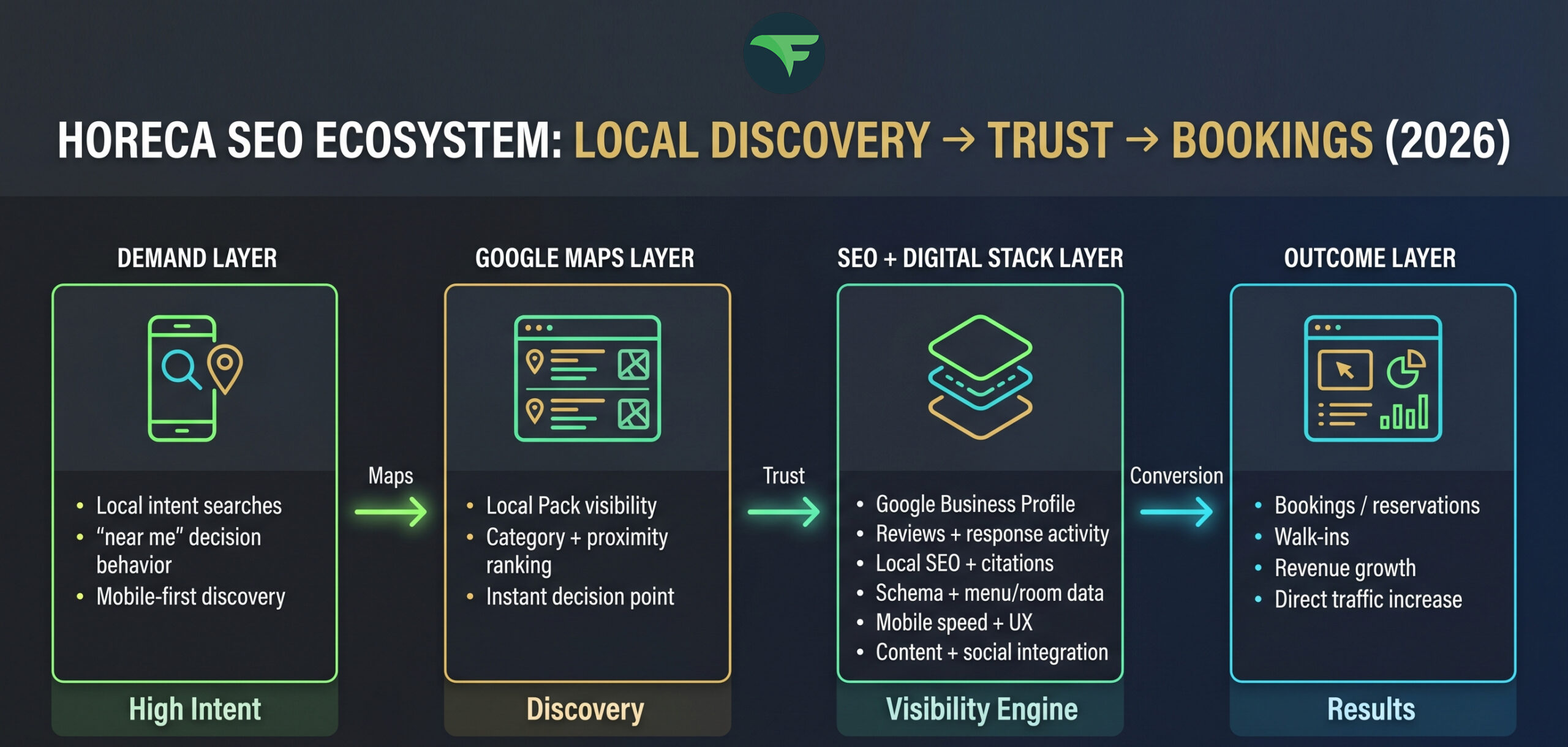
The path from search to revenue follows the same structure across all three verticals: search → compare → decide → book or visit. The entry point — the Google Maps Local Pack — is where most of these decisions are made, not on a business’s website.
A hotel that doesn’t appear in Maps results for its own district loses to competitors that do, regardless of the property’s actual quality. Controlling Local Pack placement is the single highest-leverage action in HORECA SEO — and only 19% of hospitality businesses are actively investing in it, which means the competitive gap for early movers is significant.
How to Rank on Google Maps Across All Three Verticals
A complete, accurately maintained Google Business Profile is the non-negotiable foundation of HORECA local search performance. This means current hours, high-resolution photos of the space and product, accurate categories, and regular posts that signal operational activity to Google’s algorithm.
Consistent NAP (name, address, phone) data across all directory listings reinforces this foundation — discrepancies suppress rankings regardless of GBP quality.
Reviews as a Ranking and Conversion Factor
Reviews influence both where a business ranks and whether a user chooses it after clicking. Volume, recency, and owner response rate all affect Local Pack positioning — and the businesses that respond to every review, including negative ones, signal to both Google and prospective customers that the operation is actively managed.
arXiv research on review credibility and consumer decision-making adds an important nuance: consumers are increasingly sensitive to review authenticity. Genuine, detailed reviews with specific staff names, dishes, or experiences consistently outperform high-volume accounts with generic ratings — making review quality a conversion factor independent of its direct ranking effect.
Digital Marketing Channels That Work for HORECA
Technical SEO — site speed, mobile optimization, structured data markup — determines whether a website can rank at all. Social media generates the brand awareness and intent that SEO then captures. Paid ads bridge visibility gaps during competitive periods or new openings.
The HORECA businesses that consistently outperform have stopped treating these as separate channels. Strong SEO drives organic discovery, social creates the emotional pull that increases click-through rates on search results, and paid campaigns retarget visitors who didn’t convert on first contact.
SEO, Social, and Paid: The Combined Discovery System
ResearchGate research on digital marketing for the restaurant industry frames digital presence as infrastructure for customer acquisition and retention — not a campaign-by-campaign tactic.
A hotel or restaurant that invests only in paid ads generates traffic without durability; one that invests only in SEO builds authority slowly without the burst capacity that seasonal peaks require. The integrated approach — SEO for long-term visibility, paid for demand spikes, social for brand building — is what sustains consistent occupancy and reservation volume year-round.
Content Strategies for Hospitality Businesses
Content marketing in HORECA works when it’s built around the questions customers ask before visiting. “Best brunch in [neighborhood],” “things to do near [hotel name],” and “where to eat in [city] for a date night” are not generic blog topics — they’re queries with direct booking intent that a structured content program can own.
The SBA’s guidance on small business marketing identifies location-based content as one of the most cost-effective channels for local service businesses, specifically because it compounds over time. A blog post ranking for “best coffee in [neighborhood]” generates discovery visits every month, not just on the day it published.
Local Content That Builds Authority Over Time
Location-specific landing pages, neighborhood guides, and seasonal content earn the backlinks — local news features, tourism site citations, community blog references — that translate into sustained ranking improvements.
These are also the content types that AI-driven search surfaces in generative answers. A hotel post titled “What to Do in [City] for a Weekend” is far more likely to appear in a ChatGPT or Perplexity response than a homepage that only lists room rates and amenities.
Common HORECA Marketing Mistakes
The most damaging pattern in HORECA digital marketing is over-reliance on third-party platforms — OTAs for hotels, delivery apps for restaurants — at the expense of owned visibility. Each booking through a platform carries a commission cost of 15 to 30% per transaction and builds no long-term SEO authority for the business itself.
SEO and web design packages that combine a direct booking or ordering interface with local SEO reduce platform dependency while compounding the business’s own search visibility. The second most common mistake is treating Google Business Profile as a set-and-forget asset — outdated hours, missing photos, and unanswered reviews consistently suppress rankings regardless of what else a business is doing right.
Building a HORECA SEO Strategy That Converts
The HORECA businesses that dominate local search treat digital presence as operational infrastructure, not a marketing add-on. GBP maintenance, review management, local content, and technical optimization are not quarterly projects — they’re ongoing functions that compound into durable competitive positioning.
Flying V Group works with hotels, restaurants, and cafés to build exactly this kind of integrated local SEO program. From initial audit to long-term execution, the focus stays on the metrics that actually matter: bookings, reservations, and foot traffic. To see what a HORECA-specific SEO strategy looks like for your business, reach out to the team.
Frequently Asked Questions
How is HORECA SEO different from standard local SEO?
HORECA SEO is built around immediate, location-driven intent rather than research-phase queries. A consumer searching “hotel near me” or “restaurant open now” is minutes from a booking or visit decision — not weeks away. This compresses the conversion window significantly and means that GBP completeness, review recency, and mobile page speed have a more direct and measurable impact on revenue than in most other industries.
How long does it take for HORECA SEO to show results?
Google Business Profile optimization and review generation can produce measurable Local Pack improvements within 60 to 90 days. Organic website rankings for location-specific content typically require four to six months of consistent content and technical work. The fastest wins come from GBP completeness, NAP consistency across directories, and an active review response strategy — all of which can be implemented immediately.
Should a hospitality business invest in SEO or paid ads first?
For most HORECA businesses, the highest priority is organic local visibility — specifically GBP optimization and review management — because these directly affect the Local Pack placement that drives the majority of walk-in and same-day booking traffic. Paid ads are most effective as a supplement during peak demand periods or specific promotions, not as a substitute for a foundational SEO presence that compounds over time.
Do reviews actually affect a hotel or restaurant’s Google ranking?
Review volume, recency, and the owner’s response rate are all confirmed factors in Google’s local ranking algorithm. A business with 200 recent reviews will consistently outrank one with 50, assuming other signals are equal. Research also shows that review authenticity — specific, detailed accounts rather than generic five-star ratings — increasingly influences consumer trust and conversion, independent of its direct ranking effect.
Do HORECA businesses need a website if they already have a strong social media presence?
Social media and a Google Business Profile control discovery and initial impression, but neither can rank for the informational and comparison-based queries that precede many booking decisions. A website provides the crawlable structure needed to appear for searches like “best hotels in [neighborhood]” or “Italian restaurant near [landmark].” It also enables direct booking and ordering integrations that reduce costly dependence on third-party platforms.
What content should hotels, restaurants, and cafés be publishing?
The highest-performing HORECA content targets local intent: neighborhood guides, seasonal menu announcements, event-specific pages, and experience-based posts that answer questions real customers ask before visiting. “Things to do near [hotel],” “best brunch in [area],” and “private dining in [city]” are examples of content that earns both search rankings and backlinks from local media and tourism publications.
How does mobile search behavior affect HORECA SEO specifically?
The majority of HORECA searches happen on mobile devices while the customer is already in motion — commuting, traveling, or walking through a neighborhood. Page speed, tap-to-call functionality, and map integration are conversion factors, not UX enhancements. A restaurant website that loads in under two seconds and displays a click-to-book option prominently will consistently convert more mobile searchers than one requiring multiple steps to reach an action.