
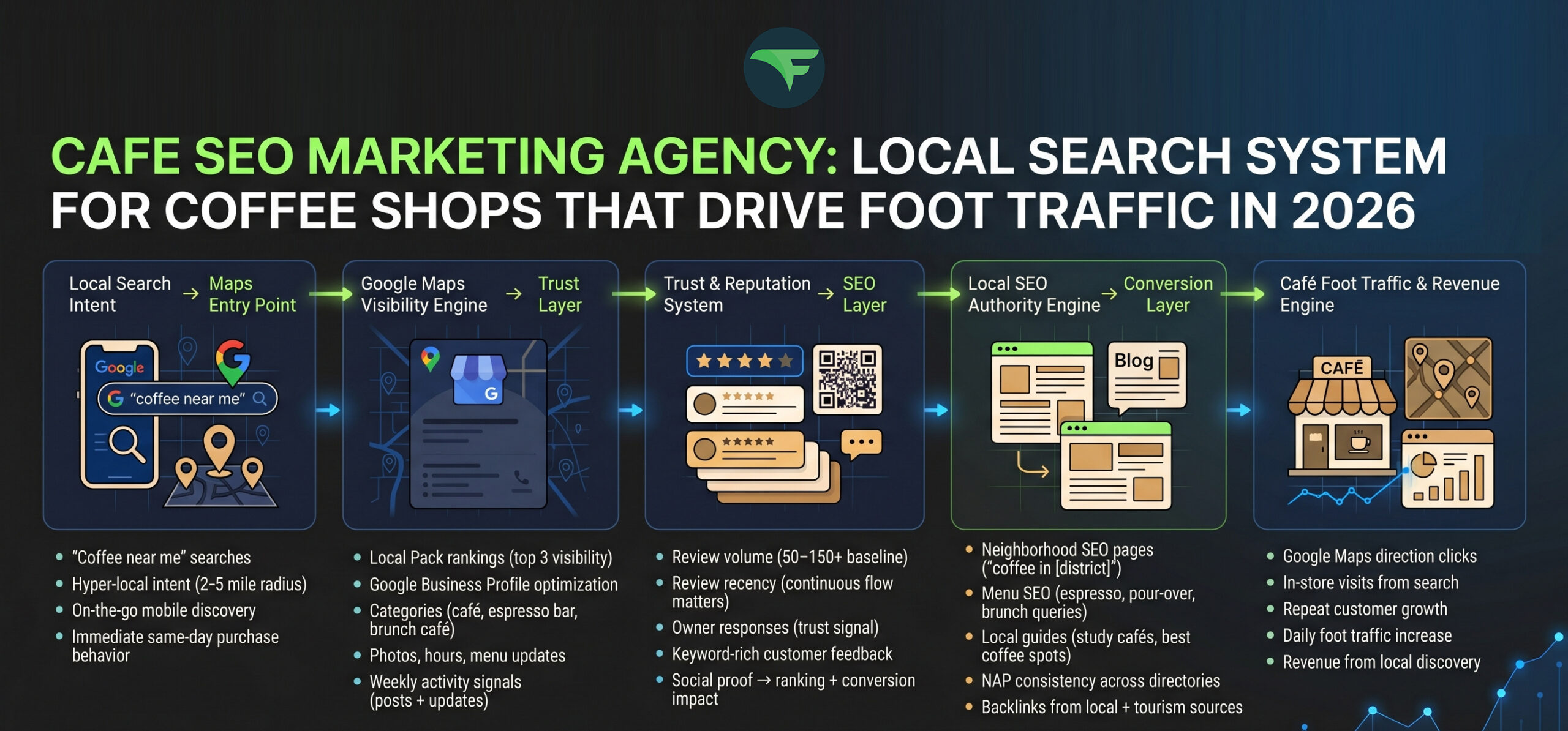
Most café owners know they need to show up online. Fewer understand that the gap between “having a website” and “being found when it counts” is where revenue is actually won or lost. According to Think with Google, 46% of all Google searches carry local intent — and 76% of those searches result in a physical visit within 24 hours. For a coffee shop, that’s not a marketing statistic — that’s a footfall metric.
The businesses capitalizing on this aren’t necessarily the ones with the biggest budgets. They’re the ones that have built a coherent local search presence: optimized Google Business Profiles, a consistent review strategy, and content that addresses how customers actually search. Flying V Group works with local businesses to build exactly this kind of presence — connecting SEO services to real-world revenue outcomes. For cafés specifically, the approach differs meaningfully from conventional SEO, and that difference matters.
Why Local SEO Is Different for Coffee Shops
Search engine optimization for a café isn’t primarily about ranking for national terms. It’s about controlling the search experience within a two-to-five-mile radius, in the exact moment someone decides where to get coffee next.
Coffee is a daily-use product with deeply habitual purchase behavior. Statista’s coffee market research confirms that U.S. consumers drink an average of over three cups per day, and a significant portion of those decisions happen on the move.
The Intent Behind “Near Me” Searches
The query “coffee shop near me” signals immediate intent — the person searching is not planning for next week. They’re walking down the street.
This means the standard levers of conventional SEO — domain authority, keyword difficulty, national search volume — matter less than proximity signals, review velocity, and the completeness of local data. A café that doesn’t appear in the Google Maps Local Pack for its own neighborhood has optimized for the wrong audience entirely.
Google Business Profile: Your Most Valuable Local Asset
If there is one thing café owners consistently underinvest in, it’s their Google Business Profile (GBP). This is where most café discovery actually happens — not on a website, not on Instagram, but in the Maps results that surface when someone types “coffee near me” on their phone.
U.S. Census retail and food service data shows food service establishments have seen consistent growth driven by digital discovery, a trend that accelerated sharply post-2020. A GBP that is incomplete, infrequently updated, or missing photos actively suppresses local rankings.
Building a GBP That Ranks
A complete GBP includes accurate hours (updated for holidays), a primary category that reflects how customers search, high-resolution photos of the interior and menu items, and a description that names the neighborhood and drink specialties you want to rank for.
Weekly posts to the profile signal to Google that the business is active, which directly influences Local Pack positioning. The U.S. Small Business Administration identifies digital presence maintenance as one of the highest-ROI activities for local businesses, specifically because it demands time rather than budget.
Reviews: The Ranking Signal Most Cafés Underuse
Reviews function as both a trust signal and a ranking factor. Third-party attribution strengthens authority in networked environments — a dynamic that extends directly to how Google weights review volume and recency.
A café with 200 reviews averaging 4.6 stars will consistently outrank a competitor with 40 reviews averaging 4.9 stars. Volume and recency matter as much as rating. A QR code on receipts, a prompt from staff at the register — these small operational choices compound into a meaningful ranking advantage over six to twelve months.
Keywords Cafes Actually Need to Target
The queries that drive café foot traffic don’t look impressive in a reporting dashboard. They’re hyper-local, conversational, and increasingly voice-driven. Keyword research tools confirm that the highest-converting café queries follow predictable patterns:
- “coffee shop near me” — pure proximity, highest intent
- “best coffee in [city/neighborhood]” — comparative, trust-driven
- “café with WiFi near [area]” — needs-based, filters competition
- “brunch café [neighborhood]” — occasion-specific, lower volume, higher conversion
- “pour over coffee [city]” — product-specific, captures specialty buyers
What Actually Determines Ranking
These terms rarely require competitive technical SEO — domain authority is not the limiting factor.
What determines ranking is the accuracy of local signals: NAP (name, address, phone) consistency across directories, GBP category alignment, and on-page optimization for neighborhood-level terms.
From Discovery to Visit: Turning Rankings Into Foot Traffic
Ranking is the precondition. Conversion is the goal. Think with Google’s research shows 78% of local mobile searches result in an offline purchase — but the café that earns the click still has to earn the visit.
The decision path for café customers is short and emotionally driven. They search, scan the top three results, check photos and reviews, and decide in under 60 seconds. Photos of the interior, menu items, and coffee preparation are conversion assets, not aesthetic choices. A GBP with no photos loses to one with twenty, regardless of review parity.
Content That Builds Local Authority Over Time
A website creates the ranking foundation that a GBP alone cannot provide. Location-specific landing pages — “Best Coffee in [Neighborhood]” or “Specialty Espresso in [City]” — give Google structured, crawlable signals that a Maps profile cannot generate.
Content marketing builds this authority incrementally: posts covering seasonal offerings, neighborhood guides, or barista spotlights earn backlinks and brand mentions that compound over months. Bureau of Labor Statistics consumer expenditure data shows spending on food away from home is now one of the largest discretionary categories in U.S. household budgets — which means the competitive floor for café marketing is rising year over year.
How Small Cafés Beat Big Chains in Local Search
Large coffee chains carry national domain authority and substantial marketing budgets. They do not have neighborhood specificity. This is where independent cafés consistently outperform: targeting the hyper-local queries that chains rarely optimize for, and building the review volume that reflects genuine community engagement.
A café that positions itself as “the study spot in [neighborhood]” or “the only café in [zip code] with single-origin pour-overs” competes in a search space chains aren’t contesting.
Owning the Neighborhood, Not the City
Fighting a chain for “coffee shop” in a major city is a losing proposition. Owning “coffee shop in [specific neighborhood]” is entirely achievable.
SEO and web design packages that pair structured local landing pages with technical optimization can establish this neighborhood authority in months, not years. The mistake most independent café owners make isn’t a lack of effort — it’s competing on the wrong terms.
Building Your Online Presence Starts With the Right Partner
Local SEO for cafés is specific enough that generalist advice frequently misses. The variables that determine whether a café ranks in the Local Pack — GBP completeness, review velocity, hyperlocal content signals, NAP consistency — require both a technical foundation and an ongoing content strategy working in tandem.
Flying V Group builds local SEO programs tailored to exactly this kind of business. From initial audit to long-term content execution, the approach ties search visibility directly to in-store traffic and measurable revenue outcomes. If your café’s online presence isn’t generating foot traffic proportional to your product quality, contact the team to see what a focused local SEO strategy looks like for your specific market.
Frequently Asked Questions
How long does it take for local SEO to work for a café?
Most cafés see meaningful movement in Google Maps rankings within 60 to 90 days of consistent GBP optimization and active review generation. A completely unclaimed or unoptimized profile can show results in weeks once fully built out. Ranking for competitive website keywords — such as “best coffee in [city]” — typically requires four to six months of sustained content and technical work.
What’s NAP consistency, and why does it affect my café’s rankings?
NAP stands for name, address, and phone number — the core identifying data for any local business. When this information appears differently across Google, Yelp, Facebook, and local directory listings, Google’s algorithm treats each variation as a separate or unverified entity, suppressing local rankings. Auditing and standardizing NAP data across all directories is one of the highest-leverage early steps in any local SEO program.
How many reviews does a café need to appear in the Local Pack?
There is no fixed number, but cafés in mid-sized cities typically need 50 to 75 recent reviews as a baseline to compete for Local Pack placement, with 150 or more providing a meaningful edge. Review recency matters as much as volume — a café with 300 total reviews but none in the past 60 days will often be outranked by a competitor with 80 reviews and a steady weekly cadence of new responses.
Does posting on Instagram or TikTok help a café’s Google rankings?
Social media does not directly influence Google rankings, but it affects two factors that do: branded search volume and review generation. When customers discover a café on Instagram or TikTok and then search for it by name on Google, that branded search signal builds authority over time. Social platforms also create the moments where customers form the intent to leave a review — the indirect relationship is real, even if it doesn’t show up in a standard SEO audit.
Should cafés create content targeting specific drinks, like “oat milk latte” or “pour over near me”?
Product-specific keywords attract higher-intent customers and face significantly less competition than generic café terms. A customer searching “single origin espresso near me” is not a chain drinker. These keywords perform best on menu pages and blog content rather than homepage copy, where they build topical authority without diluting the primary local intent signals.
Is a website necessary if a café already has a strong Google Business Profile?
A Google Business Profile controls Maps and Local Pack visibility, but it cannot rank for informational or comparison-based searches on its own. A website provides the crawlable content structure needed to rank for terms like “best coffee shop in [neighborhood]” or “study café near [landmark].” The two work together: the GBP handles proximity-driven queries, while the website extends reach to the broader search behavior that precedes a visit decision.
What separates a local SEO strategy that drives foot traffic from one that just improves rankings?
The distinction comes down to conversion signals — the elements a customer evaluates in the 60 seconds between finding your listing and deciding to visit. High-quality photos, recent reviews, accurate hours, and a website that confirms the experience they’re expecting are what turn a ranking into a visit. Rankings without these elements generate impressions, not customers.