

Getting a San Diego law firm in front of the right clients starts with understanding where those clients look — and what they find when they get there. FindLaw’s 2024 Consumer Legal Needs Survey found that 97% of legal consumers who searched for an attorney online used search engines, and the majority contacted only one firm before hiring.
Flying V Group builds SEO services programs for law firms competing in local markets like San Diego. Whether you practice personal injury in Mission Valley, immigration law in National City, or business litigation in La Jolla, consistent inbound cases start with showing up in search at the moment a client is ready to act. See how we structure search engine optimization programs for legal clients.
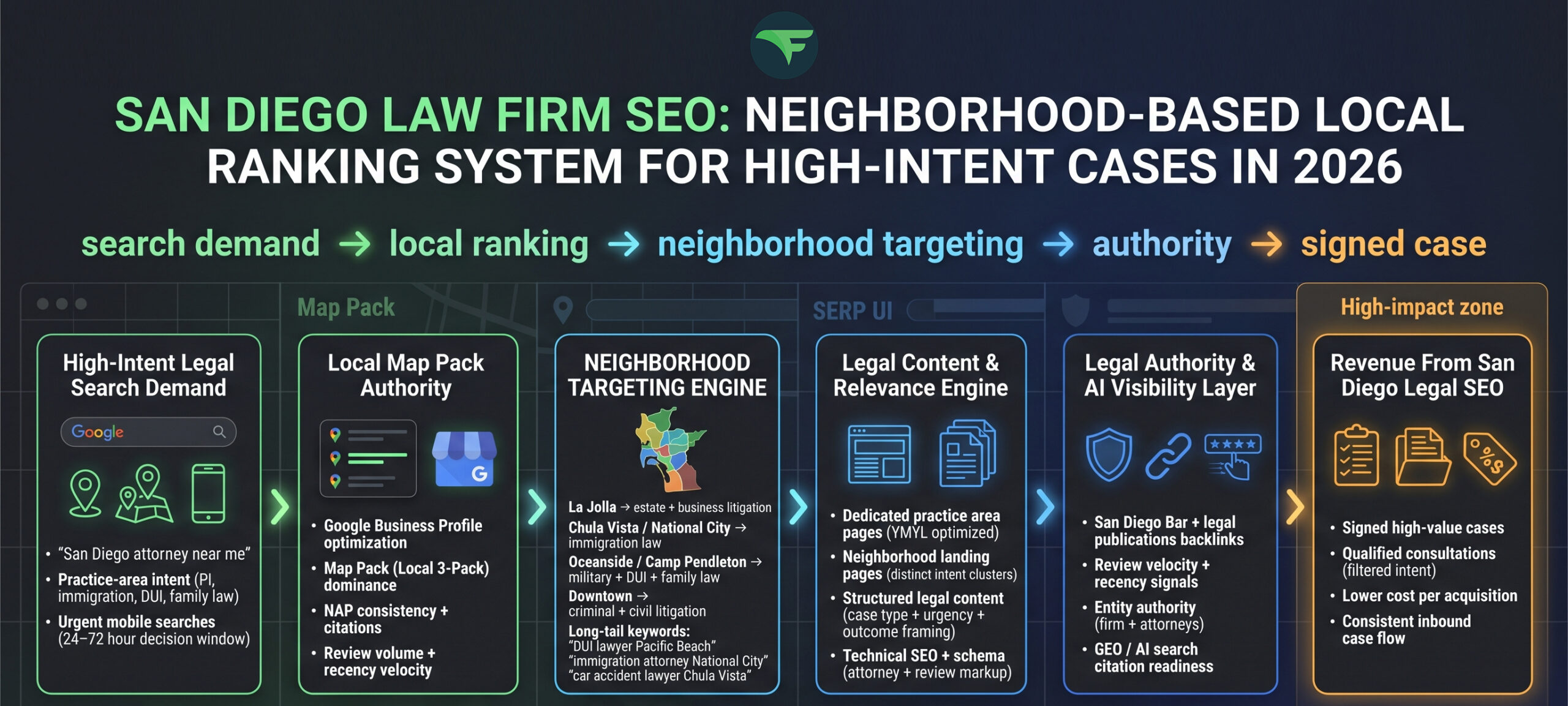
Why San Diego’s Legal Market Requires Its Own Strategy
San Diego’s economy creates legal demand patterns that differ sharply from other California markets. San Diego Regional Economic Development Corporation data shows the county is home to the largest concentration of military assets in the world, with defense-related spending accounting for approximately 20 percent of San Diego’s gross regional product.
That military presence generates steady demand across family law, DUI defense, veterans’ benefits claims, and immigration — categories with search patterns that differ from civilian legal markets. State Bar of California attorney demographics show more than 225,000 licensed attorneys statewide, but San Diego’s mix of immigration demand (driven by proximity to Tijuana), military family law, biotech-sector employment disputes, and high-volume personal injury creates a market where practice-area specificity matters more than broad name recognition.
How Google Decides Which Law Firms Get Found
Google’s documentation on local ranking factors identifies three inputs: relevance, distance, and prominence. Distance is fixed. Relevance is table stakes. Prominence — built through reviews, authoritative backlinks, and consistent business signals — is where competitive separation actually happens.
Most San Diego firms address relevance at a basic level. The gap is almost always in prominence, which is why firms with strong content but a thin review profile consistently trail competitors who have the opposite setup.
The Technical Gap Most San Diego Firms Ignore
Google’s SEO Starter Guide establishes crawlability, mobile performance, and structured data as non-negotiable foundations. Attorney schema, review schema, and local business markup help Google accurately identify what a firm practices and where. Flying V Group’s technical SEO work for legal clients starts here — because structural gaps suppress rankings regardless of how strong other signals are.
The Google Business Profile Opportunity Most Firms Leave Open
The local Map Pack — the three results in Google’s map view — generates a majority of clicks for most local legal searches. A well-configured Google Business Profile is the primary driver of Map Pack placement: accurate practice area categories, consistent NAP data, an active posting cadence, and a deliberate review acquisition strategy.
San Diego firms that configure their GBP once and leave it static are consistently outperformed by firms with active profiles — recent reviews, updated categories, and prompt responses. This gap is where smaller firms most reliably close distance with larger, better-funded competitors.
Neighborhood Targeting Across San Diego’s Distinct Markets
San Diego’s geography creates a keyword research opportunity most firms never fully exploit. Searches like “immigration attorney National City,” “DUI defense attorney Oceanside,” or “family law attorney near Camp Pendleton” carry lower competition and higher conversion intent than city-level terms.
La Jolla generates strong demand for estate planning and business litigation. Chula Vista and National City are among Southern California’s highest-volume immigration law markets. Oceanside and Carlsbad serve large military family populations with specific and recurring legal needs. Firms targeting these combinations outperform those competing for generic “San Diego attorney” terms dominated by directories.
Where San Diego’s Legal Demand Actually Comes From
California Office of Traffic Safety crash data places San Diego County among the state’s highest-volume traffic incident jurisdictions. Accident victims typically begin searching for legal representation within 24–72 hours, predominantly on mobile, in a narrow window that rewards early search visibility.
San Diego Superior Court handles all civil cases, criminal matters, family law, probate, and small claims across the county — reflecting the full breadth of legal demand. Clients search at multiple stages: when they first recognize a problem, when evaluating whether to hire, and during active cases. Content marketing that addresses each stage captures demand that competitors miss by targeting only the hire-now query.
Maximizing the Search Window
The highest-converting legal queries combine practice area, location, and urgency — “car accident lawyer Chula Vista,” “military divorce attorney San Diego,” “DUI attorney Pacific Beach.” These convert better than city-level terms because they match both need and geography simultaneously.
A firm with well-optimized neighborhood-specific pages regularly generates more qualified consultations than one ranking fourth for a contested city-level term. Specificity is the equalizer.
Building Authority in a Competitive Legal Market
Legal content falls under Google’s YMYL classification, which means authority signals carry more ranking weight than in standard local categories. Google Search Central’s documentation on how links function in search explains that backlinks from relevant, authoritative sources — San Diego Bar Association resources, regional legal publications, local news outlets — carry disproportionate prominence weight.
FTC guidelines on endorsements and reviews establish both the influence of reviews on purchasing decisions and the compliance framework for soliciting them. A review acquisition process built into client intake and case closure is among the highest-leverage activities available to any San Diego law firm. Review recency matters as much as volume — a steady cadence of new reviews outperforms a large batch of old ones. Link building that targets topically relevant San Diego sources compounds both signals over time.
GEO, AI Search, and What Changes in 2026
Pew Research Center’s 2025 survey on AI summaries in search found that 65% of U.S. adults now encounter AI-generated answers at the top of search results. For legal queries — which are often research-intent before they become transactional — visibility in AI-generated responses is increasingly part of the conversion path.
Flying V Group’s Director of SEO Sean Fulford leads the firm’s Generative Engine Optimization (GEO) methodology, which structures legal content so AI models can parse, trust, and cite it accurately. In a YMYL niche like law, GEO requires clear entity identification, attributed sourcing, and expertise signals that satisfy both algorithmic and generative evaluation. Firms optimizing only for traditional rankings are already missing part of how clients find them.
San Diego’s Legal Market Has Gaps — Most Firms Aren’t Filling Them
Neighborhoods left untargeted. Military-adjacent practice areas with real demand and little competition. GBP profiles configured once and abandoned. These are consistent, addressable gaps across the San Diego legal market — and the firms closing them are generating the consultations everyone else is missing.
Flying V Group builds SEO programs that find and close exactly those gaps. Talk to our team about where your firm stands and what a targeted San Diego strategy looks like for your specific practice areas.
Frequently Asked Questions
How does San Diego’s military population affect law firm SEO strategy?
San Diego’s military community creates concentrated demand for specific practice areas — military divorce, JAG-related family law, veterans’ benefits disputes, and DUI defense near installations. Neighborhoods surrounding Naval Station San Diego, Camp Pendleton, and Miramar are lower-competition, high-intent markets that most general practice firms don’t specifically target, making them reliable sources of qualified traffic for firms that do.
What practice areas have the least SEO competition in San Diego?
Military law, veterans’ benefits, elder law, and niche business litigation sub-categories — IP disputes in the biotech sector, for example — are significantly less contested than personal injury, family law, and criminal defense. These areas combine meaningful search volume with fewer well-optimized competitors, making them high-ROI targets for firms willing to build focused content around them.
How many practice area pages does a San Diego law firm website need?
Each practice area a firm actively wants to rank for requires its own dedicated page. Under YMYL standards, thin multi-practice pages signal shallow expertise across all listed areas. A mid-size San Diego firm typically needs individual pages per practice area, neighborhood-targeted landing pages for the highest-volume sub-markets, and attorney biography pages with verifiable credentials and bar admission information.
Does a law firm need a physical San Diego address to rank in local search?
A verified San Diego address is the strongest signal for Map Pack placement within the city. Firms without a San Diego office can still rank in organic listings below the map, but Map Pack visibility — which drives the majority of clicks for most legal queries — requires a verified local address. Service area configuration in Google Business Profile is an option but carries less ranking weight than a physical location.
What’s a realistic monthly budget for law firm SEO in San Diego?
Full-service local SEO for San Diego law firms typically ranges from $2,500 to $8,000 per month, depending on practice area competitiveness, the number of neighborhoods targeted, and whether content production and link acquisition are included. Personal injury and criminal defense sit at the higher end due to intense competition. Entry-level retainers below $1,500 per month rarely include the content and authority-building necessary to move rankings in contested categories.
How can San Diego law firms get more Google reviews without violating bar rules?
California’s Rules of Professional Conduct permit review solicitation as long as it doesn’t involve payment or create false impressions. The practical approach is requesting reviews from satisfied clients at case close — via email or in person — directing them to the firm’s Google Business Profile. Firms should not script review content or offer incentives. Consistent acquisition over time outperforms a one-time push; recency is a direct ranking signal.
Can a San Diego law firm rank in multiple neighborhoods simultaneously?
Yes — through a combination of neighborhood-specific landing pages, locally relevant content addressing each area’s legal concerns, and a Google Business Profile service area configured to include target locations. Each landing page needs to be substantively distinct; templated pages with only the location name swapped out are evaluated as thin content and suppressed accordingly.