
AI Search - Generative Engine Optimization (GEO)
Most businesses are fighting last year’s war. While competitors obsess over traditional search rankings, over 25% of search traffic has already migrated to AI platforms: ChatGPT, Perplexity, Claude, and Gemini. These generative engines answer queries directly, recommend solutions, and influence purchase decisions without necessarily sending users to your website.
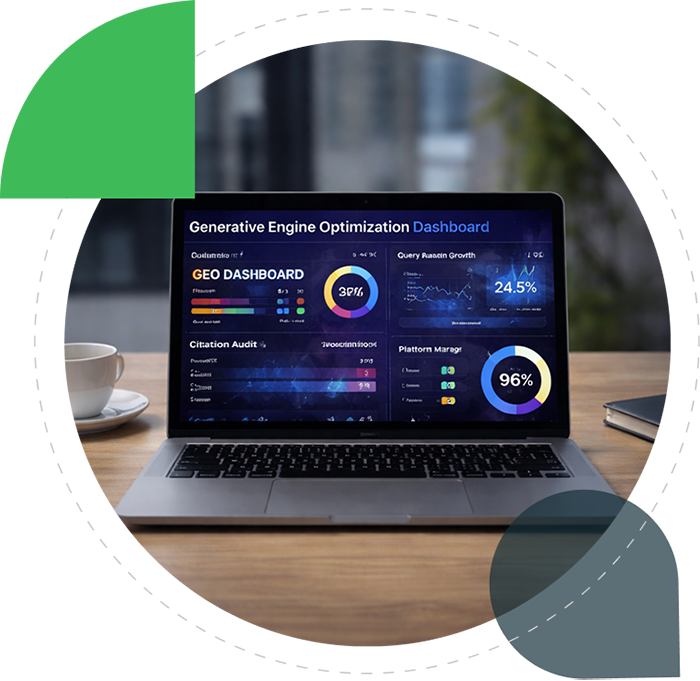
The strategic question: Will you be cited when AI engines field queries in your category?
AI platform usage follows exponential adoption curves. The businesses establishing authoritative presence now benefit from compounding citation momentum—each mention increases likelihood of future citations.
The window for first-mover advantage closes as:
- More competitors recognize GEO’s importance.
- AI platforms refine their citation algorithms.
- Training data sets become increasingly historical (harder to influence).
- Zero-click behavior becomes default user pattern.
Waiting means entering a saturated citation environment where displacement requires significantly more investment than early positioning.
Why We Stand Out

Proprietary GEO Genius Toolset
We’ve built internal software that solves problems standard SEO platforms can’t address. Our GEO Genius suite includes Citation Difficulty Scoring (quantifies competitive intensity for specific AI platform queries), Query Fanout Simulation (models how initial citations expand into related query coverage), and real-time Citation Velocity Tracking across multiple AI platforms simultaneously.

Attribution-First Framework
We’ve built tracking infrastructure that isolates AI-referred traffic and attributes revenue to specific platforms. Most agencies can’t measure this; they celebrate citation mentions without proving business outcomes. Our attribution modeling distinguishes between direct AI referrals, AI-influenced organic search, and baseline traffic, eliminating the attribution ambiguity that makes most GEO “reporting” meaningless.

Technical Depth
Sean Fulford’s team includes specialists who understand both traditional information retrieval and transformer-based language models. This matters because effective GEO requires understanding how LLMs parse, synthesize, and attribute information—knowledge traditional SEO specialists lack. We don’t guess at what might influence AI citations; we analyze retrieval patterns, study tokenization behavior, and reverse-engineer ranking signals from observed citation patterns across thousands of queries. This technical foundation produces strategies that actually move citation frequency rather than cosmetic optimizations that feel productive but generate no results.

Integrated Approach
GEO doesn’t replace traditional SEO; it extends it. We maintain your existing search visibility while simultaneously capturing AI platform traffic.Our methodology identifies synergies; that is, content that serves both traditional SERP rankings and AI platform citations, technical implementations that satisfy both Google’s crawlers and LLM parsing requirements, and measurement frameworks that attribute revenue accurately across all inbound channels.

Sector Specialization
We’ve developed query pattern libraries for dozens of verticals between legal and automotive to hospitality and finance, our experience in pioneering GEO accelerates time-to-results. When you’re not discovering query patterns from scratch, you reach citation traction faster. These libraries represent thousands of hours analyzing how your target buyers actually use AI platforms, this is the difference between generic GEO consulting and domain-specific expertise that produces revenue outcomes in months instead of years.
Flying V Group's Technical Approach
We’ve spent the past 18 months developing GEO frameworks that tie directly to revenue outcomes. Sean Fulford leads a team that’s generated trackable AI-referred revenue for clients in professional services, financial services, and B2B technology.
Our methodology
Phase 1
Citation Audit & Competitive Analysis (Weeks 1-2)
- Current AI platform visibility assessment across target query patterns.
- Competitor citation frequency analysis.
- Entity disambiguation review (ensuring AI correctly identifies your business).
- Content gap analysis for query patterns where you’re absent from AI responses.
Phase 2
Authority Architecture Development (Weeks 3-6)
- Source authority content strategy (depth, breadth, semantic relationships).
- Entity-focused schema implementation.
- Multi-platform presence optimization.
- Attribution signal deployment across owned and earned media.
Phase 3
Response Engineering & Testing (Weeks 7-10)
- Query-specific content optimization for AI synthesis.
- Prompt pattern testing (how users actually query AI platforms).
- Citation monitoring infrastructure deployment.
- A/B testing for citation frequency improvement.
Phase 4
Measurement & Optimization (Ongoing)
- Attribution modeling for AI-referred traffic.
- Conversion rate optimization by platform source.
- Cohort analysis comparing AI-referred vs. traditional search traffic.
- Continuous refinement based on AI platform algorithm updates.
Critical distinction
We measure success by revenue attribution from AI platforms, not citation counts. Most agencies optimize for visibility.
We optimize for P&L impact.
We optimize for P&L impact.
Investment & Timeline Expectations
Realistic timeframe
3-4 months to initial citation traction, 6-8 months to measurable revenue attribution.
GEO demands sustained investment because
- Authority building across AI-recognized sources takes time.
- Algorithm updates require ongoing optimization.
- Competitive dynamics shift as more businesses adopt GEO.
- Multi-platform presence maintenance requires continuous content development.
Typical engagement structure
Months 1-3
Foundation building (citation audit, authority architecture, technical implementation).
Months 4-6
Optimization and scaling (citation frequency improvement, conversion refinement).
Months 7+
Sustained growth and competitive displacement.
Who This Is For
GEO delivers strongest ROI for businesses where
- Purchase decisions involve research phases (professional services, B2B technology, financial services).
- Expertise can be demonstrated through substantial content (domain authority matters for AI citations).
- Sales cycles span weeks or months (AI platforms influence early consideration stages).
Not ideal for
- Pure e-commerce with low transaction values.
- Local-only businesses (unless in highly competitive markets).
- Companies without existing content foundation.
- Businesses seeking immediate results (wrong channel for short-term thinking).
Next Steps
We conduct GEO assessments for businesses that meet our client profile: growth-focused, sophisticated buyers who view marketing as revenue investment rather than expense.
Assessment includes
- Current AI platform visibility analysis.
- Competitive citation audit in your category.
- Revenue opportunity modeling based on query volume and attribution patterns.
- Recommended strategy with timeline and investment requirements.
Schedule a consultation with Sean Fulford’s team. We’ll determine whether GEO represents a strategic opportunity for your business—and if we’re the right partner to execute it.
Schedule a GEO Assessment with Flying V Group Today.
TESTIMONIALS
Trusted By Executives of Premier Business
Take a look at what Owners, Founders, Partners, CEOs, CMO’s, and more are saying about Flying V Group.