

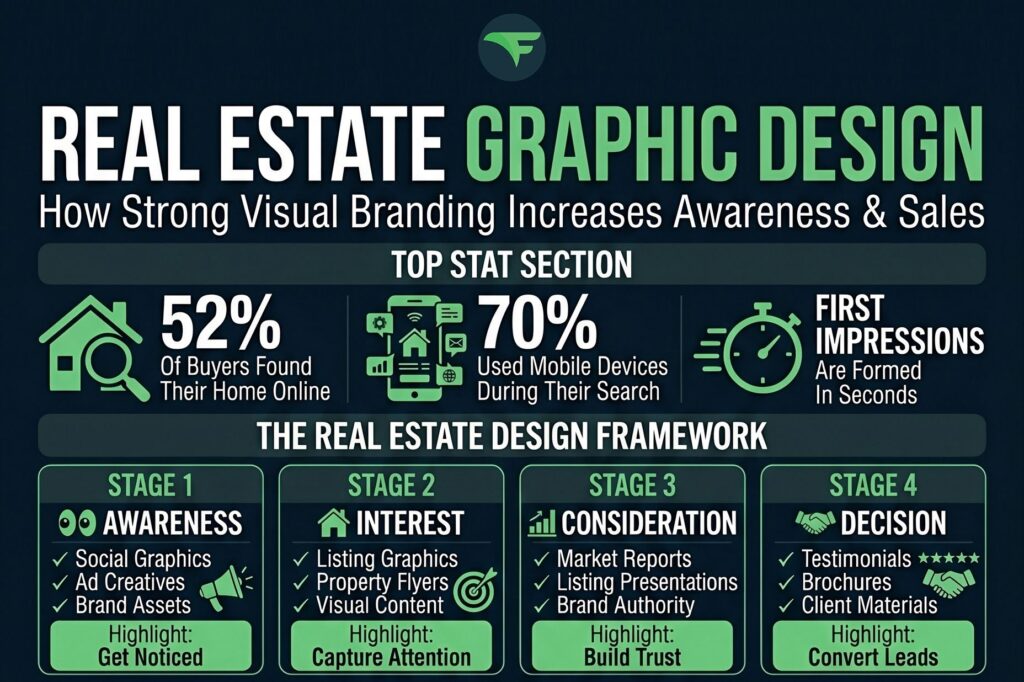
The 2025 NAR Profile of Home Buyers and Sellers reported that 52% of buyers found their home online and 70% used a mobile device or tablet during their search. That means the first impression most buyers have of a property or the agent representing it is visual, digital, and formed in seconds. Graphic design is not a finishing touch in real estate marketing. It is often the difference between capturing a buyer’s attention and losing it to another listing nearby in the search results.
Flying V Group produces creative content and social media marketing that helps real estate professionals build brand recognition and convert more leads. Contact us to see what a visual brand strategy looks like for your market.
Why Branding Sells More Than Properties Alone
Buyers are not only evaluating homes — they are evaluating the agent and brokerage presenting them. Research published in the Asia-Pacific Journal of Management and Technology found that branding significantly influences consumer decisions in real estate purchasing, with buyers factoring in perceived professionalism and trustworthiness alongside the property itself.
This has direct implications for graphic design strategy. An agent with polished, consistent visual materials signals competence before a single conversation happens. An agent with inconsistent, amateur-looking materials signals the opposite — regardless of their actual expertise or track record.
Design Across the Full Buyer Journey
Competitors rarely map design assets to buyer stages. The reality is that different materials serve different moments in the decision cycle:
| Buyer Stage | What They Need | Design Asset |
| Awareness | To discover you exist | Social media graphics, Google Ads creatives |
| Interest | To see what you offer | Listing photos, property flyers |
| Consideration | To evaluate your expertise | Listing presentations, market reports |
| Decision | To feel confident choosing you | Brochures, testimonial graphics |
| Retention / Referral | To remember and recommend you | Client newsletters, community guides |
An agent running strong awareness-stage design but weak decision-stage materials will generate leads they struggle to close. Both ends of the funnel require attention.
The Design Elements That Actually Drive Results
Professional Photography
Property listings with professional photography generate substantially faster and higher-value sales than those relying on phone snapshots. This is not primarily an aesthetic point — it is a search behaviour point. According to NAR, buyers viewed a median of seven homes during their search, spending significant time evaluating listings online before requesting a showing. The listings that earn those showing requests are the ones that stop the scroll.
Professional photography should capture natural light, staging-ready interiors, accurate exterior perspectives, and detail shots of premium features. For higher-value listings, aerial drone photography and twilight exterior shots provide visual differentiation that stock-angle photos cannot.
Colour, Typography, and Visual Consistency
Colour is not decoration — it influences how buyers emotionally experience a brand. Blue signals trust and stability. Green suggests growth and calm. Warm tones create approachability. Agents should select a defined palette and apply it consistently across all materials, from social media graphics to open house signage to email templates.
Typography follows the same logic. Font choices communicate personality: clean sans-serif fonts suggest modernity and accessibility; serif fonts suggest heritage and authority. The critical point is consistency. A brand that uses three different fonts across its materials does not read as a brand.
For brokerages managing multiple agents, visual consistency often matters more than creative originality. Buyers who encounter your brand across multiple touchpoints and recognise it each time are more likely to request a showing or referral conversation.
Layout and Visual Hierarchy
Effective design directs the viewer’s eye toward the information that matters. Research on visual attention confirms that cluttered, unstructured layouts force viewers to work to find key details — and most won’t bother. A well-designed property flyer leads with the image, transitions naturally to price and key features, and ends with a clear contact call-to-action.
The same principle applies to digital assets. A listing on a poorly designed website with slow load times and unclear navigation loses buyers to competing listings that make the decision easier. Web design that prioritises hierarchy, whitespace, and mobile responsiveness directly supports conversion.
The Most Valuable Real Estate Design Assets
Most articles in this category mention logos and flyers. The full inventory of design assets that drives real estate marketing performance is considerably broader:
- Just Listed / Just Sold graphics: High-frequency social media posts that build neighbourhood authority and generate referral conversations
- Listing presentations: The visual collateral that wins seller mandates — often the deciding factor when a seller interviews multiple agents
- Property brochures: Premium printed and digital materials for open houses and direct mail campaigns
- Market reports: Infographic-style data summaries establishing local expertise
- Email templates: Consistent branded templates for drip campaigns, open house invitations, and quarterly market updates
- Community guides: Neighbourhood lifestyle content that positions an agent as a local authority, not just a transaction facilitator
- Social media ad creatives: Platform-specific graphics for Facebook, Instagram, and LinkedIn lead generation campaigns
Each of these serves a distinct function. Treating them as interchangeable or producing them inconsistently undermines the cumulative brand-building effect they should generate together.
Graphic Design and Social Media Performance
The NAR data shows that buyers rely heavily on digital discovery, and social platforms are a primary channel for real estate brand visibility. Carousel posts, Reels thumbnails, neighbourhood spotlight graphics, and agent branding content each require platform-specific design considerations — what performs on Instagram does not translate directly to LinkedIn.
The unifying principle across platforms is that branded, visually consistent posts outperform unbranded content in recall and engagement. An agent whose social presence looks polished and professional over time builds the kind of ambient authority that generates inbound enquiries. An agent posting inconsistently, with no visual brand logic, generates followers but rarely clients.
Social media marketing for real estate professionals should integrate design, posting cadence, and audience targeting as a unified system, not three separate activities.
Measuring What Design Actually Does
The most common gap in real estate graphic design strategy is the absence of any measurement framework. Design investment without tracking produces anecdotal impressions rather than business intelligence.
Metrics worth monitoring by asset type:
| Design Asset | Relevant Metric |
| Social media graphics | Reach, saves, profile visits, DM enquiries |
| Listing presentations | Win rate on seller mandates |
| Property listings | Days on market, showing request rate |
| Email campaigns | Open rate, click-through rate, reply rate |
| Website design | Time on page, contact form submissions |
| Paid ad creatives | Click-through rate, cost per lead |
Tracking these metrics over time reveals which design investments are generating return and which need revision — a discipline that separates professionals treating design as a cost from those treating it as a revenue lever.
Build a Real Estate Brand That Lasts Beyond the Listing
Real estate professionals who invest seriously in graphic design build brands that outlast individual listings. Flying V Group’s creative studio and content marketing teams help agents and brokerages develop visual brand systems that generate consistent recognition and inbound lead flow. Contact us to discuss what that looks like for your business.
Frequently Asked Questions
What is real estate graphic design?
Real estate graphic design refers to the creation of visual marketing materials used to promote properties, build agent and brokerage brand identity, and convert potential buyers and sellers into clients. It encompasses everything from property photography and listing flyers to social media graphics, listing presentations, email templates, and website design.
Why is graphic design important for real estate agents?
Graphic design is important because most buyers begin their property search online, where visual presentation determines whether a listing earns a click or is scrolled past. According to NAR’s 2025 Profile of Home Buyers and Sellers, 52% of buyers found their home online — which means the visual quality of an agent’s marketing materials directly influences how many leads they generate.
Does graphic design help sell homes faster?
Professional photography and well-designed marketing materials contribute to faster sales by generating more showing requests, stronger open house attendance, and higher perceived property value. Listings with professional visual presentation compete more effectively in digital search environments where buyers are comparing multiple options simultaneously.
What graphic design assets does every real estate agent need?
At minimum: professional headshots, branded social media templates, property listing graphics, a Just Listed/Just Sold social series, an email template, and a listing presentation deck. Higher-producing agents and brokerages should also invest in market report infographics, community guides, and platform-specific ad creatives for lead generation campaigns.
What is the difference between branding and graphic design in real estate?
Branding is the strategic identity of an agent or brokerage — the positioning, values, and market personality. Graphic design is how that identity gets expressed visually. Strong graphic design without a clear brand strategy produces polished materials that don’t add up to a recognisable brand. Strong branding without quality design produces a coherent identity that no one notices. Both are required.
How does graphic design improve social media marketing for real estate?
Consistent, well-designed social media graphics increase content recognition, encourage saves and shares, and build the ambient brand familiarity that generates inbound enquiries over time. Buyers and sellers who repeatedly encounter the same polished visual identity across a feed are more likely to contact that agent when they are ready to transact.
Should real estate agents hire a professional designer or use DIY tools?
For template-based content — recurring social posts, market update graphics, email headers — tools like Canva provide sufficient quality for most agents. For strategic brand assets — listing presentations, campaign creatives, brokerage brand systems, high-stakes listing materials — professional design investment produces materially better results. The distinction is between content that maintains a brand and collateral that builds or wins business.