Schaumburg is the largest center of economic development in Illinois outside the City of Chicago, with more than 200 restaurants competing for diners pulled from a 150,000-person daytime population. The village hosts nearly 5,000 businesses, 30 hotels, and a 75,000-resident base whose median household income sits at $104,062, roughly 30% above the U.S. average per the 2024 American Community Survey.
Schaumberg is a high-spending, dense, restaurant-saturated market, and like most places in the States, the restaurants that fill their tables consistently are the ones winning the Google query that happens three minutes before a reservation.
What changed in 2026 is what that query looks like. Google’s AI Overviews now answer “best Italian for a date night near Woodfield” with a direct recommendation drawn from structured restaurant data, review sentiment, and Google Business Profile signals.
According to the OpenTable 2026 Dining Trends Report, 44% of Americans plan to use AI more to discover restaurants and book reservations in 2026. Restaurant marketing in Schaumburg in 2026 means competing in three layers at once: traditional local SEO, paid search, and generative AI visibility. Flying V Group’s restaurant SEO and GEO programs are built to handle all three, and the rest of this guide breaks down how each layer works for Schaumburg operators.
How Schaumburg diners find restaurants in 2026
Inside the broader $1.5+ trillion U.S. restaurant market, the customer journey for an independent restaurant in Schaumburg now runs entirely through local search. In a high-density retail hub defined by the Woodfield corridor and Golf Road sprawl, over 60% of dining searches happen on mobile phones, often by drivers or shoppers making split-second decisions.
It is not trite to repeat the oft-known fact that the difference between stars on a review is the difference between margins. Harvard Business School research by Michael Luca (Working Paper 12-016) finds that a one-star increase in Yelp rating produces a 5 to 9 percent revenue lift for independent restaurants. When local algorithms or AI search tools sort through dozens of competing spots along Golf Road, a fraction of a star is the precise boundary line between a fully booked Friday night and an empty dining room.
Right now, corporate chains are winning because they have full-time teams managing their digital storefronts. We level the playing field. We don’t just ‘manage’ your Google Business Profile; we optimize it to capture the 62% of local diners making split-second decisions on their phones. We handle the review responses, the attribute updates, and the local SEO keywords so you can handle the kitchen.
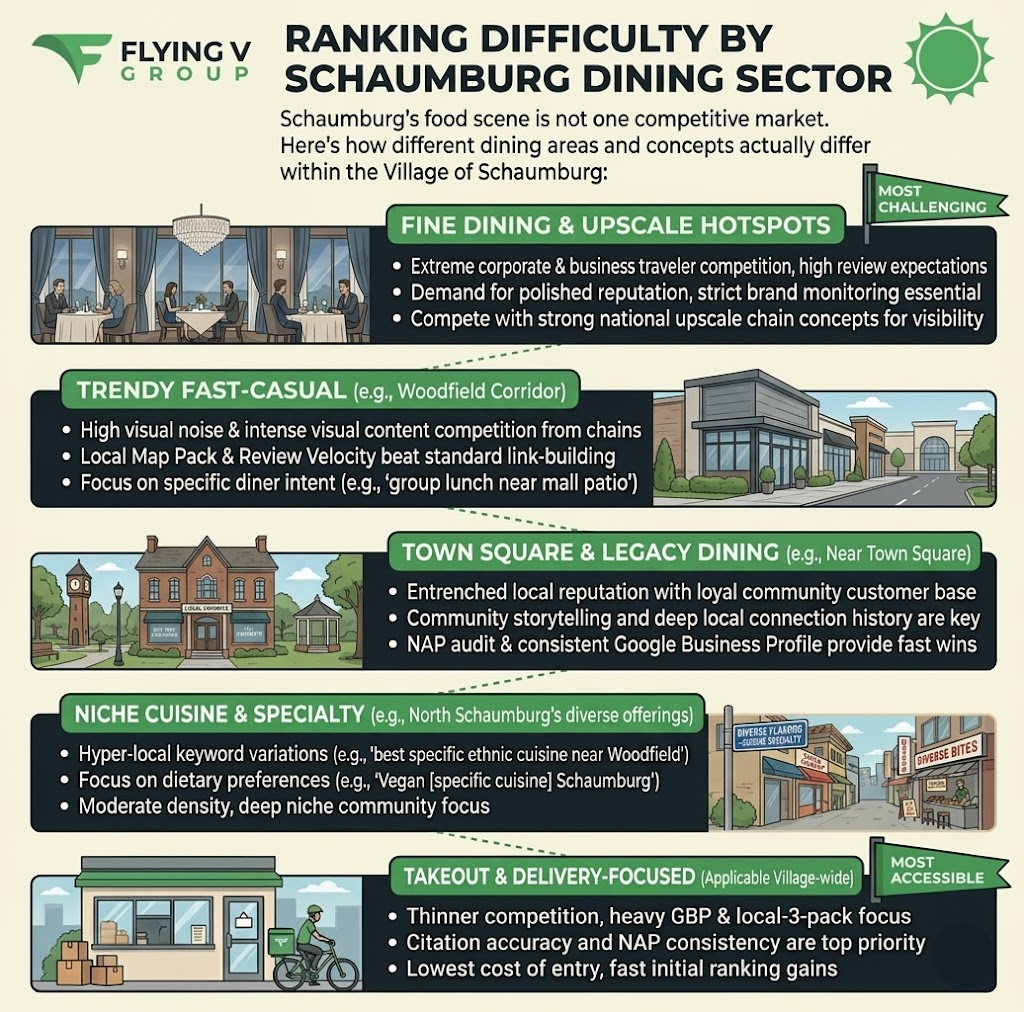
Local SEO: where the Google Map Pack still does the heavy lifting
The Map Pack is the three-pin block of map-pinned local results that appears above traditional organic listings. For “near me” and cuisine-plus-neighborhood queries, it captures most of the click volume in local search. Showing up there requires four things working together: a Google Business Profile with precise category and attribute selection, consistent business citations across third-party directories, location-relevant content on the restaurant’s own site, and structured review velocity.
For Schaumburg restaurants, the keyword surface is more specific than most operators assume. “Best ramen Schaumburg,” “happy hour Streets of Woodfield,” “private dining Northwest Suburbs,” and “Renaissance Convention Center restaurants” each represent a different diner intent at a different moment in the decision cycle. Flying V Group’s SEO services build neighborhood-targeted landing pages, citation cleanup workflows, and review request systems calibrated to each restaurant’s actual diner geography rather than generic city-level keywords.
AI Overviews and generative search: the new layer of discovery
Generative search engines now mediate a meaningful share of restaurant discovery. Google’s AI Overviews synthesize answers from structured data, reviews, and Maps. ChatGPT, Gemini, and Perplexity produce direct recommendations. Google’s general availability release of Grounding with Maps lets AI applications pull live restaurant data, including subjective signals like “vibe” pulled from user reviews, directly into generative answers.
Flying V Group’s GEO program for restaurant clients runs through the GEO Genius toolset under Sean Fulford, our Director of SEO. Citation Difficulty Scoring identifies which AI-cited domains are within reach for a given restaurant’s authority profile. Query Fanout Simulation maps how a single diner query like “best brunch near Woodfield Mall” expands into the multi-source synthesis AI engines now perform.
Our Citation Velocity Tracking measures how quickly a restaurant earns mentions inside ChatGPT, Perplexity, and Google AI Overview answers over time. Combined with Restaurant, Menu, and LocalBusiness schema markup on the restaurant’s own site, the program builds citation eligibility into both traditional search and the generative layer.
Paid search: fast visibility while organic compounds
SEO and GEO are durable but slow. Paid search closes the gap between launch and reservation. A well-structured Google Ads campaign can put a Schaumburg restaurant at the top of results within a day, targeting diners by radius, time of day, device, and search query. Lunch campaigns fire between 11 AM and 1 PM for the corporate crowd flowing out of Woodfield-area offices. Dinner campaigns activate Thursday and Friday afternoons. Weekend brunch promotions hit phones while diners are mid-decision.
Flying V Group is a Google Premier Partner, which per Google’s own program documentation places us in the top 3% of Google Ads partners per country, with team-wide certifications and verified client growth and retention metrics. Our PPC team has managed more than $10 million in ad spend. Given Schaumburg’s $104,062 median household income, upscale and premium-casual concepts in particular tend to find a receptive audience through paid search, where higher-intent queries can be captured directly.
Social media and review velocity: the trust layer that feeds AI recommendations
Instagram and TikTok function as visual search engines for younger diners, particularly business travelers landing for conferences at the Renaissance Schaumburg Convention Center or the surrounding hotel circuit. A restaurant with sharp food photography, active stories, and consistent posts signals freshness before a single fork hits a plate.
The underrated value of social and review consistency in 2026 is that they feed the AI recommendation systems described above. Google’s Grounding with Maps reads review text (not only star ratings) to determine a restaurant’s “vibe” and match it to occasion-specific queries. Reviews mentioning “quiet corner tables,” “great for groups,” or “romantic atmosphere” influence which AI-powered queries a restaurant appears in. Review velocity is no longer only about social proof for human diners. It is direct input into the machine layer of discovery.
What separates a real restaurant marketing partner from a general digital agency
The metrics that determine whether marketing is working for a restaurant do not show up on standard agency dashboards unless someone configures them deliberately. Cover counts. Average check. Reservation conversion rate. Online order volume. Repeat-guest frequency. A partner worth retaining frames the engagement around LTV:CAC ratios and P&L impact rather than impressions or rankings as ends in themselves. When evaluating a culinary marketing partner, the useful questions are which restaurants they currently serve in your category, how they report performance, and how the program ties into your existing reservation, POS, and review platforms.
Ready to build a Schaumburg restaurant marketing program?
If your restaurant is losing the search query that happens minutes before a reservation, the fix is structural and the work compounds. Reach out to the Flying V Group team and we will scope what a restaurant-specific SEO, paid search, and GEO program looks like for your concept, location, and growth model.
Frequently Asked Questions
How long does restaurant SEO take to produce results in a competitive suburban market like Schaumburg?
Most Schaumburg restaurants begin seeing measurable movement in local rankings within three to four months of a structured campaign. Google Business Profile optimization can produce faster Map Pack and call-volume improvements, sometimes inside the first 60 days, while organic content and link building typically compound over six to nine months. Paid search runs in parallel and produces traffic immediately.
How does AI search affect a Schaumburg restaurant’s visibility in 2026?
AI Overviews, ChatGPT, Gemini, and Perplexity now answer a meaningful share of restaurant discovery queries directly, with the recommended restaurants drawn from structured data, review sentiment, and citation signals across the open web. According to OpenTable’s 2026 Dining Trends Report, 44% of Americans plan to use AI more for restaurant discovery this year. Restaurants without Restaurant, Menu, and LocalBusiness schema markup, complete Google Business Profiles, and consistent third-party mentions are systematically less visible in generative answers.
Can paid advertising work for a small independent restaurant in Schaumburg?
Yes. PPC campaigns scale to any budget, and smaller restaurants often outperform chains in paid search because they can target specific, high-intent local queries with less competition. A family-owned Thai restaurant in Schaumburg can run a focused Google Ads campaign around “authentic Thai food Schaumburg” or “Thai restaurant near Woodfield” and capture diners who are already past the browsing phase and ready to book.
How much do Schaumburg restaurants typically spend on digital marketing?
Most established restaurants allocate 3 to 6 percent of monthly revenue to marketing, with growth-stage or newly opened restaurants often running closer to 5 to 10 percent during the early ramp. Specialist restaurant SEO engagements generally start in the low four figures monthly for single-location independents and scale into the mid-to-high four figures for multi-unit work. A credible agency will size the engagement against realistic return projections rather than push a fixed package.
Do online reviews actually move restaurant revenue, or are they a vanity metric?
They move revenue, and the effect is documented. Michael Luca’s Harvard Business School research found that a one-star increase in Yelp rating produces a 5 to 9 percent increase in revenue for independent restaurants, with the effect driven by independents rather than chains. Review velocity and sentiment also feed directly into the Google Maps and AI recommendation systems that now mediate restaurant discovery, which means a strong review program produces a compounding effect across traditional search and the generative layer.
What should I look for when choosing a restaurant marketing partner?
Look for documented case studies with restaurant-specific numbers, vertical experience in your category and price point, and a clear answer to how performance will be reported. Confirm the partner understands your revenue model (single-location independent, multi-unit, fine dining, fast casual) and ask which restaurant clients they currently serve in a comparable Chicago-area market. A partner who frames the engagement around covers, reservations, and order volume rather than impressions and rankings is generally a stronger fit for operators.