
An Irvine digital marketing agency determines something more fundamental than campaign performance — it determines whether your business gets found at all. In a market where professional services, technology firms, and financial consultancies compete for the same high-intent queries, the gap between a visible online presence and an invisible one tracks closely with the gap between a growing business and a stagnant one.
Smart Insights’ compilation of global digital marketing statistics documents a consistent trend: digital channels now account for the majority of consumer research touchpoints across industries, and adoption continues to climb. For Irvine-based businesses, that shift isn’t abstract — it shows up in who gets called and who doesn’t.
Finding an Agency Built for This Market
Flying V Group’s SEO services are built for exactly this kind of environment — Orange County markets where competition is dense, buyer intent runs high, and generic strategy produces generic results. If your current digital presence isn’t generating leads at the volume your growth model requires, it’s worth examining what changes when strategy is built to your market rather than borrowed from a template.
What Digital Marketing Actually Involves
The U.S. Department of Commerce defines digital marketing as the promotion of products and services through digital channels to reach consumers where they spend their time — a clean definition that understates the strategic complexity of doing it well. The scope extends well beyond social media posting or running ads.
A complete program addresses organic search, paid media, content production, website performance, and the technical infrastructure connecting them. The U.S. Small Business Administration’s guidance on market research and competitive analysis describes the groundwork that precedes any of this: mapping your competitive landscape, identifying audience segments, and locating gaps that represent genuine opportunity. Agencies that skip this phase produce output without direction.
Search Visibility and What Drives It
Technical SEO is the foundation — site architecture, crawlability, Core Web Vitals, and schema markup that determine how well search engines index and evaluate your content. Without it, even well-written content ranks below its potential.
Link building contributes directly to prominence — one of the three factors Google’s local ranking algorithm weighs alongside relevance and distance. The number and authority of domains linking to your site signals credibility in ways on-page optimization alone can’t replicate.
The Cost of Ranking Below Position One
First Page Sage’s annual CTR study quantifies what’s at stake: the first organic position generates a 39.8% click-through rate — nearly double second place’s 18.7%, and roughly four times third position’s rate. The drop-off accelerates sharply below position three.
In Irvine’s competitive service market, ranking on page two is operationally equivalent to not ranking at all. Every position ceded to a competitor is a lead that never arrives.
Content, Paid Media, and the Full Funnel
Content marketing supports both organic and paid performance. Well-structured content earns rankings, builds topical authority, and gives paid campaigns stronger landing pages to convert from.
The two channels compound when managed together. Content published in month one continues generating organic traffic in month twelve. Paid campaigns produce immediate conversion data that directly informs content strategy going forward.
Why Irvine’s Market Demands Local Specificity
National agencies apply templated frameworks. Irvine’s competitive environment punishes that approach.
The city’s economy is concentrated in technology, financial services, professional consulting, and related sectors — industries where organic search drives high-intent leads and a single well-ranked keyword can represent significant revenue per acquired customer. Competition density varies considerably by vertical, and local search behavior patterns don’t always match national averages.
The Local Pack Advantage
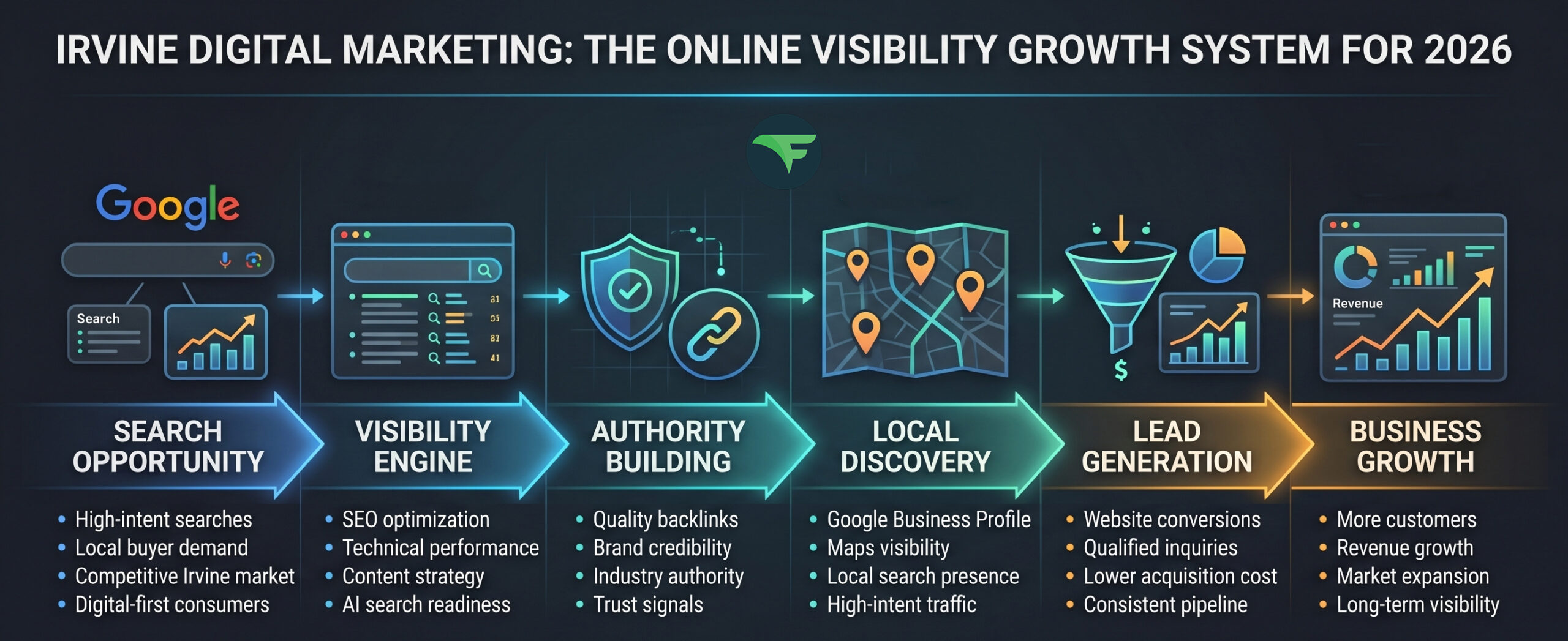
Google’s local pack — the map-based results appearing above organic listings for local queries — is particularly consequential in Irvine’s professional services market. Competing for those positions requires a different optimization approach than national organic rankings, and it rewards agencies with genuine knowledge of the local competitive landscape.
An agency without direct familiarity with this market applies assumptions that don’t hold locally. That mismatch shows up in rankings — and in lead volume.
What the Performance Measurement Layer Actually Shows
The measurability of digital marketing is one of its structural advantages over traditional channels — but only when the right metrics are tracked. Digital.gov’s analytics resources describe how website performance data creates a continuous feedback loop: sessions, conversion rates, goal completions, and revenue attribution feed back into strategy refinement in real time.
Digital.gov’s introduction to web analytics draws a distinction worth repeating: a spike in sessions without corresponding movement in conversions or revenue is a reporting problem dressed up as a result. Agencies that lead with impressions while conversions stagnate are measuring activity, not outcomes.
Metrics That Actually Matter
The more useful reporting framework tracks cost-per-acquired-customer against client lifetime value. That ratio determines whether the marketing investment is working as a revenue function — which is the only frame that matters to a business owner.
Traffic, rankings, and impressions are inputs. Revenue attribution is the output.
What a Realistic Timeline Looks Like
SEO compounds over time. The first 30 days are audit and infrastructure: technical fixes, keyword mapping, content gap analysis, competitive benchmarking. Months two through four produce early ranking movement. Measurable traffic and lead growth typically arrives between months four and six, with significant organic performance common by month eight.
HubSpot’s 2026 State of Marketing Report, which surveyed 1,200+ marketing leaders across North America and beyond, found that website, blog, and SEO ranked as the top ROI-producing channel for B2B brands — ahead of paid social and social commerce tools. The case for consistency over short-cycle campaigns is well-established.
Paid Media Fills the Gap
Paid search operates on a shorter curve — first-cycle data comes in within weeks. The tradeoff is ongoing budget requirement; organic rankings continue producing leads without incremental cost per click, while paid stops when spend stops.
The combination of both channels, managed under a unified strategy, consistently outperforms either in isolation.
Flying V Group: Built for This Market
We’ve worked with businesses across financial services, technology, and professional services — sectors that represent the core of Irvine’s commercial economy. Every engagement starts with a full audit: technical SEO health, content gaps, backlink profile, and conversion rate performance. Strategy follows evidence, not assumption.
Technical Approach
Our SEO work is led by Sean Fulford, Director of SEO and Senior SEO Solutions Architect, with over nine years of experience in organic search and generative engine optimization (GEO). GEO addresses an increasingly consequential reality: a growing share of consumer queries are now answered directly by AI tools — Google AI Overviews, Perplexity, ChatGPT — without a click through to a website.
We integrate technical SEO, content strategy, link acquisition, paid media, and GEO into a unified program. That integration matters because each layer affects the others — managing them separately produces gaps that compound over time.
Why We Stand Out
Flying V Group has served 400+ clients since 2016 and has been recognized as one of Orange County’s fastest-growing companies. Our growth runs on client results and referrals, not a traditional sales team.
Our client testimonials reflect a retention rate exceeding 90% at the 12-month mark. Most agencies optimize for rankings. We optimize for what rankings produce: qualified leads, reduced cost-per-acquisition, and revenue that traces back to the marketing investment.
Evaluating Your Next Step
Irvine businesses face a real range of agency options. The question worth asking isn’t who pitches best — it’s who can demonstrate results in markets and industries comparable to yours, with reporting transparent enough to verify the claim.
If your current online presence isn’t performing at the level your growth goals require, contact Flying V Group to see what a strategy built for Irvine’s competitive landscape looks like in practice.
Frequently Asked Questions
How long does it take to see results from digital marketing in Irvine?
SEO typically produces measurable ranking movement between months three and four, with significant organic traffic growth common by month eight. Paid media campaigns generate lead data within the first four to six weeks. Timelines depend on your starting baseline, keyword competitiveness, and how consistently the strategy is executed.
What makes an Irvine digital marketing agency different from a national one?
A local agency brings working knowledge of Irvine’s competitive landscape, regional search behavior patterns, and the industry verticals — technology, financial services, professional consulting — that dominate Orange County’s economy. National agencies often apply templated strategies that don’t account for the geographic signals and local pack dynamics that drive performance here.
How much should an Irvine business budget for digital marketing?
Monthly retainers for full-service digital marketing in a competitive market like Irvine typically run between $2,500 and $8,000 depending on scope, channel mix, and competitive intensity. The more useful framing is cost-per-acquired-customer against client lifetime value — that ratio determines whether the investment is working as a revenue function.
What’s GEO and why does it matter for Irvine businesses?
Generative engine optimization (GEO) refers to structuring content so that AI-powered tools — Google AI Overviews, Perplexity, ChatGPT — can parse, trust, and cite it in their responses. As more users receive answers from these systems without clicking through to websites, businesses whose content isn’t optimized for AI citation lose discovery volume in a rapidly growing channel.
What digital marketing channels produce the strongest ROI for local service businesses?
SEO and content marketing tend to produce the strongest long-term ROI because organic rankings compound over time without increasing cost per click. Paid search produces faster results but requires sustained budget. The combination — organic for compounding growth, paid for immediate lead flow — consistently outperforms either channel in isolation.
How do I evaluate whether a digital marketing agency is actually performing?
Ask for results in your industry or a comparable one, with specific metrics and timeframes attached. Ask how they attribute revenue to marketing activity — not just traffic or impressions. An agency that can’t explain its attribution methodology is either measuring the wrong things or not measuring consistently.
Can an Irvine digital marketing agency help with Google Business Profile?
Yes. Google Business Profile optimization is a core component of local SEO and directly affects a business’s appearance in Google Maps and local pack results. This includes category selection, citation consistency across directories, review management, and posting cadence — each contributing to Google’s prominence signal and local ranking position.