
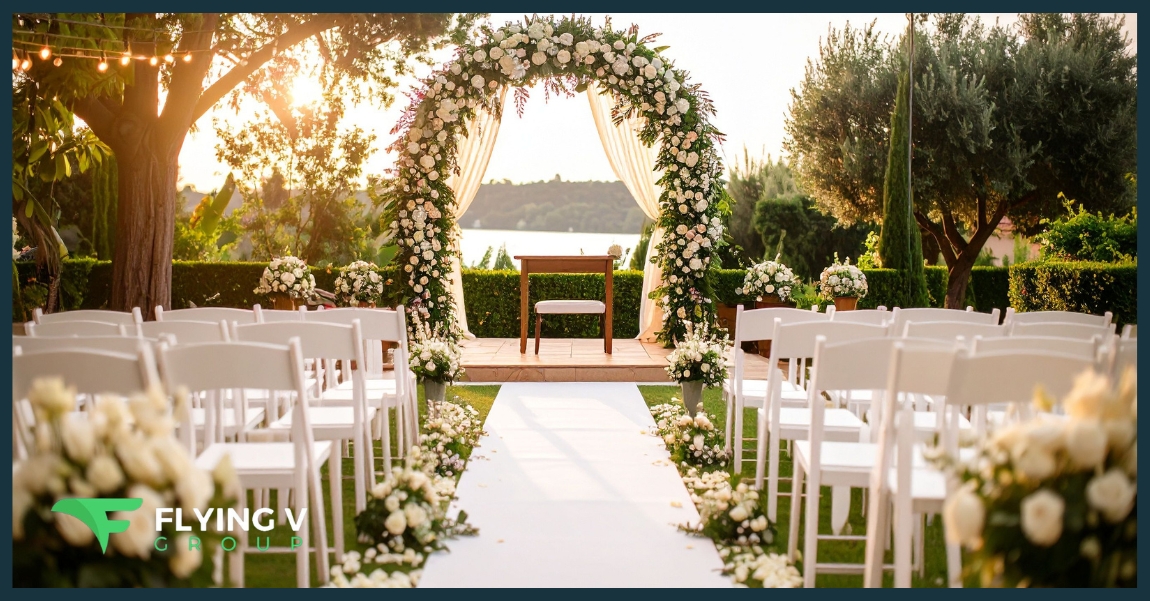
The venues generating consistent tours and bookings aren’t always the most expensive or the most well-known — they’re the ones couples actually find during the planning process. The Knot’s 2024 Real Weddings Study puts the average U.S. wedding cost at $33,000, with venue fees as the largest single line item. That’s a high-consideration purchase made almost entirely through online research.
Academic research on SEO implementation across venue websites documents widespread failures in basic optimization — missing schema, unoptimized gallery pages, thin location content — creating a significant opportunity for venues willing to do the work competitors aren’t. Flying V Group’s full-service digital programs are built around capturing that opportunity for venues that compete on digital infrastructure, not luck.
How Couples Actually Search for Wedding Venues
Understanding how couples find venues is the foundation of every SEO decision a venue owner makes. Couples rarely search by venue name. They search by style, geography, and experience — often starting on Pinterest to collect aesthetic inspiration, then moving to Google to find venues that match what they’ve envisioned.
Location-aware venue discovery research confirms that proximity, convenience, and contextual relevance drive venue selection — which is why searches like “outdoor wedding venue near me,” “rustic barn venue in Texas,” and “lakefront wedding venue upstate New York” dramatically outperform generic searches like “wedding venue.” Seasonal timing matters too: engagement announcements spike after the holidays, meaning January and February represent peak research windows for summer and fall weddings, often 14–18 months out.
The search patterns venues need to own break into four categories:
- Style + location: “boho outdoor wedding venue Colorado,” “industrial loft wedding venue Chicago”
- Budget modifiers: “affordable all-inclusive wedding venue,” “luxury estate wedding [state]”
- Occasion type: “micro wedding venue,” “elopement venue with officiant”
- Destination: “vineyard wedding venue Napa,” “beach wedding venue Gulf Coast”
Brides’ wedding planning timeline research documents that most venue research happens 12–18 months before the wedding date — meaning the content that introduces couples to a venue must exist well before they’re ready to schedule a tour.
Why SEO Beats Directory Dependence
Most venues generate the majority of their inquiries through platforms like The Knot, WeddingWire, and Zola. That’s a fragile position. Platform algorithms change, subscription costs increase, and every listing places a venue side-by-side with direct competitors on a comparison grid that makes differentiation nearly impossible.
WeddingWire’s newlywed report documents that couples discover venues through multiple channels simultaneously — search engines, social platforms, directories, and photographer referrals. Venues that own their presence across multiple touchpoints reduce platform dependency while building an audience no algorithm change can eliminate.
SEO Builds What Directories Can’t: Owned Visibility
SEO builds visibility that compounds rather than resets. A venue’s ranking for “rustic wedding venue in [region]” doesn’t stop generating inquiries the moment a subscription payment lapses. The venues consistently filling their calendars treat directory listings as one channel among many, not the primary growth mechanism.
Local SEO and Google Maps: Where Bookings Begin
Research on venue selection behavior establishes that couples make venue shortlists based on proximity, accessibility, and the immediate visual impression a venue creates — often before reading any descriptive content. Google Maps is where that shortlisting starts.
A complete Google Business Profile lists “Wedding Venue” as the primary category, adds secondary categories for available spaces, includes capacity and pricing data, and uploads photos within the last 30 days. Review velocity directly influences map pack placement — a venue with 20 new reviews in 90 days consistently outranks one with 200 older reviews that stopped accumulating.
What to Do This Week
The highest-leverage, lowest-effort local SEO actions most venues haven’t completed:
- Set the correct primary GBP category (“Wedding Venue,” not “Event Venue”)
- Upload 5–10 new ceremony or reception photos with keyword-relevant file names
- Respond to every unresponded review
- Build or claim listings on WeddingWire, The Knot, Junebug Weddings, and local wedding planning directories
- Ensure NAP (name, address, phone) is identical across every listing
Visual SEO: The Unfair Advantage for Wedding Venues
No business category benefits from visual search optimization more than wedding venues. Couples make their initial venue shortlist based almost entirely on aesthetic response — which means venues whose photography is properly indexed and discoverable have a structural advantage that no amount of written content can replicate.
Pinterest Business trend data documents that Pinterest functions as a search engine for engaged couples building mood boards — often months before they contact a single venue. Venues with keyword-optimized Pinterest boards (“Rustic Barn Weddings,” “Outdoor Ceremony Ideas,” “Pacific Northwest Wedding Venues”), consistent pin uploading from styled shoots, and geo-tagged real wedding content generate evergreen discovery traffic that’s entirely separate from Google search.
Image SEO Fundamentals
Google’s image search documentation establishes the indexing signals that surface venue photography in Google Images — a meaningful discovery channel most venues ignore entirely.
The practical implementation: rename gallery images with descriptive file names (“garden-ceremony-venue-charleston-sc.jpg” rather than “IMG_4892.jpg”), write keyword-relevant alt text, add photography to the XML sitemap, and use WebP format for fast loading. Styled shoots with local photographers and florists generate backlinks from vendor blogs — building local authority while filling the gallery with content that performs across Pinterest, Instagram, and Google Images simultaneously.
Our social media marketing programs for venues coordinate this content across platforms — ensuring styled shoot imagery performs as discovery content on Instagram and TikTok as well as an SEO asset on the venue website.
Your Website as a Booking Machine
Experiential marketing research documents that wedding venue bookings are driven primarily by emotional visualization — the moment a couple sees themselves getting married in a space. A venue website’s job is to create that moment early and reduce every friction point between that emotion and an inquiry submission.
Our website design programs for wedding venues prioritize: inquiry forms visible without scrolling on mobile, gallery pages organized by season and style (not just venue area), pricing transparency that pre-qualifies couples before they inquire, and testimonials placed immediately before consultation CTAs. The venues generating the highest inquiry-to-tour conversion rates from organic traffic share a common pattern — they make it emotionally easy and logistically effortless to say “I want to see this space.”
Schema Markup for Visibility and Events
Google’s structured data documentation for events enables venue open houses, bridal showcases, and wedding expos to generate rich results in search — displaying event dates, registration links, and location data directly in Google Search. LocalBusiness and WeddingVenue schema communicate capacity, style, pricing ranges, and service area to Google’s systems and to the AI models that generate local venue recommendations.
Schema isn’t complicated to implement, but most venue websites haven’t done it — which means every venue that does immediately differentiates itself in the technical signals that determine AI search visibility.
Content Strategy for the Planning Timeline
Couples searching “how to choose a wedding venue” aren’t ready to book a tour. They’re 14 months out and still figuring out what they want. The venue that answers that question with genuinely useful content becomes familiar — and familiarity dramatically increases the likelihood that a couple will shortlist a venue when they’re ready to commit.
Our content marketing programs for wedding venues map content to each planning stage: early-stage guides that introduce the venue (“10 questions to ask before touring”), mid-stage content that moves couples toward inquiry (“what’s included in our package”), and late-stage content that builds confidence before signing (“real wedding stories,” “our spaces in every season”). Each piece builds Google authority while serving the couple’s actual planning needs.
How Wedding Venue SEO Generates ROI
A single additional wedding booking generates $8,000–$20,000 in venue revenue — and one additional inquiry per week from organic search, converting at even a modest tour-to-booking rate, produces annual revenue that makes most SEO investments look conservative.
Our work with hospitality and event-focused clients shows a consistent pattern: venues that invest in foundational SEO infrastructure build ranking authority that continues generating bookings years after the initial investment. The organic channel doesn’t charge per inquiry, doesn’t reset when a subscription lapses, and builds compounding authority that paid directory listings never produce.
GEO and AI Visibility: The Emerging Booking Channel
Google AI Overviews, ChatGPT, and Perplexity increasingly answer “best outdoor wedding venues near [city]” queries with AI-generated venue recommendations before a couple visits any website. Venues that appear in those outputs share consistent signals: complete and active GBPs, venue-specific schema, structured FAQ content, and authoritative real wedding content with verifiable location and style data.
GEO is still an emerging priority compared to Google Maps and organic search — but venues building those structural signals now will have a meaningful advantage as AI-generated discovery grows. Director of SEO Sean Fulford leads FVG’s GEO programs for hospitality clients, structuring venue content for both traditional search and AI extraction simultaneously.
The Venues That Fill Their Calendars Built Their Digital Presence First
Calendar fill, peak season demand, and inquiry volume are the outcomes. SEO, visual content, and conversion optimization are the infrastructure that produces them. Venues that treat digital marketing as a year-round investment rather than an off-season task consistently outperform those that spin up campaigns when the calendar looks thin.
If your venue is ready to build that infrastructure, get in touch with our team to discuss what a booking-focused digital strategy looks like for your space and market.
Frequently Asked Questions
How long does wedding venue SEO take to start generating bookings?
Most venues see measurable improvement in local pack rankings within 60 to 90 days of structured optimization. Given that couples book 12–18 months in advance, SEO investment made now generates bookings for the next one to two wedding seasons.
What’s the most important GBP optimization for a wedding venue?
Primary category precision — “Wedding Venue” rather than “Event Venue” — is the highest-leverage single change, unlocking placement in category-filtered searches that generic listings miss. Photo freshness and active review responses compound the visibility gain over time.
Should venues still pay for The Knot and WeddingWire listings alongside SEO?
Yes — directories supplement SEO rather than replace it. The strategic shift is treating them as one channel among many rather than the primary booking source, so a platform algorithm change doesn’t eliminate the majority of a venue’s inquiry volume.
How do styled shoots help with SEO?
A single styled shoot generates backlinks from photographer and vendor blogs, fresh gallery content optimized for Google Images, and Pinterest-ready imagery — producing 20–40 pieces of linkable, shareable content that performs across search and social for years.
What’s the ROI of wedding venue SEO compared to paid advertising?
Paid advertising stops generating leads the moment spend stops; SEO builds ranking authority that continues compounding. For venues where a single booking generates $8,000–$20,000+, a sustained SEO program consistently outperforms equivalent paid media spend over a 12-to-18-month horizon.
How do venue websites reduce inquiry friction?
The most common friction points are forms buried in subpages, missing pricing transparency, and slow-loading galleries that cause abandonment before emotional engagement. Fixing any one of these converts a meaningful percentage of existing traffic into inquiries without increasing marketing spend.
How often should wedding venues update their website galleries?
At minimum after each wedding season — spring, summer, fall, and winter — to capture seasonal search queries and maintain the visual freshness that affects both Google’s activity signals and the emotional impression couples form on first visit.