
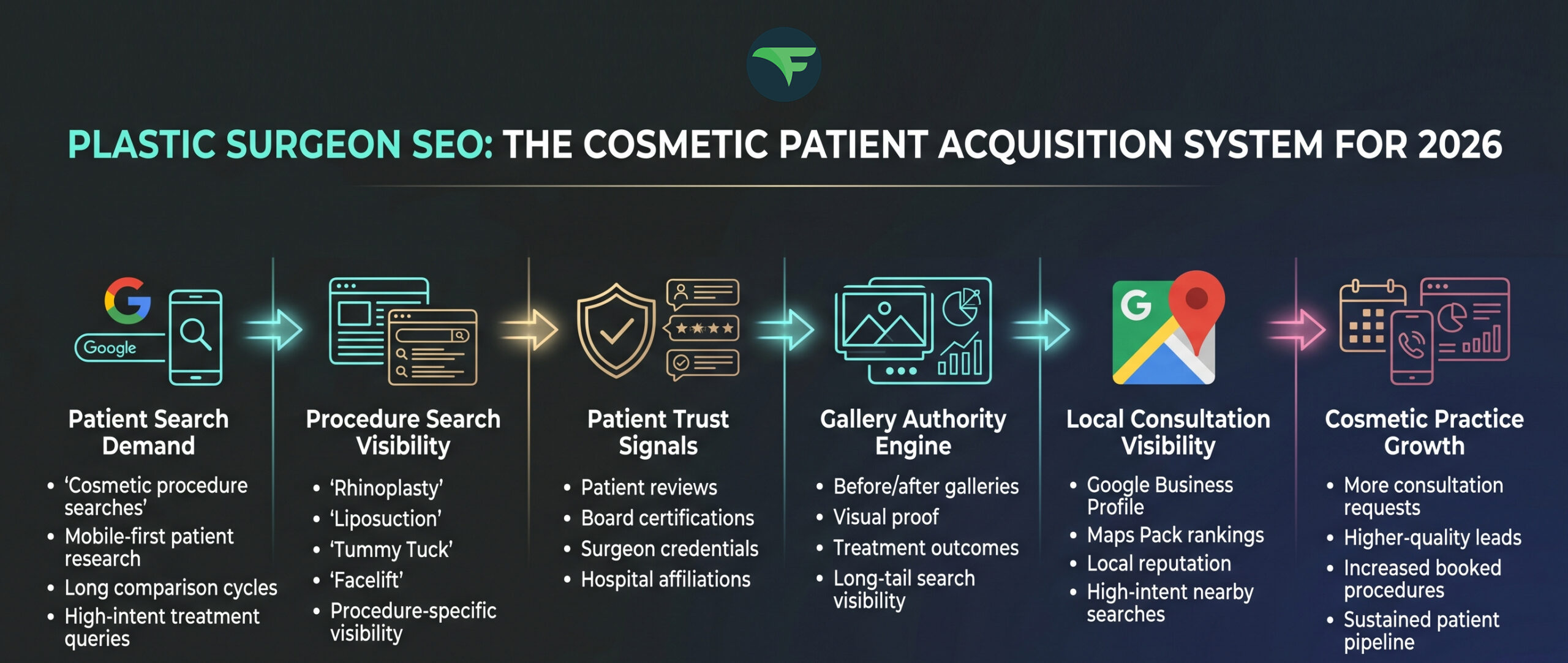
Plastic surgeon SEO occupies a category most digital marketing frameworks aren’t built for. Prospective patients don’t book rhinoplasties or body contouring procedures the way they purchase products — they research for weeks or months, comparing surgeons, studying reviews, and building trust long before submitting a single inquiry.
A systematic review published in the Aesthetic Surgery Journal Open Forum found that social media has become a critical tool for plastic surgeons, facilitating patient engagement, peer-to-peer education, and public outreach — confirming that digital presence directly shapes how prospective patients discover and evaluate practices before ever making contact.
Where SEO Fits in Patient Acquisition
Flying V Group’s SEO services are built around this dynamic: turning search visibility into booked consultations, not just traffic. If your practice ranks for the right procedures but isn’t converting those visitors into inquiries, it’s worth examining where the funnel breaks down — and what a strategy built around patient acquisition, rather than rankings as an end goal, actually changes.
How Patients Find Plastic Surgeons Online
Cosmetic surgery patients don’t make impulsive decisions. The Library of Congress consumer research guide draws on government and academic data sources that document how consumers evaluate service providers — a pattern that maps directly to cosmetic surgery: extended comparison periods, heavy reliance on online sources, and final decisions driven by perceived credibility rather than proximity alone.
That research phase typically starts with Google, moves through review platforms and before/after galleries, and ends with a direct call to the practice the patient trusts most.
The Digital Patient Journey
Search is the entry point. Queries like “rhinoplasty near me,” “best plastic surgeon Orange County,” and “liposuction cost” come from patients who already know what procedure they want. They aren’t in discovery mode — they’re in selection mode, evaluating which practice earns their business.
Review platforms, social profiles, and procedural content are the trust filters that narrow that shortlist. The practice that owns the most of these touchpoints across the patient journey captures the most consultations — regardless of who has the largest ad budget.
SEO Strategies That Drive High-Intent Traffic
Not all search traffic carries equal conversion potential. The U.S. Small Business Administration’s guidance on market research and competitive analysis makes the underlying logic clear: identifying which audience segments are closest to conversion determines where to focus strategy first. In plastic surgery SEO, that means mapping keyword intent rather than chasing raw search volume.
First Page Sage’s annual click-through rate study documents that position one captures 39.8% of organic clicks — almost double second place’s 18.7%. Ranking for the right keywords, at the right position, is what determines whether those clicks become inquiries.
Keyword Intent Mapping
Informational queries (“is rhinoplasty safe?”) attract early-stage researchers. Commercial queries (“rhinoplasty cost Irvine”) indicate a patient actively comparing options. Transactional queries (“book rhinoplasty consultation”) signal readiness to act.
A practice optimizing only for informational traffic captures interest without capturing consultations. Procedure-specific pages built around commercial and transactional intent are where inquiry volume lives.
Local SEO and the Maps Pack
Google’s local pack — the map-based results appearing above organic listings — drives a disproportionate share of inquiries for cosmetic practices. A patient searching “best plastic surgeon near me” is often hours from booking. Ranking there demands optimization of relevance, distance, and prominence — the three signals Google’s local algorithm weighs.
Link building contributes directly to prominence. Google Business Profile optimization — accurate category selection, consistent NAP citations, review volume, and regular posting — handles the rest. For practices with strong reputations not yet capturing local search demand, this is frequently the highest-leverage SEO investment available.
Turning Traffic Into Consultation Requests
Traffic without conversion produces dashboards, not revenue. Content marketing is the connective tissue between search visibility and booked consultations: procedure pages, patient education articles, and FAQ content that reduce objections and establish authority before a visitor decides whether to reach out.
Calls convert at significantly higher rates than form submissions in this vertical. Practices that make phone contact frictionless — prominent numbers, click-to-call on mobile, no buried contact flows — consistently generate higher inquiry volume from equivalent traffic than those relying on forms alone.
Trust Signals That Move Patients to Act
High-ticket, emotion-driven decisions require more than a contact button. Board certifications, detailed surgeon bios, hospital affiliations, and procedure-specific outcome information all contribute to the credibility that closes the gap between a site visit and a consultation request.
The patient isn’t just evaluating outcomes — they’re evaluating whether they trust the person performing the procedure. Every trust signal on the page either shortens or extends that decision timeline.
Before/After Content and Gallery SEO
Visual proof is among the most persuasive content formats in this vertical. Optimized before/after galleries — with proper image compression, descriptive alt text, and procedure-specific file naming — serve both patient trust and search engine indexing simultaneously.
A gallery page optimized for “rhinoplasty results Orange County” or “tummy tuck before and after Newport Beach” functions as a conversion tool and a source of long-tail organic traffic. Most practices treat galleries as static assets. Treating them as indexed, keyword-rich content pages is one of the clearest SEO gaps in this category.
Measuring What Actually Drives Inquiries
Digital.gov’s analytics resources describe how website performance data creates a feedback loop that drives ongoing optimization — sessions, conversion rates, goal completions, and call volume all feeding back into strategy in real time.
Digital.gov’s introduction to web analytics draws the critical distinction: traffic metrics are inputs, inquiry volume is the output. A practice generating 5,000 monthly sessions at a 1% conversion rate is solving a different problem than one generating 900 sessions at 6%.
The Metrics That Matter for Cosmetic Practices
The most useful reporting framework tracks organic sessions by procedure page, conversion rate per landing page, call volume by traffic source, and cost-per-inquiry across channels. These metrics tell you which content is earning consultations and which is just earning clicks.
Flying V Group: Built for High-Ticket Patient Acquisition
We’ve worked with practices in professional services and high-ticket consumer categories — markets where trust drives conversion and long decision cycles demand a fundamentally different SEO approach than commodity industries. Every engagement starts with a full audit: technical SEO health, content gaps, local pack positioning, and conversion performance across procedure pages.
Technical Approach
Our SEO work is led by Sean Fulford, Director of SEO and Senior SEO Solutions Architect, with over nine years of experience in organic search and generative engine optimization (GEO). GEO matters for plastic surgery practices because a growing share of patient queries are now answered directly by AI tools — Google AI Overviews, Perplexity, ChatGPT — without a click through to a website. Practices whose content isn’t structured to be cited by those systems are losing discovery volume in a channel that grows every quarter.
We integrate technical SEO, content strategy, local optimization, link acquisition, and GEO into a unified program rather than isolated service lines. In a trust-driven vertical, every layer reinforces the others.
Why We Stand Out
Flying V Group has served 400+ clients since 2016, earned recognition as one of Orange County’s fastest-growing companies, and grows primarily through client results and referrals rather than a traditional sales team. Our client testimonials reflect a 12-month retention rate above 90%.
Most agencies track rankings. We track what rankings produce: inquiry volume, consultation bookings, and revenue tied directly to the marketing investment.
Evaluating Your Next Step
Plastic surgery practices evaluating SEO agencies face a wide range of options. The question that cuts through the pitch: can they show you what happened to consultation volume for a comparable practice, with specific metrics and a traceable timeline?
If your current SEO investment isn’t producing measurable inquiry growth, contact Flying V Group to see what a patient acquisition strategy — built around cosmetic procedure search, not generic rankings — looks like for your practice.
Frequently Asked Questions
How long does plastic surgeon SEO take to produce more consultations?
SEO for cosmetic practices typically produces measurable ranking movement within three to four months, with inquiry growth becoming visible by months five to seven. Competitive procedure keywords in dense metro markets may take longer to break through. Practices combining SEO with a well-optimized Google Business Profile often see local inquiry volume increase faster than organic rankings alone.
What keywords should a plastic surgery practice prioritize first?
Commercial and transactional keywords — those indicating a patient actively comparing costs or ready to book — produce the highest consultation conversion rates. Procedure-specific terms like “rhinoplasty cost [city]” or “liposuction consultation [region]” typically outperform broad informational terms for inquiry volume, even at lower search volumes.
How important is Google Business Profile for cosmetic surgery inquiries?
Extremely. Google Business Profile directly controls whether a practice appears in the local Maps Pack — the results that appear before organic listings for location-based queries. Optimizing it for the right procedure categories, maintaining consistent citations, and generating regular reviews are all factors in local pack ranking and are among the fastest ways to increase inquiry volume.
What’s the difference between SEO and paid ads for plastic surgeons?
Paid search (PPC) produces faster visibility but stops generating leads when spend stops. SEO builds compounding organic traffic that continues producing inquiries without incremental cost per click. For most cosmetic practices, the most effective strategy combines both: paid campaigns for immediate lead flow while organic rankings develop over six to twelve months.
How do online reviews affect plastic surgeon SEO performance?
Reviews contribute to the prominence signal in Google’s local ranking algorithm and are a direct conversion factor for prospective patients comparing practices. Practices with a higher volume of recent, detailed reviews consistently outperform those with older or thinner review profiles in local pack results. A structured approach to review generation — not just passive collection — compounds this advantage over time.
What should a well-optimized plastic surgery procedure page include?
A high-performing procedure page addresses the full range of patient questions: candidacy criteria, what the procedure involves, recovery timeline, expected outcomes, and cost range. It should include original before/after imagery with properly optimized alt text, a clear inquiry CTA above the fold, and structured data markup where applicable. Pages that answer patient questions thoroughly tend to rank for more long-tail queries and convert at higher rates.
Should before/after photo galleries be optimized for search engines?
Yes — and most practices don’t do this. Each gallery image should have a descriptive file name (e.g., rhinoplasty-results-newport-beach.jpg) and alt text describing the procedure and result. Gallery pages built around specific procedures and locations can rank for long-tail queries and serve as both an SEO asset and a patient trust signal simultaneously.