
By Sean Fulford, Director of SEO and Senior SEO Solutions Architect at Flying V Group.
Finding the right local SEO expert in 2026 is harder than it looks. The SERP is full of generalists who optimize one Google Business Profile at a time, deliver map pack rankings for a single location, and call it a win.
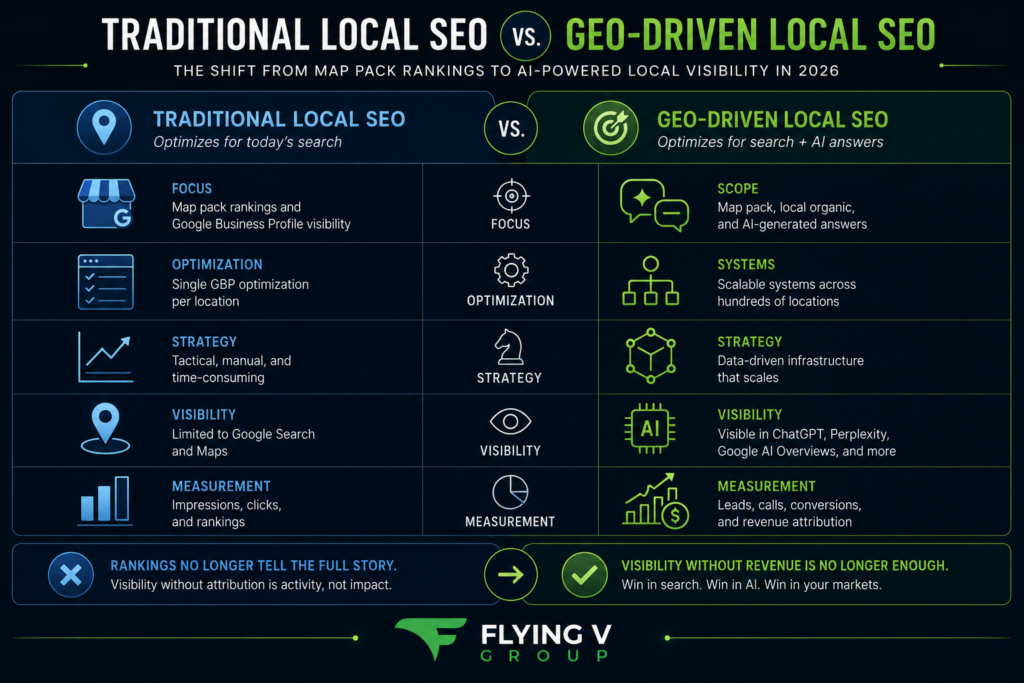
That approach does not scale. AI referral traffic grew more than sevenfold year-over-year in 2025 as ChatGPT, Perplexity, and Google AI Overviews now field local queries directly with no click required.
The brands appearing in those answers are not always the ones ranking in the map pack. A local SEO consultant who has not built a GEO framework for location-level entity signals is already behind.
The market has split into two categories. The first: consultants who go deep on a single discipline, GBP optimization, citation building, or location page content, without the infrastructure to connect any of it to revenue.
The second: practitioners who build systems across traditional search and AI platforms simultaneously, manage NAP consistency at scale, and attribute local organic performance to a location-level pipeline. For franchise and multi-location brands, the second category is where the leverage is.
The seven experts below represent the strongest options across both. If you want to see what local SEO looks like when it ties directly to location-level revenue, Sean Fulford’s approach at Flying V Group is worth reviewing first.
How We Evaluated These Local SEO Experts
Each expert on this list was assessed against four criteria:
- Multi-location and franchise fit: Does their track record include brands with 5+ locations, not just single-location SMBs?
- GEO readiness: Do they have a defined framework for AI platform visibility at the local level?
- Systems over tactics: Do they build repeatable processes that scale across locations, or do they optimize one profile at a time?
- Revenue attribution: Does their reporting connect local organic activity to location-level leads and revenue?
Experts were excluded if their documented work was limited to single-location businesses or if their methodology showed no GEO component for local search.
The 7 Best Local SEO Experts for Franchise and Multi-Location Brands
1. Sean Fulford — Local SEO and GEO Built for Multi-Location Revenue
Best For: Franchise systems and multi-location brands that need local SEO tied directly to location-level revenue, not just map pack rankings.
Most local SEO consultants optimize for map pack rankings. We optimize for what those rankings produce. Sean Fulford has spent more than 8 years building local and organic search programs for clients spanning SMBs to Fortune 500 companies.
As Director of SEO and Senior SEO Solutions Architect at Flying V Group, every location gets a revenue-model audit before any optimization begins.
Our client roster includes Bain Consulting and John Hancock. Flying V Group was recognized as the eighth-fastest-growing company in Orange County by the Los Angeles Times, built on a client base spanning professional services, healthcare, legal, and multi-location retail across 400+ engagements.
Our work has been verified through Clutch, where FVG holds a strong review record across SEO and local search engagements.
Sean is also a moderator of SEO Signals Lab, one of the largest practitioner SEO communities in the world with 75,000+ members, and a contributor to SEMrush on advanced local and enterprise SEO strategy.
Core Capabilities:
- Multi-location GBP strategy: profile optimization, category architecture, and review systems built to scale across locations
- Generative Engine Optimization (GEO) targeting local visibility in ChatGPT, Perplexity, and Google AI Overviews at the location level
- Location page architecture: content frameworks that build topical authority for each market without cannibalizing rankings across locations
- Local link building with DA 50+ placements mapped to target markets
- Revenue-model audit that connects location-level organic activity to leads and pipeline before execution begins
Sean’s Technical Approach
Our GEO framework runs on three infrastructure layers inside our proprietary GEO Genius toolset: Citation Velocity (how quickly a brand earns mentions across AI-indexed sources at the local level), Query Fanout Simulation (mapping how LLMs expand a location-based search into related queries), and LLM Discoverability (structuring location pages for AI retrieval, not just Google crawling).
For multi-location brands, each location builds its own citation footprint and content entity signals rather than competing against other locations in the same brand’s portfolio.
Why We Stand Out
We start every multi-location engagement with a location-level revenue audit. We map which locations generate qualified organic leads, which pull traffic from informational keywords with no commercial intent, and which GBP profiles are optimized for impressions rather than conversions.
That audit typically finds 30 to 50% of a multi-location brand’s GBP traffic landing on profiles with incomplete service information, inconsistent NAP data, or review profiles too thin to convert. We rebuild from the bottom up: citation consistency, review velocity systems, and location page content aligned to transactional intent at each market.
We’ve helped clients achieve organic traffic increases of 230%+ and lead conversion improvements of up to 75%. A vacation destination client in Orange County saw a 76% increase in web traffic after our local organic program launched.
A home remodeling firm landed 8 new clients within the first six months. Over 90% of our clients stay for more than 12 months. That retention rate reflects results, not contract terms.
2. Joy Hawkins — Google Business Profile and Multi-Location Troubleshooting
Best For: Multi-location brands dealing with GBP suspensions, complex reinstatement cases, or ranking inconsistencies that generalist agencies cannot diagnose.
Joy Hawkins has been working in local search since 2006 and founded Sterling Sky, a boutique local SEO consultancy operating across Canada and the US.
She owns LocalU and the Local Search Forum, and serves as a Platinum Google Business Profile Product Expert. When a GBP suspension or map pack anomaly arises, Sterling Sky’s diagnostic process is the first resource most agencies reach for.
Why She’s Notable: Hawkins and her team specialize in the complex multi-location cases standard agencies cannot solve: suspended profiles, ranking inconsistencies across markets, and map pack volatility after algorithm updates. Her annual research on local ranking factors is the closest thing the industry has to a practitioner-built signal consensus.
One thing to understand about her approach: Sterling Sky is selective about clients and focuses on high-complexity cases. It is better suited to consulting and troubleshooting than to full campaign execution across hundreds of locations.
Ideal Client: Multi-location brands and franchises experiencing GBP issues or algorithm-driven traffic losses that a generalist agency has already failed to fix.
3. Darren Shaw — Local Ranking Factor Research and Citation Systems
Best For: Franchise and multi-location brands that need citation infrastructure built to scale, grounded in data rather than convention.
Darren Shaw founded Whitespark in 2005 and has led the Local Search Ranking Factors survey for over a decade, the most rigorous practitioner-built research on what actually moves map pack and local organic rankings.
Whitespark serves over 150,000 customers with tools covering citation building and management, local rank tracking, review management, and GBP optimization.
Why He’s Notable: Shaw’s 2026 Local Search Ranking Factors report is the current industry benchmark for local visibility signals. For franchise systems managing citations across dozens or hundreds of locations, Whitespark’s infrastructure is the practical standard.
One thing to understand about his approach: Shaw’s primary output is research and tooling. Brands that need hands-on execution alongside citation infrastructure will need to pair Whitespark with an execution-focused partner.
Ideal Client: Franchise systems that need citation management at scale, grounded in current data on local ranking signals.
4. Greg Gifford — Local SEO Education and Multi-Location Strategy
Best For: Multi-location brands and franchise marketing teams that need a practitioner-level educator to build internal local SEO capability alongside agency support.
Greg Gifford serves as Chief Operating Officer of Search at SearchLab Digital, a boutique local SEO and PPC agency based in Chicago.
He brings over 17 years of online marketing experience and is one of the most in-demand speakers at digital marketing conferences worldwide, known for translating complex local SEO frameworks into systems that marketing teams can actually use.
Why He’s Notable: Gifford’s strength is making multi-location local SEO operational for in-house teams. His conference content has shaped how a generation of local SEO practitioners approaches map pack optimization and review strategy at MozCon, SMX, and BrightLocal’s Local Search Summit.
One thing to understand about his approach: SearchLab focuses on SMBs and regional multi-location businesses. Enterprise franchise systems with hundreds of locations may need a partner with more dedicated infrastructure for that scale.
Ideal Client: Multi-location brands with 5 to 50 locations that need both expert execution and an educational partner to build internal team capability over time.
5. Mike Blumenthal — Local Search Pioneer and AI Search Behavior Research
Best For: Multi-location brands that need to understand the behavioral and design signals shaping local search that most agencies overlook.
Mike Blumenthal is one of the longest-tenured local search researchers in the field, often called the “professor of local SEO” by practitioners.
He co-founded Near Media, a research and advisory firm focused on local search behavior, Google Business Profile design, and the consumer decision signals that drive local pack engagement.
Why He’s Notable: Blumenthal’s research on local SERP consumer behavior is the most granular available in the field. For multi-location brands making decisions about review strategy, photo optimization, and GBP content at scale, his data gives decision-makers a foundation that goes beyond ranking factor surveys.
One thing to understand about his approach: Blumenthal operates in a research and advisory capacity. Brands that need implementation alongside strategic counsel will need to pair his input with an execution partner.
Ideal Client: Franchise marketing directors who need to understand consumer behavioral signals shaping local search before deciding how to invest at scale.
6. Claire Carlile — Multi-Location Content Strategy and Local E-E-A-T
Best For: Multi-location brands in regulated or high-trust verticals that need location-level content built for both local search authority and AI platform citation.
Claire Carlile is a UK-based local SEO consultant and brand ambassador for BrightLocal, specializing in local content strategy, E-E-A-T signals for location pages, and multi-location organic authority building. She contributes regularly to Search Engine Land and speaks at Local Search Summit and BrightLocal events.
Why She’s Notable: Carlile’s work on location page content architecture addresses the content layer of multi-location SEO that citation and GBP specialists often leave underdeveloped. For franchise brands where each location page is currently a duplicate template, her content framework is the fix.
One thing to understand about her approach: Carlile operates as an independent consultant. High-volume location page production requires a content team to execute on her frameworks separately.
Ideal Client: Multi-location brands in healthcare, legal, or financial services where location page content quality and E-E-A-T signals are the primary barrier to ranking performance.
7. Tim Capper — Google Business Profile Compliance and Spam Fighting
Best For: Franchise systems operating in competitive local verticals where GBP spam, fake listings, and competitor manipulation are suppressing rankings.
Tim Capper is a UK-based local SEO consultant and a longtime Google Business Profile Product Expert recognized for his technical expertise in GBP compliance, spam detection, and listing integrity at scale. He has worked with franchise networks and multi-location brands across Europe and North America on GBP audits, spam reporting, and listing recovery.
Why He’s Notable: In competitive verticals including legal, home services, and healthcare, GBP spam and fake listings routinely outrank legitimate multi-location brands. Capper’s forensic approach to compliance and spam removal addresses a problem that standard local SEO tactics cannot fix.
One thing to understand about his approach: Capper specializes in GBP compliance and spam fighting, not full-service campaign execution. His engagements work best alongside a broader local SEO program.
Ideal Client: Franchise systems in competitive verticals where GBP spam and competitor listing manipulation are a documented problem affecting rankings.
Visit Tim Capper at Online Ownership
How to Choose a Local SEO Expert: 5 Criteria for Multi-Location Brands
The decision is different from hiring a local SEO consultant for a single location. Scale changes what matters.
1. Do they have a documented multi-location track record?
Single-location case studies do not transfer. Ask for examples with 10+ locations or franchise systems. The strategies that work at one location, such as manual review requests, individual citation submissions, and one-off local link building, break at scale.
2. Can they build systems, not just optimize profiles?
Multi-location local SEO requires a repeatable infrastructure: NAP consistency management, citation-building workflows, review-generation systems that scale with a distributed franchise team, location page templates that avoid duplicate-content penalties, and GBP protocols for new location launches.
3. Do they have a GEO framework for local queries?
A user asking ChatGPT for “best [service] near [city]” gets an answer without having to click through to Google. Ask how they structure content for LLM citation and whether they implement LocalBusiness schema markup and llms.txt across location pages.
According to Whitespark’s 2026 Local Search Ranking Factors report, three of the top five AI search visibility signals are citation-related, including prominence on top industry domains and the quality of unstructured citations such as blog posts and editorial mentions.
A practitioner without a defined framework for building those signals is not operating at the level this channel requires.
4. How do they attribute local organic performance to revenue?
Map pack impressions are inputs. Qualified phone calls and booked appointments are outputs. Ask whether their reporting shows a franchise marketing director rather than a location owner.
5. What is their retention rate across multi-location clients?
The industry average for local SEO engagements runs 6 to 9 months. Agencies producing real location-level results keep clients well beyond that. Ask for average engagement length specifically among multi-location accounts.
Frequently Asked Questions
What is a local SEO expert?
A local SEO expert improves a business’s visibility in location-based search results, including Google’s map pack, local organic listings, and AI-generated local answers. The work covers GBP optimization, NAP consistency, local citation building, location page content, local link building, review management, and LocalBusiness schema markup.
For multi-location brands, this means building systems that perform consistently across every location, not just the flagship storefront.
What is the difference between a local SEO expert and a local SEO consultant?
The terms are largely interchangeable. The more important distinction for multi-location businesses is whether the practitioner has experience building systems that scale across locations versus optimizing individual listings. Title matters less than track record.
What is GEO, and why does it matter for local businesses in 2026?
Generative Engine Optimization (GEO) structures a brand’s content and entity signals so that AI platforms cite specific locations when responding to high-intent local queries. For multi-location brands, GEO adds a third channel alongside map pack and local organic: direct AI citation at the location level.
Concrete implementation includes llms.txt files that communicate with AI crawlers, structured content optimized for LLM retrieval, and citation velocity strategies that build AI-indexed mentions across authoritative sources.
How long does it take to see results from a local SEO expert?
GBP optimizations and citation corrections typically produce map pack movement within 6 to 10 weeks. NAP consistency fixes can produce ranking movement faster in markets where citation conflicts were actively suppressing listings.
Location page content improvements take 3 to 5 months to compound into measurable traffic gains. Any consultant promising top-3 map pack rankings within 30 days is either targeting low-value keywords or misrepresenting the timeline.
How much does local SEO consulting cost for a multi-location brand?
Local SEO consulting for multi-location brands typically runs $3,000 to $15,000 per month depending on location count, competitive intensity, and scope. Per-location pricing ranges from $300 to $800 per location per month for franchise systems.
A well-executed program in a competitive vertical typically produces a 3 to 6x return within 12 to 18 months when measured against qualified leads rather than GBP impressions.
Is local SEO still worth investing in when AI is changing search behavior?
Yes, and the investment case is stronger for multi-location brands than it has been in years. AI platforms are adding a channel, not replacing local search.
A multi-location brand that ranks well in the map pack, maintains strong review diversity across Google, Yelp, and industry-specific platforms, and earns AI citations is now visible in three places: map pack, local organic, and AI-generated answers.
Brands that ignore GEO while investing in traditional local SEO are building half the asset they could be building for the same investment.
Sean Fulford’s local SEO practice is built for multi-location brands that measure performance in location-level leads and revenue, not GBP impressions and map pack positions.
Visit Flying V Group or read more on the FVG blog about local SEO, GEO, and franchise search strategy.