

Ranking on Google in Los Angeles isn’t the goal. Signed, high-value cases are. Most law firm SEO programs in LA produce traffic — some even produce calls — but fail to deliver the consultation quality that justifies the investment. The difference is in how a program is built: around traffic targets or around case outcomes.
FindLaw’s 2024 Consumer Legal Needs Survey found that 97% of legal consumers who searched for an attorney online used search engines, and most contacted only one firm before hiring. That second number matters more than the first — in a market this competitive, visibility earns you the call, but the wrong visibility earns you the wrong call. See what Flying V Group has produced for clients competing in high-stakes markets at our client testimonials page.
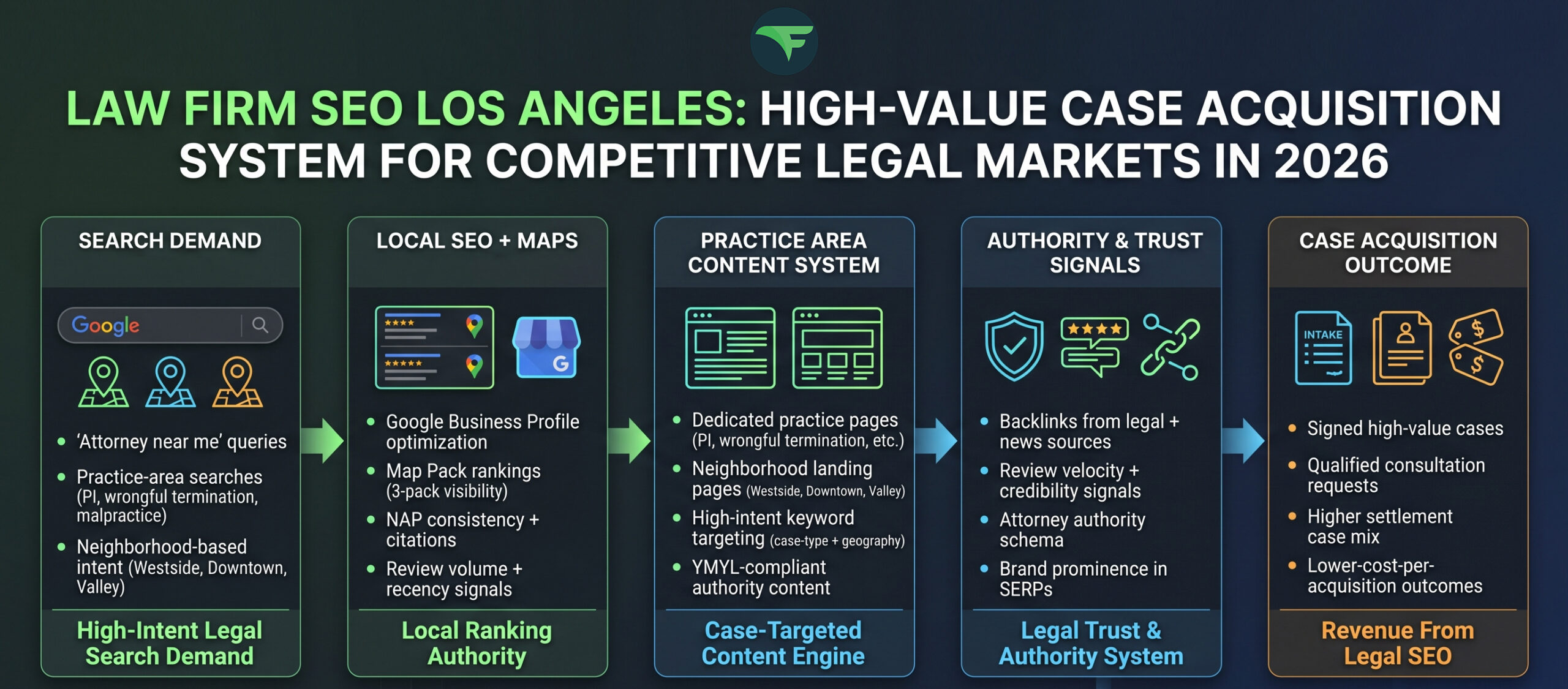
Why Most LA Law Firm SEO Produces Traffic, Not Cases
The gap between traffic and signed cases is a targeting problem. U.S. Census Bureau data for Los Angeles County shows pronounced income stratification across the metro: Beverly Hills, Bel Air, and the Westside generate dramatically different case profiles than the San Fernando Valley or East Los Angeles. A firm ranking for broad city-level terms captures demand from all those populations indiscriminately.
Broad terms attract broad callers. Firms extracting the most revenue from LA legal SEO target specific combinations — catastrophic injury, wrongful death, wage-and-hour class actions — rather than the general terms directories already dominate. Lower search volume, higher case value per client acquired.
The Los Angeles Legal Market: Scale and Competition
State Bar of California attorney demographics show more than 225,000 licensed attorneys statewide, with Los Angeles County holding the largest concentration in California. Legal keywords here rank among the highest cost-per-click in any industry nationally — a direct measure of how aggressively firms compete for the same high-value queries.
California Office of Traffic Safety crash data places Los Angeles County among the state’s highest-volume traffic incident jurisdictions. The 405, 110, and I-10 corridors generate sustained accident volume that maps directly to personal injury search demand. The competitive question isn’t whether demand exists — it’s whether your firm appears when a high-value client is actively searching.
Where High-Value Cases Concentrate in Los Angeles
Bureau of Justice Statistics civil litigation data shows that personal injury, product liability, medical malpractice, and employment discrimination cases consistently produce the highest plaintiff recoveries nationally. Los Angeles adds entertainment contract disputes, tech and film industry employment claims, and insurance bad faith cases — practice areas with high per-case values and lower organic competition than general PI terms.
These categories don’t generate the most search volume. They generate the most revenue per case acquired.
How Google Ranks Law Firms in Los Angeles
Google’s documentation on local ranking factors identifies relevance, distance, and prominence as the three drivers of local visibility. For a Los Angeles law firm, prominence is the decisive variable. Relevance is addressable through content and page structure; distance is fixed. Prominence — authoritative backlinks, review velocity, and brand signals — requires sustained investment and doesn’t come from a single campaign.
Firms that dominate Los Angeles legal search spent years building prominence in specific niches. Competing against them on broad terms rarely produces ROI. Competing against them on targeted, high-value practice-area and neighborhood-specific terms often does.
Technical Foundations That Determine Case Visibility
Google’s SEO Starter Guide establishes crawlability, mobile performance, and structured data as non-negotiable ranking prerequisites. For law firms in a YMYL category, Flying V Group’s technical SEO work includes attorney schema, review schema, and practice-area markup that signals expertise before content is even evaluated. Structural gaps consistently explain why established LA firms plateau despite ongoing investment.
The Keyword Strategy That Attracts High-Value Cases
Generic terms attract generic callers. High-value cases come from high-specificity queries — “catastrophic injury attorney Los Angeles,” “wrongful termination lawyer Century City,” “trucking accident attorney I-405 corridor.” These carry lower competition than broad queries and pre-filter for clients whose cases justify the time and cost of representation.
Keyword research built from case type → case value → geographic intent produces a content architecture that attracts the consultations worth taking. Los Angeles’s geographic spread creates distinct legal markets within the same city:
| Neighborhood / Area | Primary Practice Areas | Case Value Profile |
| Beverly Hills / Westside | Employment, entertainment, estate disputes | High-income plaintiffs, complex damages |
| Downtown / Mid-Wilshire | Business litigation, class action, civil rights | Commercial and multi-party cases |
| Long Beach / South Bay | Maritime injury, industrial accidents | Specialized liability, high settlements |
| San Fernando Valley | Personal injury, family law | High volume, mid-to-high value |
| East Los Angeles | Immigration, criminal defense, personal injury | High community demand, competitive |
Practice Area Pages as the Core Conversion Asset
Each practice area a firm wants to rank for requires its own dedicated, substantive page. Google’s YMYL evaluation means thin multi-practice pages suppress rankings across all listed areas simultaneously. Content marketing that addresses specific case types, realistic timelines, and outcome factors on dedicated pages consistently outperforms consolidated service overviews in both rankings and consultation conversion.
How High-Value Clients Move Through Legal Search
California Courts’ self-help civil case documentation illustrates that clients search at multiple stages — recognizing a legal issue, evaluating whether to hire, and throughout active cases. High-value clients in particular are research-intensive before making contact, evaluating multiple firms before calling any of them.
An SEO program targeting only the hire-now query misses the clients doing the most due diligence — often the same clients with the highest-value cases. Content that addresses the research and evaluation stages as well as intake captures a wider share of the qualified funnel.
The Authority Signals That Earn High-Value Trust
FTC guidance on endorsements and reviews confirms the weight reviews carry in purchasing decisions. For high-value clients comparing firms, review quality and recency are frequently the deciding factor between calling one attorney or the next.
Google Search Central’s documentation on how links function in search explains why backlinks from reputable legal publications, bar association resources, and regional news outlets carry disproportionate prominence weight in YMYL niches. Link building that targets these topically relevant, authoritative sources builds both the ranking signal and the trust signal that converts high-value prospects.
GEO, AI Search, and High-Value Case Visibility in 2026
AI-generated answers are reshaping how potential clients encounter legal information before they ever click a result. For LA law firms targeting high-value cases, this means AI visibility is now part of the conversion path — not separate from it.
Flying V Group’s Director of SEO Sean Fulford leads the firm’s Generative Engine Optimization (GEO) methodology, which structures SEO services content so AI models can parse, trust, and cite it accurately. In a YMYL niche like law, GEO requires clear entity identification, attributed sourcing, and substantiated claims — the same standards that improve traditional rankings, applied to how AI models evaluate credibility. Firms building only for traditional search are already missing a growing share of how high-value clients discover legal representation.
Los Angeles Legal SEO Built Around Cases, Not Traffic
High-value cases don’t come from high-volume keywords. They come from precise targeting, content that satisfies YMYL standards, and the authority that convinces a research-intensive client your firm is worth calling over everyone else. Flying V Group builds programs at exactly that level. Talk to our team about where your firm’s case acquisition gaps are — and what it takes to close them.
Frequently Asked Questions
What keywords actually bring high-value cases in Los Angeles?
High-value legal cases come from specificity, not search volume. Terms like “catastrophic injury attorney Westside Los Angeles,” “employment class action lawyer Beverly Hills,” or “insurance bad faith attorney Century City” convert at higher rates and attract clients with higher-value cases than broad city-level terms dominated by directories. The target is intent-matched queries that pre-filter for case type and geography simultaneously.
How do smaller LA law firms compete against firms spending $15,000–$20,000 a month on SEO?
By targeting narrower markets with greater depth. A smaller firm that owns a specific practice area in a specific neighborhood — building more substantive content, stronger local citations, and more active review acquisition than any competitor in that niche — consistently outperforms larger firms spreading budget thinly across broad terms. Specificity and execution discipline in a defined niche outperform spend without focus.
Why does high Google traffic sometimes produce few actual cases?
Traffic without case intent produces calls that don’t convert. The issue is typically keyword strategy: ranking for informational or low-intent terms attracts researchers, not clients ready to hire. Conversion gaps on landing pages — weak calls to action, missing trust signals, slow intake response — compound the problem. Effective legal SEO requires optimizing both visibility and the conversion pathway from that visibility.
Which LA neighborhoods and corridors should a personal injury firm target for SEO?
The highest-demand areas combine accident volume with client ability to sustain litigation. Freeway corridor terms along the I-405, I-10, and US-101 capture high volume; Westside and Mid-City terms tend to attract higher-income plaintiffs with larger damage profiles. Neighborhood-specific landing pages addressing each area’s common incident types consistently outrank single citywide pages in both ranking position and consultation conversion.
How long does it take for LA law firm SEO to produce signed cases?
In Los Angeles’s competitive legal market, meaningful ranking movement on targeted practice-area terms typically requires 4–6 months, with signed case attribution from organic search usually appearing at the 6–9 month mark. Firms targeting lower-competition niches — entertainment law, insurance bad faith, niche employment categories — may see attribution earlier. Personal injury in contested LA sub-markets should expect the longer end of this timeline.
Is it worth investing in legal SEO when directories like Avvo dominate the results?
Yes — because directories dominate city-level organic terms, not practice-area-specific and neighborhood-specific terms. The Map Pack, which appears above organic listings for most local legal queries, is not occupied by directories; it’s occupied by individual law firms. A firm investing in Google Business Profile optimization and local prominence signals can appear in the Map Pack for targeted searches without competing directly against directory domain authority.
What role do landing pages play in converting legal SEO traffic into signed cases?
Landing pages are where SEO investment either produces revenue or doesn’t. A landing page for a specific practice area should answer the client’s immediate question, establish credibility through credentials and case results, make intake frictionless, and load quickly on mobile. Law firms driving qualified organic traffic to a generic homepage or multi-practice overview page consistently underperform those with dedicated, conversion-optimized pages per practice area and sub-market.