
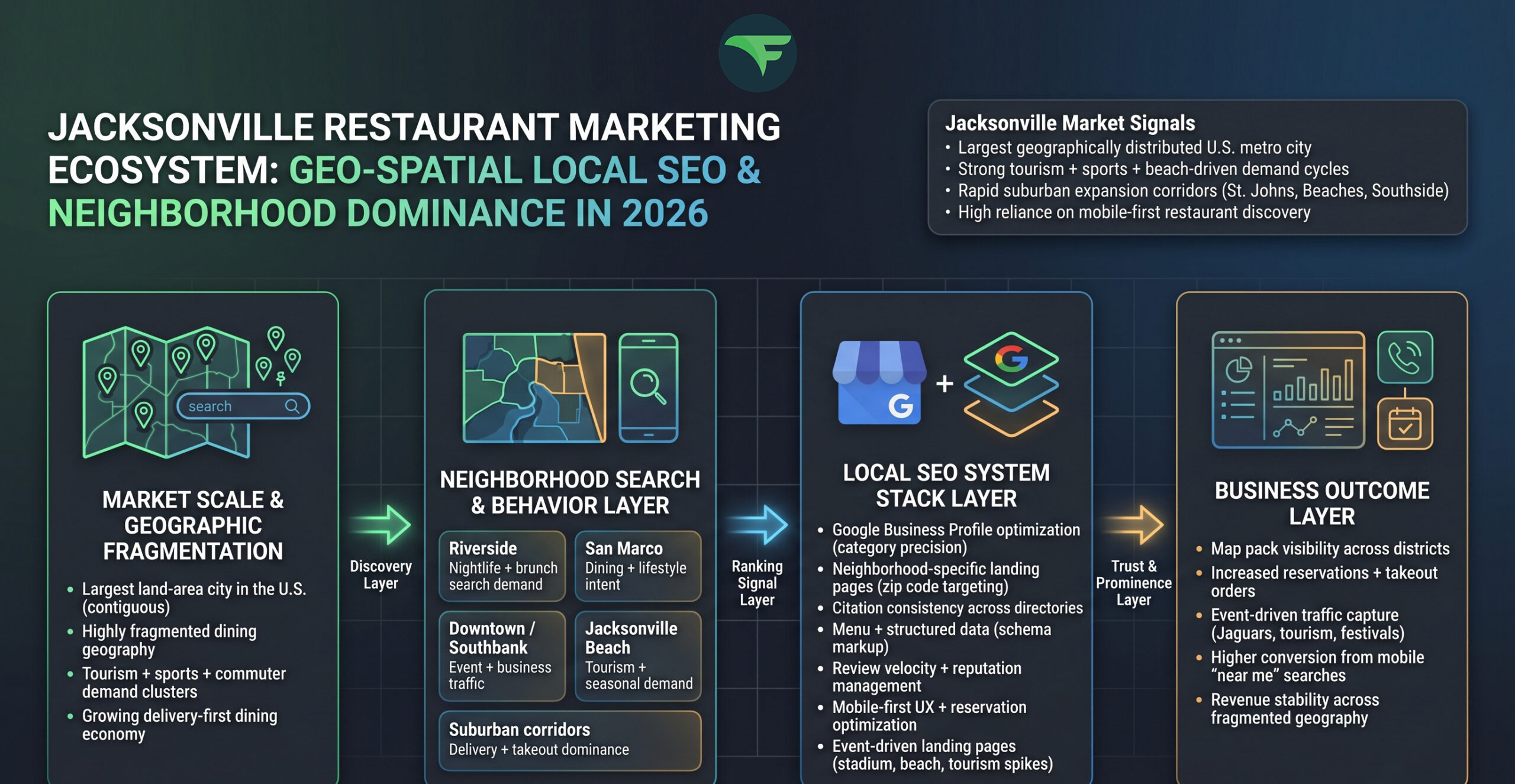
Jacksonville is the largest city by land area in the contiguous United States — a geographic fact that creates a restaurant marketing problem most owners underestimate. According to U.S. Census Bureau data, the city’s population exceeds 949,000 across neighborhoods as distinct as Riverside, San Marco, Downtown, and the Beaches. A restaurant that ranks in one district can be effectively invisible four miles away.
Florida’s restaurant industry employs over 1.4 million people and generates more than $80 billion in annual sales, according to National Restaurant Association state data. Jacksonville’s share of that market is growing — and the competition for local search visibility is growing with it. The restaurants winning new customers aren’t necessarily serving better food; they’re structuring their digital presence around how Jacksonville diners actually discover them.
Flying V Group’s SEO services are built for exactly this kind of fragmented local market, where zip code-level search behavior determines foot traffic. Their results across growth-focused clients show what a deliberately structured local SEO program produces.
Jacksonville’s Restaurant Market: What the Data Shows
Visit Jacksonville’s research and reports show the city draws millions of visitors annually through its beaches, the PGA TOUR headquarters, Jaguars home games, and a growing convention economy. That tourist traffic concentrates around Riverside, Southbank, and Jacksonville Beach — all of which are hypercompetitive for restaurant map-pack placement.
Analysis of Jacksonville’s quick-service and delivery corridor by Trinity Commercial Real Estate identifies the city as an emerging hub for takeout-first dining concepts, with demand concentrated along major commuter corridors and near suburban growth nodes like St. Johns Town Center. For independent restaurants, this means delivery and takeout visibility has become a revenue line that can’t be optimized separately from local search.
1. How Google Ranks Local Restaurants — and Why It Matters
Google’s local ranking algorithm uses three primary signals: relevance, distance, and prominence. Most restaurant owners focus exclusively on distance — their physical location — and ignore the other two. Relevance is determined by how precisely your Google Business Profile matches what a diner is searching for. Prominence is built through review volume, backlink signals, and citation consistency across directories.
Technical SEO at the restaurant level means addressing all three signals simultaneously: precise primary categories, structured menu data, and a citation footprint that’s consistent from Google to Yelp to TripAdvisor to local directories.
Google Business Profile: The Foundational Asset
Google’s Business Profile guidance identifies complete, accurate profiles with frequent photo updates and active review engagement as the baseline for improved local pack placement. For Jacksonville restaurants, this is the first and most overlooked competitive lever.
Most profiles in the Jacksonville market are incomplete on at least two critical fields: menu URLs and attributes (outdoor seating, reservations, delivery options). Each missing attribute is a missed relevance signal — and a missed opportunity to surface in filtered local searches.
Neighborhood-Level Keyword Targeting
Jacksonville’s distinct districts generate their own search demand. “Riverside brunch Jacksonville,” “San Marco dinner,” and “restaurants near Jaguars stadium” each carry different search volumes, competition levels, and diner intent profiles. A single homepage targeting “Jacksonville restaurants” competes against every establishment in the metro.
Keyword research tools calibrated to Jacksonville’s neighborhood structure help identify which district-specific terms carry the highest commercial intent relative to current competition — and where a restaurant has a realistic path to map-pack visibility without competing against downtown chains for broad terms.
2. Review Velocity and Reputation Infrastructure
Florida local SEO data from DataPins shows that Florida consumers trust online reviews nearly as much as personal recommendations, with the majority reading at least four reviews before visiting a restaurant. Review volume alone isn’t sufficient — recency matters equally, and a profile with 200 reviews that hasn’t received a new one in three months reads as dormant to both diners and Google’s ranking algorithm.
A review velocity strategy for Jacksonville restaurants has three components: a prompt asking satisfied diners to leave feedback (timed correctly relative to the meal experience), a response protocol covering 100% of reviews within 48 hours, and a monitoring process that catches new reviews before they sit unanswered. The SBA’s marketing guidance for small businesses identifies reputation management as one of the highest-ROI marketing investments for independent food-service operators.
3. Mobile-First Visibility and Modern Discovery Channels
Think With Google research on mobile search behavior confirms that 76% of mobile “near me” searchers visit a business within a day. Jacksonville’s tourism and beach economy amplifies that number — visitors at Jacksonville Beach or Riverside are making real-time dining decisions on mobile devices with zero tolerance for slow-loading menus or broken reservation links.
Beyond Google, restaurant discovery now routes through AI Overviews, ChatGPT recommendations, and TikTok’s location-tagged food content. Restaurants with structured local data — consistent NAP, schema markup, and high-quality photo assets — are more likely to surface in AI-generated recommendations than those relying on unstructured web presence alone.
Content and Experiential Marketing as a Discovery Signal
Research published in an academic study on experiential marketing and tourism demand identifies atmosphere, brand aesthetics, and event programming as significant drivers of both tourism-led restaurant visits and social content creation. Jacksonville restaurants with distinctive waterfront settings, live music programming, or visual identity worth photographing generate organic social content that functions as a discovery channel.
Content marketing aligned to Jacksonville’s event calendar — Jaguars game days, The Players Championship week, Art Walk nights in Riverside — builds the kind of timely, location-specific content that search algorithms and social platforms reward above generic restaurant posts.
4. Marketing Through Jacksonville’s Seasons and Disruptions
Jacksonville’s tourism peaks align with PGA events, the college football season, and winter snowbird traffic from November through March. Restaurants that shift paid social and search ad spend toward these windows, rather than distributing budgets evenly across twelve months, get materially better returns on the same annual investment.
Storm season runs June through November across the Florida coast. NOAA hurricane preparedness data places Jacksonville within active storm risk corridors, and restaurants with a pre-built digital communication protocol — updated GBP hours, social posts confirming closures or reopening timelines, and email communication to loyalty customers — maintain the community relationships that translate into recovery-period revenue once the weather clears.
Building a Jacksonville Restaurant SEO Strategy That Holds
Flying V Group, founded in 2016 and headquartered in Newport Beach, California, works with growth-focused restaurants and hospitality businesses across competitive Florida markets. Our SEO and web design packages address the full spectrum of local discoverability: Google Business Profile audits, neighborhood-targeted landing pages, citation cleanup, and review velocity programs built around Jacksonville’s specific competitive landscape.
Technical Approach
We structure restaurant SEO around the three signals Google actually uses — relevance, distance, and prominence — rather than treating rankings as a single variable. Each engagement begins with a citation audit, a category precision review, and a keyword map calibrated to the specific neighborhoods a concept intends to dominate.
Why We Stand Out
Most agencies optimize for rankings. We optimize for P&L impact. For Jacksonville restaurants navigating a geographically distributed, event-driven, tourism-inflected market, that distinction shows up in covers and revenue — not just position changes. Our client results reflect what execution-level local SEO looks like across real engagements.
If your restaurant isn’t capturing the Jacksonville search traffic its location and concept deserve, get in touch with our team to discuss what a neighborhood-specific digital strategy looks like for your situation.
Frequently Asked Questions
How long does local SEO take to produce results for a Jacksonville restaurant?
Most Jacksonville restaurants see measurable improvements in Google Business Profile visibility and local pack rankings within 60 to 90 days of a structured optimization effort. Competitive terms tied to high-traffic neighborhoods like Riverside or San Marco typically take four to six months to show full ranking gains, depending on existing domain authority and citation consistency.
What are the three local ranking factors Google uses for restaurants?
Google’s local ranking algorithm evaluates relevance (how well your profile matches the search query), distance (proximity to the searcher), and prominence (review volume, citation consistency, and authority signals). Most restaurant owners only optimize for distance — their physical location — and leave relevance and prominence improvements unaddressed.
How many Google reviews does a Jacksonville restaurant need to rank competitively?
Review count matters less than review velocity. A Jacksonville restaurant with 40 recent reviews will typically outrank one with 300 older reviews if the latter hasn’t received new feedback in several months. Google treats recency as a freshness signal — an active profile reads as more relevant than a dormant one regardless of total review count.
Should Jacksonville restaurants target neighborhood-specific keywords or broader city terms?
Neighborhood-specific terms — “Riverside brunch,” “San Marco dinner,” “restaurants near Jaguars stadium” — carry higher conversion rates and more achievable ranking paths for independent restaurants than broad city terms. Broad terms like “Jacksonville restaurants” are dominated by aggregators and chains; neighborhood terms surface local independent concepts with far less competition.
How do AI search tools like ChatGPT affect restaurant discovery in Jacksonville?
AI-generated restaurant recommendations increasingly pull from structured local data — Google Business Profile details, schema markup, review patterns, and consistent citation signals — rather than generic web presence. Jacksonville restaurants with complete, well-maintained profiles and strong review velocity are meaningfully more likely to surface in AI Overview results and chatbot recommendations than those with thin or inconsistent data.
What is the most common Jacksonville restaurant marketing mistake?
The most common mistake is treating Google Business Profile as a one-time setup rather than an ongoing asset. Categories, photos, menu URLs, and attributes require regular review; profiles with outdated information or inactive photo history lose placement to competitors who maintain their listings consistently. A profile that was fully optimized 18 months ago is not a fully optimized profile today.
Does Jacksonville’s storm season require a specific digital marketing response?
Yes — restaurants along the Jacksonville coast and St. Johns River corridor should maintain a pre-built storm communication protocol covering Google Business Profile hour updates, social media service announcements, and email alerts to loyalty customers. Restaurants that communicate clearly during named storms retain community trust that converts into recovery-period revenue; those that go dark during weather events lose it.