
Houston has no culinary dominant — Vietnamese restaurants in Bellaire, Nigerian concepts in Southwest Houston, and Tex-Mex institutions along Westheimer compete for overlapping but distinct audiences. As The New Yorker’s 2024 feature on Houston’s West African food scene illustrates, the city’s cultural food corridors have developed nationally recognized depth that generic restaurant marketing almost never captures.
Foodylytics data places Houston among the highest restaurant-per-capita metros in Texas, with Census Bureau figures putting the city above 2.3 million across a metro where the competitive field shifts entirely by neighborhood. Flying V Group’s SEO services are structured for markets with this kind of cultural and geographic complexity — their work with growth-focused clients shows what cuisine-specific, neighborhood-calibrated SEO produces.
What Sets Houston’s Restaurant Market Apart
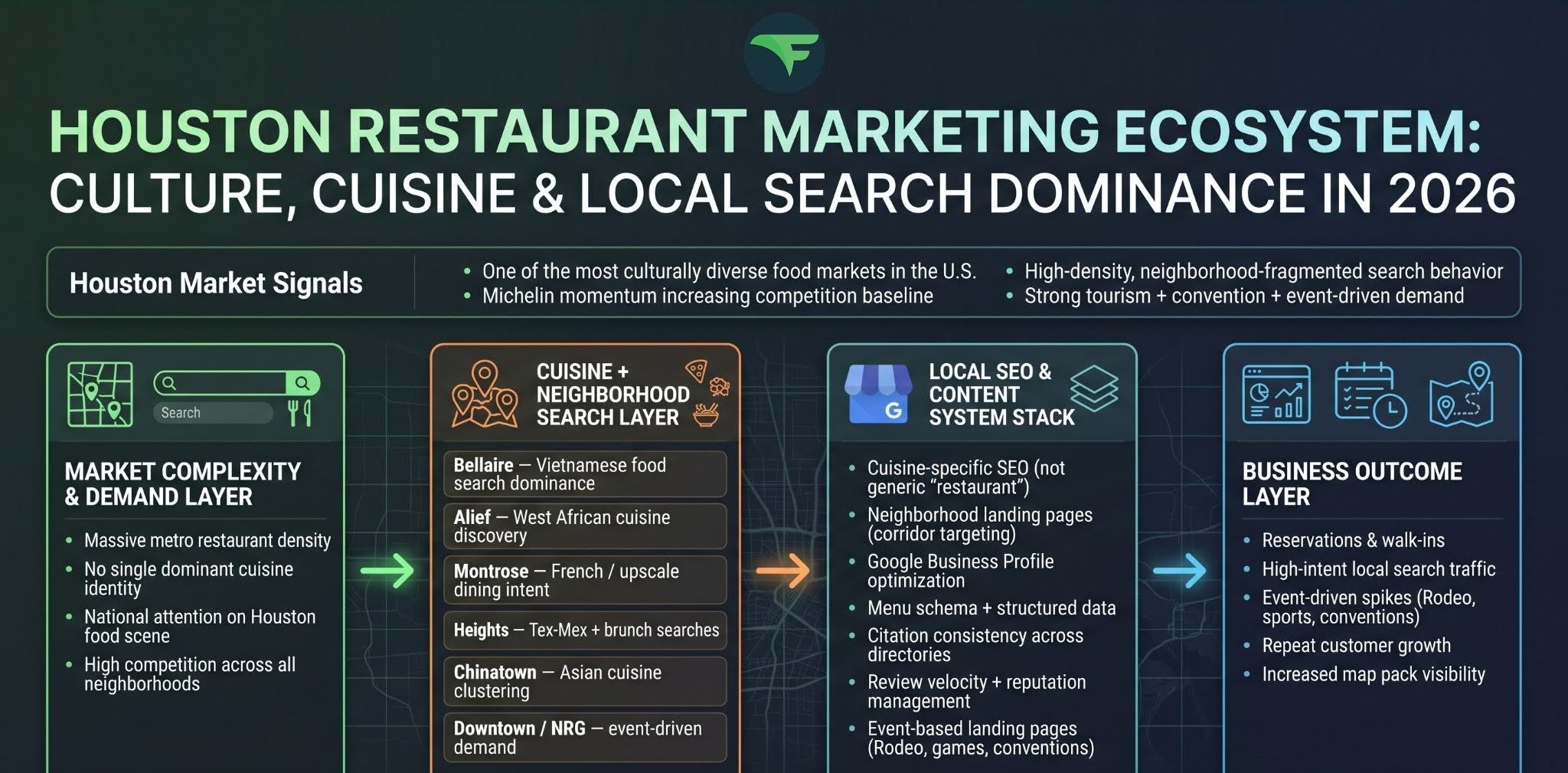
2024 was a breakout year for Houston’s dining reputation. Houston First’s coverage of the city’s food scene recognition documents Michelin momentum and sustained national media attention that has raised the competitive floor for established restaurants. Rising national reputation means new concepts enter the market with higher expectations and more sophisticated digital strategies — making the gap between well-optimized and poorly-optimized local search presence larger than it’s ever been.
Houston First’s tourism and hospitality data shows the convention economy generates substantial restaurant demand near Downtown, the Museum District, and the Space Center corridor. The University of Houston’s hospitality and tourism research resources document broader trends: Houston’s food service market is one of the fastest-scaling in the South, with new openings consistently outpacing national averages and putting sustained pressure on existing concepts’ search visibility.
Cuisine-Specific SEO: The Competitive Edge Chains Can’t Replicate
A Nigerian restaurant in Alief and a French bistro in Montrose are not competing in the same search landscape. They face different keyword structures, different review platforms with different demographic weights, and different community discovery channels — but most restaurant SEO programs treat them identically. That mismatch is where independent Houston restaurants lose ground to chains with more consistent (if generic) digital infrastructure.
Cuisine-specific SEO means building content and citation profiles around targeted search terms that reflect how Houston diners actually search. “West African food Houston,” “pho Bellaire,” “Tex-Mex Heights,” and “Houston Indian restaurant Westheimer” each carry search volumes and ranking thresholds that bear no relationship to each other.
Content creation built around cuisine origin, neighborhood identity, chef background, and ingredient sourcing builds the entity clarity that differentiates a restaurant in AI search results and Google knowledge panels — the spaces chains struggle to occupy authentically.
Neighborhood Keyword Strategy by Cultural Corridor
Technical SEO for Houston restaurants means building indexed landing pages for each cultural corridor and district a concept serves: distinct pages for The Heights, Montrose, Midtown, Chinatown, Bellaire, and Alief each with neighborhood-specific content and local citation signals.
Research on restaurant choice and location-based consumer behavior confirms that proximity drives final dining decisions — but discovery happens at the keyword level before distance factors in. Restaurants that intercept cuisine-specific and neighborhood-specific searches win the discovery moment before a competitor with better proximity but weaker SEO ever appears.
Google Business Profile in a High-Density Market
Google’s local ranking documentation identifies relevance, distance, and prominence as the three signals determining map pack placement. In Houston’s high-density market, relevance is where most independent restaurants underperform — using “Restaurant” as a primary category instead of their specific cuisine type, and leaving menu URLs, service attributes, and accessibility options incomplete.
The University of Houston hospitality data supports what local operators already sense: Houston diners make cuisine-type decisions before they make location decisions. A profile that doesn’t communicate cuisine type precisely fails the relevance test before distance or prominence ever enters the equation.
The Relevance Signal Most Houston Restaurants Miss
Most Houston restaurant profiles are missing at least two high-impact attributes: cuisine-specific secondary categories and current menu data with accurate pricing. Secondary categories allow a restaurant to surface in adjacent searches — a Tex-Mex concept that also adds “Mexican Restaurant” and “Brunch Restaurant” as secondary categories captures three separate search demand pools instead of one.
Think With Google’s mobile search research confirms that 76% of nearby mobile searches result in a same-day visit. Houston’s traffic culture means those decisions happen in real time, often while commuting or parking — which makes profile completeness a direct revenue variable, not an administrative detail.
Event Traffic: Rodeo, Game Days, and Convention Surges
The Houston Livestock Show and Rodeo — the world’s largest — runs three weeks each spring and concentrates hundreds of thousands of visitors near NRG Park. The Astros, Texans, and Rockets generate predictable downtown surges, while the George R. Brown Convention Center drives weekday lunch and dinner demand from out-of-town visitors unfamiliar with the city.
Restaurants adjacent to these venues that build event-specific landing pages and timed paid placements capture demand that general “Houston restaurant” optimization never reaches. The search window is narrow and intent is immediate — the conditions where local SEO investment converts fastest.
Reviews, Reputation, and Post-Disruption Recovery
Florida local SEO statistics from DataPins document consistent patterns across Sun Belt markets: review velocity matters more than review total, and response rates signal operational credibility to both algorithms and prospective diners. Houston’s competitive density amplifies both dynamics — a restaurant with 50 recent reviews and 100% response rate will consistently outrank one with 500 older reviews and no responses.
Storm Season and Community Trust
Houston’s history with catastrophic flooding — from Hurricane Harvey to repeated Gulf storms — makes NOAA’s hurricane preparedness guidance directly relevant to restaurant marketing operations. The active storm season runs June through November.
Restaurants with pre-built communication protocols — updated GBP hours, social service announcements, and loyalty emails before storms make landfall — maintain community relationships that convert into recovery-period revenue. Houston diners remember which restaurants communicated during Harvey. That brand memory is worth building deliberately.
SEO Built for Houston’s Culinary Depth
Houston’s restaurant market doesn’t reward generalist digital strategies — it rewards specificity. A cuisine-agnostic local SEO program applied to a West African concept in Alief performs as poorly as it would applied to a French fine-dining room in River Oaks. Flying V Group, founded in 2016 and headquartered in Newport Beach, California, structures restaurant programs around the cuisine identity, cultural corridor, and neighborhood competitive landscape specific to each concept.
Technical Approach
We build Houston restaurant SEO programs around cuisine-specific keyword maps, cultural corridor landing pages, and GBP configurations that communicate cuisine type and service attributes with the precision Google’s relevance scoring requires. Citation audits, review velocity programs, and event-aligned content run alongside the technical infrastructure.
Why We Stand Out
Houston’s diversity is a marketing asset most agencies don’t know how to activate. We treat cuisine identity and neighborhood specificity as the primary levers — not secondary considerations. Our SEO and web design packages are built around that approach, and our client results reflect what it produces for growth-focused concepts across competitive markets.
If your Houston restaurant isn’t capturing the search traffic its cuisine and neighborhood position deserve, get in touch with our team — we’ll map what a culturally and geographically specific digital strategy looks like for your concept.
Frequently Asked Questions
How does Houston’s size affect local SEO strategy for restaurants?
Houston’s geographic scale means a single homepage cannot effectively rank for multiple neighborhoods simultaneously. Restaurants serving The Heights, Montrose, or Midtown each need distinct indexed landing pages with neighborhood-specific content, schema markup, and local citation signals rather than one generalized page targeting “Houston restaurants.”
What role does cuisine type play in Houston restaurant SEO?
Cuisine specificity is a primary relevance signal in Houston’s market. A Vietnamese restaurant optimized for “Vietnamese restaurant Bellaire” or “pho near Chinatown Houston” will capture significantly more qualified traffic than one targeting generic “Houston restaurant” terms. Houston’s dining culture is neighborhood- and cuisine-specific, and search behavior reflects that directly.
How important are events like the Houston Rodeo for restaurant marketing?
Event-driven search traffic around the Livestock Show and Rodeo, Astros home games, and Toyota Center events creates predictable high-intent windows that geographically adjacent restaurants can target with event-specific content and paid search placements. Restaurants near NRG Park that build Rodeo-specific pages capture demand that general optimization never reaches.
Does Houston’s multicultural food scene require different marketing approaches by cuisine?
Yes — a West African restaurant in Southwest Houston and a Tex-Mex concept in Montrose are competing in entirely different search landscapes with different keyword structures and different community discovery channels. A single marketing approach applied across both concepts will underperform in both. Cuisine-specific strategies consistently outperform generic ones in Houston’s market.
How do reviews affect local search ranking in Houston specifically?
Review velocity is the most consistently underutilized ranking lever in Houston’s restaurant market. Google treats recent reviews as a freshness and prominence signal; a restaurant with 40 reviews in the past 90 days will typically outrank one with 400 reviews that stopped accumulating six months ago. Active review acquisition and 100% response rates are the minimum baseline for competitive map pack placement.
Should Houston restaurants invest in influencer marketing or SEO first?
SEO and Google Business Profile optimization should be the foundational investment before influencer spend. Influencer traffic is episodic — it spikes and disappears. Local search visibility produces consistent, compounding traffic from high-intent diners searching at the moment of decision. Influencer marketing amplifies an already-visible restaurant; it rarely compensates for an invisible one.
How should Houston restaurants handle marketing during hurricane season?
Restaurants should maintain a pre-built storm communication protocol covering Google Business Profile hour updates, social media service announcements, and email alerts to loyalty customers before named storms make landfall. Communicating proactively during weather disruptions builds community trust that translates into loyalty after conditions clear — a dynamic Houston’s dining community demonstrated clearly in Hurricane Harvey’s aftermath.