
Tampa’s dining scene has earned national attention — and with it, the competitive density that makes passive marketing a liability. Hillsborough County’s population exceeded 1.5 million, and the restaurant sector is among the fastest-growing segments in a market that keeps adding residents, development dollars, and tourist traffic simultaneously.
Florida welcomed a record 140.6 million visitors in 2023, according to VISIT FLORIDA research. Those visitors don’t browse printed guides — they open Google, TikTok, and Yelp while standing on the sidewalk outside your block. The restaurants capturing that traffic share a common thread: deliberate, locally-calibrated SEO services paired with reputation infrastructure that builds trust before a diner ever walks through the door.
Flying V Group works with growth-focused Tampa businesses navigating exactly this kind of high-intent local market — their work across industries shows what that process produces in measurable terms.
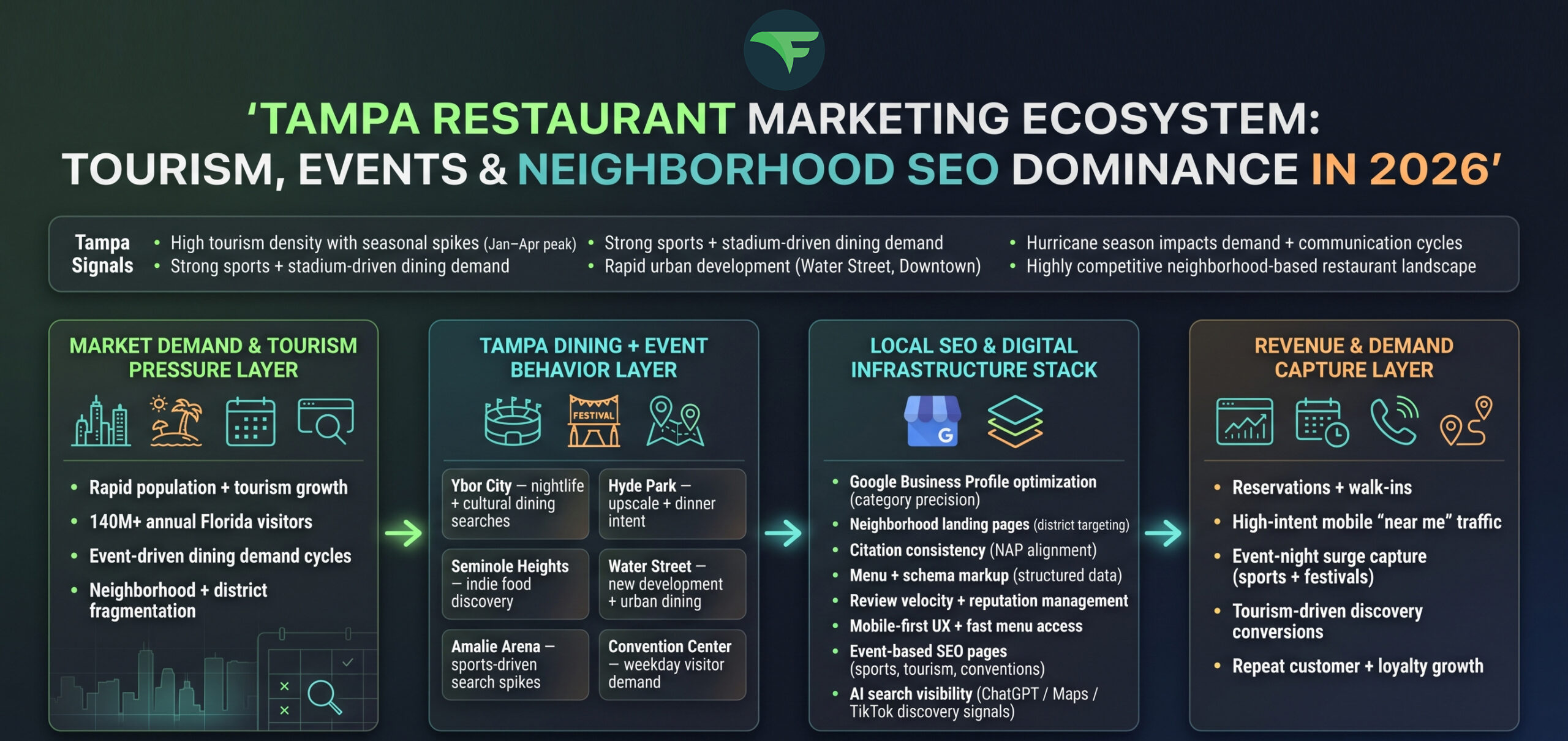
Tampa’s Food Scene by the Numbers
The Florida Restaurant & Lodging Association reports that independent restaurants face growing competitive pressure from both regional chains and nationally recognized chef-driven concepts that have entered the Tampa market in recent years. Hillsborough County’s demographic diversity means the competitive set shifts significantly by neighborhood, income corridor, and daypart.
The National Restaurant Association’s research division documents a consistent pattern: restaurants that invest in digital discovery infrastructure — Google Business Profile, online ordering integrations, and social proof channels — consistently outperform their category benchmarks on customer acquisition costs. That holds in Tampa as reliably as any major metro.
1. Dominate Local Search Before Diners Choose
Tampa restaurant searches are decided in seconds. “Best brunch Tampa,” “waterfront dining Tampa,” and “restaurants near Amalie Arena” all resolve through Google’s local map pack before a single organic result appears — which means the battle for visibility is won or lost at the local SEO level.
Technical SEO for Tampa restaurants means neighborhood-specific landing pages, geo-tagged schema markup, and citation profiles that match how actual diners search. A Seminole Heights bistro competing for generic “Tampa restaurant” terms is fighting the wrong battle.
Google Business Profile: The Reservation Happens Before the Reservation
According to Google’s Business Profile documentation, a fully optimized profile — with accurate primary categories, updated hours, regular photo uploads, and active review responses — meaningfully improves local pack placement. Most Tampa restaurants underperform on at least three of those variables.
The primary business category is the most consequential field. An Italian restaurant listing “Restaurant” instead of “Italian Restaurant” loses placement in every category-specific search. Photo frequency within the last 30 days and a consistent NAP (name, address, phone number) across all directories compound those gains.
Neighborhood-Level Targeting Across Tampa’s Districts
Tampa’s neighborhoods carry distinct culinary identities — Ybor City’s Latin heritage, Hyde Park’s upscale dinner corridor, Seminole Heights’ independent food culture, and Water Street’s emerging skyline dining district. Each generates its own search volume and its own competitive field.
Building location-specific pages for each district your concept serves, rather than relying on a single homepage to rank for everything, is the structural move that separates discoverable restaurants from invisible ones.
2. Build a Social Presence That Matches Tampa’s Event Calendar
Tampa’s dining traffic moves in predictable pulses — Gasparilla, Buccaneers home games, the Outback Bowl, boat shows, and Convention Center conference cycles all generate high-intent search and foot traffic that socially active restaurants can capture ahead of their competitors.
Research published in a 2018 academic study on mobile location and restaurant behavior found that proximity, review signals, and travel time remain the primary decision drivers — but initial restaurant discovery increasingly happens on social platforms before a mapping app is opened. Presence on those platforms, calibrated to Tampa’s event rhythm, creates discovery moments that paid impressions cannot replicate at the same trust level.
Short-Form Video as a Discovery Channel
A well-shot reel of a signature dish during a Buccaneers playoff week can drive more first-time visits than a month of static posts. Instagram performs better for Tampa’s 30–45 demographic; TikTok delivers higher discovery volume among 18–30 diners who respond to unfiltered, location-tagged content.
Content marketing built around Tampa’s specific events calendar — rather than generic food photography — builds the kind of organic reach that amplifies every other channel running alongside it.
3. Review Strategy: Managing Tampa’s Most Valuable Currency
Yelp’s economic data on restaurant behavior shows that review velocity — not just star rating — influences both search placement and diner trust. A restaurant with 30 recent reviews at 4.2 stars will typically outperform one with 200 reviews at 4.5 stars that stopped receiving new feedback six months ago.
The review ecosystem also carries credibility risk. Research from a 2024 study on fake reviews and consumer trust documents how diners have grown more skeptical of inflated ratings — and how authentic engagement patterns, including response rates and personalized replies, have become proxies for operational credibility.
For Tampa restaurants, a review response protocol is non-optional. Responding to every review within 48 hours, including critical ones, signals the kind of attentiveness that both diners and algorithms register as a trust signal.
4. Marketing Through Tampa’s Seasons and Disruptions
Tampa’s tourism volume peaks from January through April, driven by snowbirds, spring break traffic, and conference season. Restaurants that weigh paid social and Google Ads spend toward those months — while using the summer shoulder season to build local loyalty programs and content assets — consistently outperform competitors running flat monthly budgets.
Sports traffic around Amalie Arena and Raymond James Stadium creates predictable high-intent search windows. Restaurants within a mile radius that appear in “restaurants near Amalie Arena” searches during event nights are capturing one of the most commercially concentrated audiences in the market.
Storm Season and Digital Preparedness
Tampa sits within an active hurricane corridor. NOAA hurricane preparedness data places the Gulf Coast under active storm conditions from June through November — a six-month window that overlaps with the beginning of the tourist shoulder season.
For restaurants, a storm-season digital protocol is marketing infrastructure, not an emergency measure. Updating Google Business Profile hours during named storms, posting service changes before local searches spike, and communicating consistently during weather disruptions builds community trust that converts directly into long-term local loyalty.
5. Content That Earns Trust with Tourists and Residents Alike
Tampa’s tourist-to-resident ratio shifts dramatically by season, and the two audiences make decisions differently. Tourists prioritize discovery platforms and review volume. Locals prioritize consistency, community relationships, and value signals. A content strategy that ignores one cohort underperforms with both.
Think With Google’s research on mobile search behavior confirms that 76% of people who search for something nearby on mobile visit a related business within a day. Mobile-first website performance, fast-loading menus with accurate pricing, and click-to-call functionality are direct revenue infrastructure — not cosmetic upgrades.
Building a Digital Strategy Around Tampa’s Market
Executing the strategies above requires more than selecting the right tactics — it requires connecting digital performance to covers, reservations, and revenue in a market with Tampa’s specific competitive shape.
Flying V Group, founded in 2016 and headquartered in Newport Beach, California, serves growth-focused restaurants and hospitality businesses across high-density local markets. Our SEO and web design packages address the full spectrum of restaurant discoverability: from Google Business Profile audits and local citation cleanup to neighborhood-targeted content calendars and review velocity programs.
Technical Approach
We build restaurant SEO programs around the variables that actually determine map pack placement: citation consistency, category precision, schema markup, and page-level authority for each location and neighborhood a concept serves. Every strategy is tied to measurable outcomes — foot traffic, reservation volume, and cost per acquired customer.
Why We Stand Out
Most agencies optimize for rankings. We optimize for P&L impact. For Tampa restaurants competing across a tourist-heavy, event-driven, neighborhood-fragmented market, the distinction matters. Our client results reflect what that difference looks like across real engagements.
If your restaurant is competing for visibility in Tampa’s accelerating food scene, it’s worth evaluating whether your current digital strategy is built for the market you’re actually in. Get in touch with our team to discuss your specific position and what a locally calibrated strategy looks like for your concept.
Frequently Asked Questions
How long does it take for SEO to improve a Tampa restaurant’s local rankings?
Most Tampa restaurants begin seeing measurable improvement in Google Business Profile visibility and local pack rankings within 60 to 90 days of a structured optimization effort. Full organic ranking gains for competitive terms like “best brunch Tampa” or “waterfront dining Tampa” typically take four to six months, depending on current domain authority, citation consistency, and competitor activity in the target neighborhood.
What is the single most important Google Business Profile field for a restaurant?
The primary business category is the most consequential field in a restaurant’s Google Business Profile. A Thai restaurant that lists “Restaurant” instead of “Thai Restaurant” loses placement in every category-specific search conducted in its area. Beyond category, photo frequency within the past 30 days and an active review response rate are the highest-leverage variables most Tampa restaurants neglect.
How should Tampa restaurants adjust their marketing budget across seasons?
Tampa’s tourist volume peaks from January through April, creating the year’s highest-intent search window. Restaurants should front-load paid social and Google Ads spend during this peak, then shift the slower summer season toward building loyalty programs and email lists. Seasonally weighted marketing dollars consistently outperform flat monthly budgets.
Do Yelp reviews matter as much as Google reviews for Tampa restaurants?
Google reviews hold more direct influence over local search ranking and Google Maps placement than Yelp reviews. Yelp remains relevant as a discovery platform for tourists and certain demographics who use it as a primary planning tool. Tampa restaurants should actively manage both, but when resources are limited, Google review velocity should be prioritized first — it has a more direct line to map pack performance.
What makes Tampa a distinct digital marketing challenge compared to Miami or Orlando?
Tampa’s market combines a large year-round resident base with rapid development in districts like Water Street. Unlike Miami’s focus on international luxury or Orlando’s theme-park crowds, Tampa’s audience consists of experience-seeking locals and regional visitors. Marketing strategies built for international tourists or theme-park proximity often fail here without deep neighborhood-level localization.
Should a Tampa restaurant invest in influencer marketing?
Tampa-specific micro-influencers (10k–80k followers) typically yield higher conversion rates than national accounts. Their local specificity ensures the audience actually intends to dine in Tampa, whereas larger accounts often generate vanity impressions. Start with two to four local collaborations per quarter before scaling to larger influencer placements.
Does a multi-location Tampa restaurant need separate website pages for each location?
Any Tampa restaurant operating more than one location should maintain distinct, fully indexed pages for each address, including unique NAP data, location-specific schema markup, and neighborhood-relevant content. Consolidating multiple locations on a single contact page creates citation conflicts in Google’s local index and suppresses map rankings for each individual address. A properly structured multi-location SEO program treats each address as its own ranking entity.