

Colorado Springs has added over 50,000 residents in the past decade, according to U.S. Census Bureau data, making it one of Colorado’s fastest-growing cities. That growth brings new customers — and new competitors, including national franchise expansion and Denver-based agencies moving into the market with deeper domain authority than most local businesses have had time to build.
For small businesses, the window to establish local search authority during a market’s growth phase is real but finite. Flying V Group’s SEO programs are built for markets at exactly this inflection point — see how the approach translates across industries.
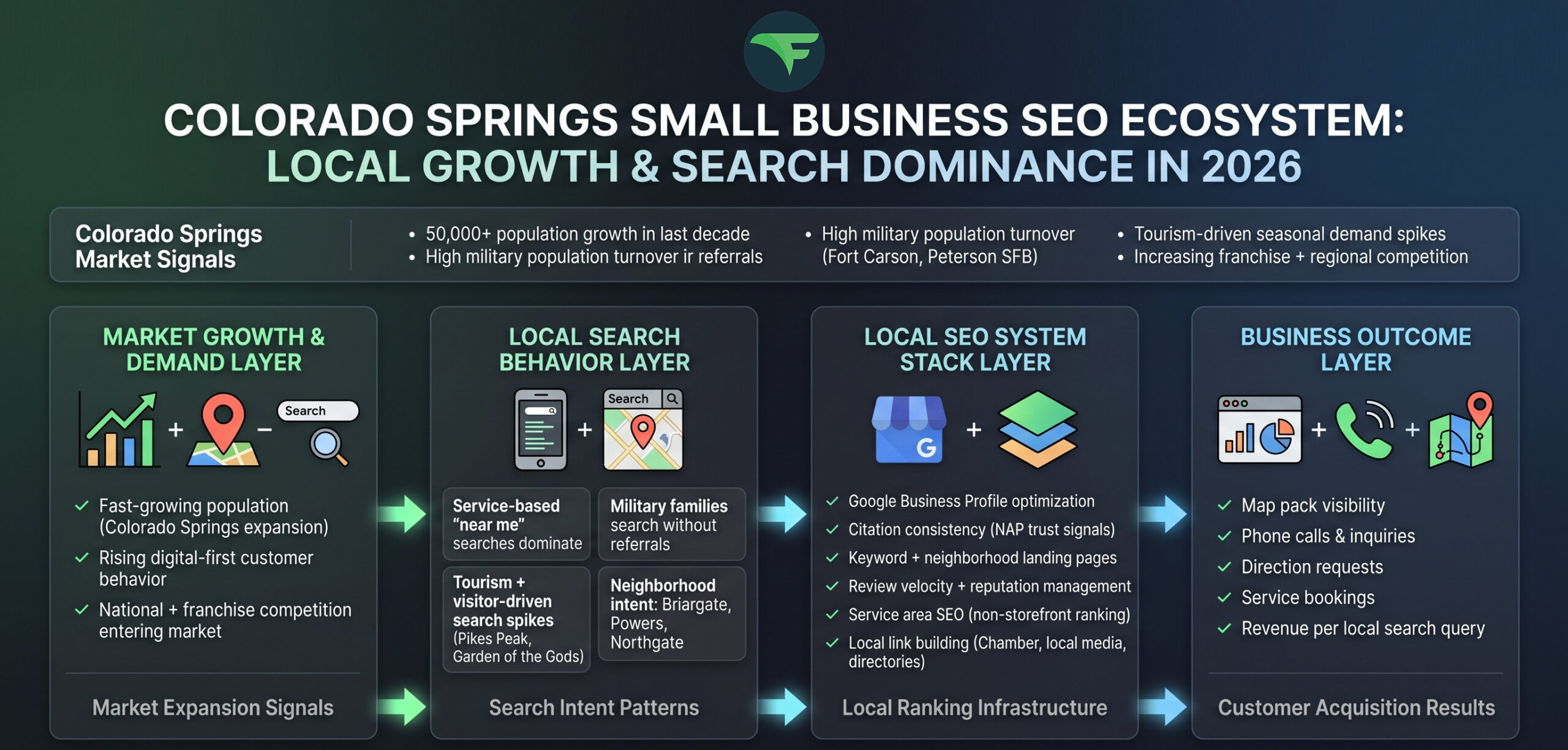
Colorado Springs: A Market Growing Faster Than Most Businesses’ Digital Presence
The Colorado Springs Chamber & EDC reports sustained commercial expansion in Briargate, Powers, and Northgate — suburban corridors where new residential development is generating service demand faster than established businesses have organized their digital presence to meet it. The gap between population growth and local search visibility is where well-positioned small businesses build durable advantages.
Colorado’s broadband expansion data shows growing internet access across the state’s urban and suburban corridors, accelerating a shift toward online-first business discovery across categories that previously relied on word-of-mouth and print. More residents searching online means more search traffic available — and more competition attempting to capture it simultaneously.
The Three Signals That Determine Local Pack Placement
Google’s local ranking algorithm aggregates three signals to decide which businesses appear when someone searches “HVAC repair Colorado Springs” or “accountant near me”: relevance (how precisely your profile matches the query), distance (proximity to the searcher), and prominence (review volume, citation consistency, and authority signals). Most Colorado Springs small businesses address none of them deliberately.
The SBA’s small business marketing guidance identifies local search visibility as one of the highest-leverage, lowest-cost customer acquisition channels for independent operators — particularly service businesses competing within defined geographic areas where national brands hold no inherent proximity advantage.
Google Business Profile as the Core Ranking Asset
Google’s local ranking documentation is explicit: a fully configured profile — accurate primary and secondary categories, complete service lists, current hours with holiday exceptions, and photos updated within the past 30 days — consistently outranks an incomplete competitor profile even when that competitor has a longer business history. Configuration is leverage most businesses leave unused.
Most Colorado Springs profiles are incomplete on at least two high-impact fields: secondary categories and service-specific attributes. Each missing field narrows the range of searches a business can surface in — a concrete, addressable problem with measurable ranking consequences.
Citation Consistency as a Trust Signal
A citation is any online mention of a business’s name, address, and phone number. When that information conflicts across directories — Google showing one phone number, Yelp showing another — Google’s algorithm treats the inconsistency as a confidence penalty that suppresses local pack placement.
Academic research on location-based business decision-making confirms that proximity and convenience dominate local consumer choices — but those signals only reach consumers if Google first trusts the business’s location data enough to surface it. Citation audits consistently produce ranking improvements within 60 to 90 days, particularly for businesses that have changed addresses or contact details.
Colorado Springs’ Unique Search Geography
Two features of Colorado Springs’ economy create search dynamics that few mid-sized cities share, and that most generic local SEO programs aren’t structured to address.
Serving a Military Population That Searches, Not Asks
Fort Carson and Peterson Space Force Base together represent tens of thousands of active-duty personnel and their families — a population that cycles through Colorado Springs regularly and relies almost entirely on online search to find local services. Military families new to the area have no established referral network. They search for dentists, contractors, childcare, and restaurants the same way they would in any unfamiliar city: by category and proximity.
For small businesses, this is a consistently replenishing high-intent audience that enters the local search ecosystem with no brand loyalty. Businesses that appear prominently for category-specific searches near major base corridors capture that demand before word-of-mouth alternatives have time to develop.
Capturing Tourism Traffic Near Pikes Peak and Garden of the Gods
Colorado Tourism Office research documents millions of annual visitors to Colorado’s natural attractions, with Colorado Springs serving as a gateway to Pikes Peak and the Royal Gorge. The City of Colorado Springs’ Garden of the Gods data puts annual park visitation above 2 million — an audience actively searching for nearby businesses across hospitality, outdoor gear, and services on mobile devices while standing near the attraction.
Tourism-adjacent businesses that build location-specific pages optimized for “near Pikes Peak” and “Garden of the Gods area” terms capture visitor intent that generic city-level pages don’t reach. Visitor searches are immediate and high-intent — the conditions where local SEO investment converts fastest.
Reviews and the Trust Problem in an Unfamiliar Market
Consumers use review signals as proxies for service quality — particularly in unfamiliar markets. For Colorado Springs businesses serving military families and tourists, reviews function as the primary trust credential for customers who have no local referral network to fall back on.
A review velocity strategy — prompting satisfied customers at the right moment, responding to every review within 48 hours, and monitoring platforms consistently — builds the prominence signal that compounds across Google and AI-generated local recommendations. A business accumulating 20 reviews per month builds structural search authority that no paid campaign can quickly replicate.
Targeting the Keywords Your Customers Actually Use
Think With Google’s mobile search research shows the majority of local searches happen on mobile, often within minutes of a purchase decision. The businesses that appear in those moments identified what their customers actually type — not what they assume they search for.
Keyword research tools calibrated to Colorado Springs reveal the specific phrases consumers use by neighborhood and service type. “Plumber Briargate” and “emergency plumber Colorado Springs” carry different volumes, different competition levels, and different conversion rates — treating them as interchangeable forfeits both rankings and budget.
Link building from locally relevant sources — the Colorado Springs Business Journal, Chamber & EDC directories, neighborhood associations, and local event sponsorships — compounds keyword gains by building the domain authority that sustains rankings in competitive categories over time.
Building a Colorado Springs SEO Program That Holds
Flying V Group, founded in 2016 and headquartered in Newport Beach, California, develops SEO strategy programs for small businesses competing in growing local markets — markets like Colorado Springs where the competitive window is still open but narrowing as more established players organize their digital presence.
Technical Approach
Every Colorado Springs engagement begins with a citation audit, a GBP precision review, and a keyword map built around the specific neighborhoods and service areas a business intends to dominate. Review velocity programs, local link acquisition, and content calibrated to both resident and tourism search behavior run alongside the technical foundation.
Colorado Springs Is Still Catchable — But Not for Long
Businesses that establish local search authority during a market’s growth phase hold that ground for years; those that wait until the market matures find the cost of competing significantly higher. Our client results document what early, deliberate local SEO investment produces across competitive local markets. If your Colorado Springs business isn’t capturing the search traffic your location and service area deserve, reach out to our team — we’ll map exactly where the gap is and what closing it looks like.
Frequently Asked Questions
How does local SEO differ from national SEO for Colorado Springs small businesses?
Local SEO targets geographic relevance — appearing when nearby consumers search by category and location — rather than competing nationally for broad keyword terms. For Colorado Springs small businesses, this means optimizing Google Business Profile, local citations, and neighborhood-specific landing pages rather than pursuing broad ranking strategies that require domain authority levels most independent operators can’t build cost-effectively.
How does Colorado Springs’ military population affect local SEO strategy?
Military families relocating to Fort Carson or Peterson Space Force Base arrive with no local referral network and high search dependency for every service category — from dentists and contractors to childcare and restaurants. Businesses that maintain complete, review-rich profiles with accurate service descriptions consistently capture this audience at the moment of need, before word-of-mouth alternatives have time to develop.
What is the single fastest action to improve local pack rankings in Colorado Springs?
Completing all missing fields in a Google Business Profile — accurate primary category, full service list, current hours including holiday exceptions, and photos added within the past 30 days — produces the fastest measurable ranking improvements of any single action. Most Colorado Springs profiles are incomplete on at least two of these fields, creating immediate opportunities for businesses that address them.
Should Colorado Springs businesses target tourism keywords or local resident keywords?
Both audience types represent distinct search behavior and should be targeted through separate content. Resident searches are consistent year-round and tend to be service-category queries; tourism searches peak seasonally around Pikes Peak and Garden of the Gods and are proximity-driven and immediate. A dedicated landing page for each audience outperforms one generic page attempting to rank for both.
Does SEO outperform Google Ads for long-term small business growth?
SEO builds ranking authority that compounds over time and continues generating traffic after the investment is made; Google Ads produce traffic only while active. For Colorado Springs small businesses with limited budgets, SEO typically produces better long-term cost-per-acquisition figures — though the lag before results appear (three to six months for most categories) means businesses with immediate revenue needs often run both simultaneously during the early phase.
What local link-building opportunities are specific to Colorado Springs?
Colorado Springs has a range of locally authoritative link sources: the Colorado Springs Business Journal, Chamber & EDC member directories, neighborhood association websites, local event sponsorships, and tourism organization partnerships near major attractions. Links from these sources carry more local ranking weight than generic directory submissions and are harder for competitors to replicate quickly.
How does a service-area business without a storefront rank locally in Colorado Springs?
Service-area businesses — contractors, HVAC providers, mobile services — can rank in Google Maps without a public-facing address by configuring a service area in their GBP rather than displaying a physical location. The same relevance and prominence signals apply: accurate service categories, consistent citations, and review velocity all influence map pack placement. Neighborhood-specific landing pages targeting district-level searches across each service area compound those signals further.