

Denver’s food scene earned its first Michelin stars in 2024, and the recognition raised the competitive floor fast. Eater Denver’s coverage of the 2025 Michelin guide documents a wave of nationally recognized concepts expanding in the market — alongside Axios reporting on concurrent closures driven by rising operational costs and tightening margins. The restaurants holding ground in that environment share a common thread: technically sound, neighborhood-specific local search visibility.
Foodylytics data puts Denver at roughly one restaurant per 251 residents — among the highest densities in the Mountain West. Flying V Group’s SEO services are built for exactly the kind of market where visibility gaps and margin pressure compound simultaneously — their results across growth-focused clients show what structured local SEO produces when both are on the line.
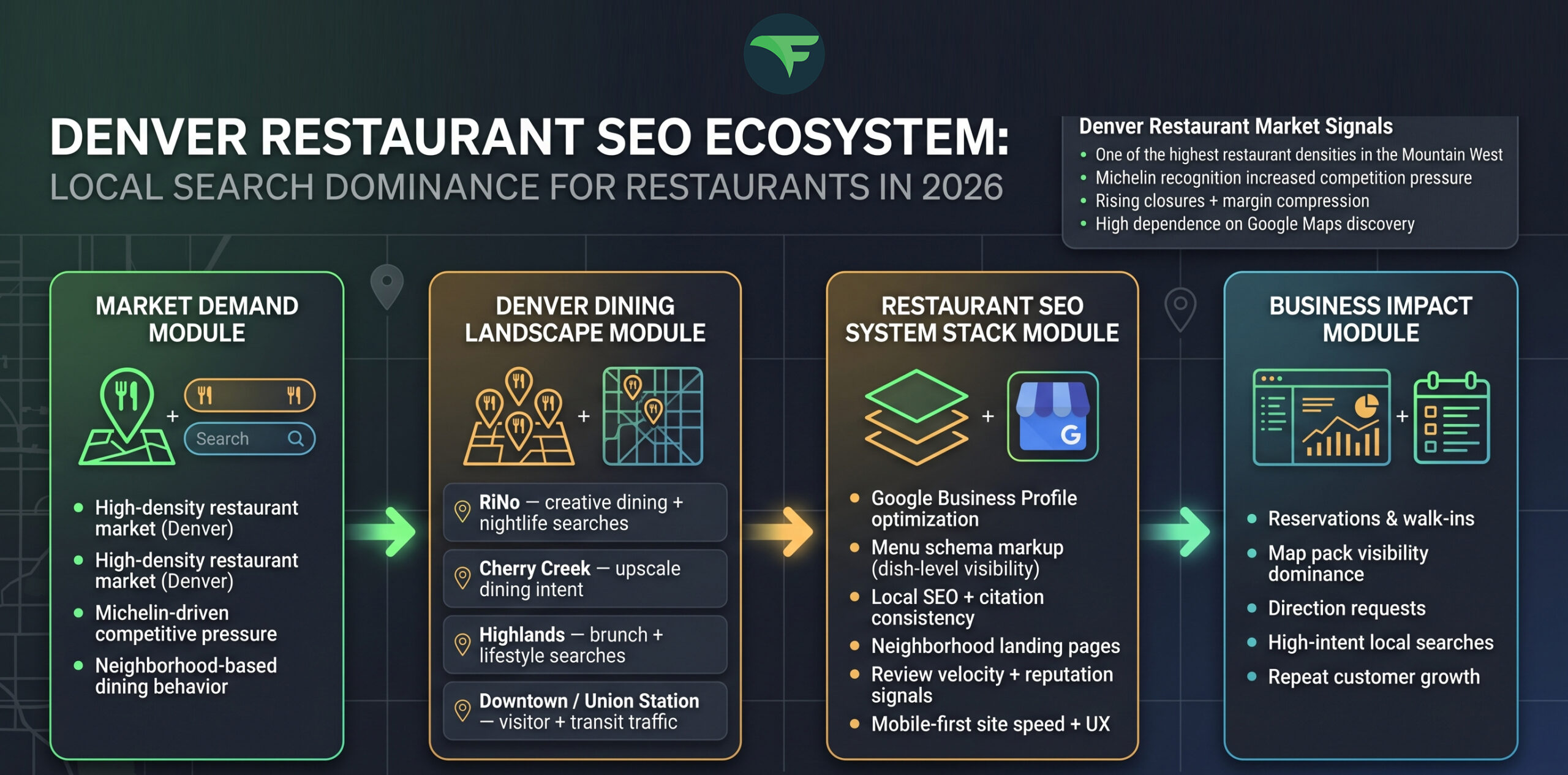
Denver’s Restaurant Market: The Pressure Behind the Prestige
The Colorado Restaurant Association’s industry data places Colorado among the most restaurant-dense states in the country, with Denver concentrating the majority of that competition within a relatively compact core. The National Restaurant Association’s Colorado fact sheet documents consistent growth in the state’s restaurant workforce — reflecting both demand and the number of concepts competing for the same dining decisions.
The Axios closure data tells the other half of the story: restaurants with strong digital infrastructure — consistent review velocity, complete local profiles, neighborhood-specific visibility — are holding ground that those relying on legacy foot traffic and word-of-mouth are losing. In a market this tight, local SEO is an operating requirement before it’s a growth strategy.
Schema, Menus, and the Technical Layer Most Restaurants Skip
Restaurant SEO has a technical dimension most operators never configure. Menu schema markup — structured data that tells Google what dishes, price ranges, and dietary options a restaurant offers — enables a profile to surface in filtered searches that plain-text listings can’t reach. A Denver restaurant with menu schema can appear in “gluten-free restaurants RiNo” or “happy hour LoDo” searches that a competitor without it is invisible to entirely.
Technical SEO for restaurants means addressing both the on-page layer (schema, page speed, mobile performance) and the off-page layer (citation consistency, backlink profile) that determine where a concept surfaces — and whether Google trusts its location data enough to show it at all.
Google Business Profile Precision in a Crowded Field
Google’s local ranking documentation identifies relevance, distance, and prominence as the three ranking signals. In Denver’s density, relevance is where most restaurants lose ground: a Cherry Creek concept listing “Restaurant” instead of “Contemporary American Restaurant” or “Brunch Restaurant” drops out of every cuisine- and occasion-specific search in that neighborhood.
Restaurant marketing data from MarketingLTB shows over 60% of restaurant searches happen on Google before a visit, with map results capturing the majority of that intent. An incomplete or miscategorized Denver profile doesn’t just suppress rankings — it routes high-intent diners directly to a competitor one listing away.
Denver’s Neighborhood Search Landscape
Denver’s dining culture is neighborhood-specific in a way that city-level SEO cannot address. RiNo’s creative dining corridor, LoDo’s nightlife-adjacent restaurant density, Cherry Creek’s upscale trade, and the Highlands’ brunch culture each generate distinct search behavior, distinct peak hours, and distinct diner profiles. A single homepage targeting “Denver restaurants” competes against thousands of listings and wins none of them cleanly.
Academic research on mobile and location-based restaurant decisions confirms that proximity drives final dining choices — but discovery happens at the keyword level before distance is calculated. Restaurants that build indexed landing pages for each neighborhood they serve intercept those searches before a competitor with better proximity but weaker SEO.
Game-Day and Event-Driven Traffic Patterns
Ball Arena, Empower Field at Mile High, and Coors Field each generate predictable high-intent dining windows — Broncos home games, Nuggets playoff runs, Avalanche nights, and Rockies summer traffic all concentrate demand around a defined radius that nearby restaurants either capture or forfeit.
Content creation calibrated to Denver’s event calendar — game-night menus, location-specific pages for venue proximity, and timed paid placements around major events — builds the kind of timely, proximity-specific visibility that surfaces in “restaurants near Ball Arena” searches at precisely the moment intent is highest.
Colorado’s Visitor Economy and the Ski Tourism Spillover
Colorado Tourism Office research documents millions of annual visitors to the state, with Denver functioning as both gateway and destination. Ski season sends a secondary wave of visitors through the city — travelers passing through DIA, staying downtown before or after mountain trips, and dining near hotels and transit corridors without brand familiarity or local referral networks.
This audience searches by proximity and category, not by brand. Denver restaurants near Union Station, the 16th Street Mall, and major downtown hotel corridors that maintain complete, photo-rich profiles with strong review velocity capture that transient traffic at a higher rate than competitors who haven’t optimized for visitor discovery patterns.
Reviews as Discovery and Retention Infrastructure
Think With Google’s mobile search research documents that 76% of nearby mobile searches convert to a same-day business visit. In Denver’s market, that conversion happens in the seconds a diner spends comparing two or three map listings — and reviews are the fastest-read trust signal in that window.
Review velocity matters more than total review count. A restaurant with 40 reviews in the past 60 days will outrank one with 400 reviews that stopped accumulating eight months ago. Responding to every review within 48 hours compounds the prominence signal and demonstrates the active management Google’s algorithm treats as a credibility indicator — particularly relevant for restaurants trying to hold visibility during slower seasonal periods.
Building a Denver Restaurant SEO Program
Flying V Group, founded in 2016 and headquartered in Newport Beach, California, structures restaurant programs around the SEO and web design packages that address Denver’s specific competitive dynamics: neighborhood-specific landing pages, menu schema implementation, citation audits, review velocity programs, and event-aligned content calendars. Our team’s background connects each deliverable to the revenue outcomes that matter in a margin-sensitive restaurant environment — reservations, direction requests, and repeat traffic.
Technical Approach
Every Denver engagement begins with a GBP precision audit, a menu schema review, and a keyword map built around the specific neighborhoods and occasion-based searches a concept intends to own. Citation cleanup and local link acquisition run alongside on-page optimization to build the prominence signals that sustain rankings in competitive corridors.
Denver’s Restaurant Market Doesn’t Wait for Slow SEO
In a market where closures are outpacing openings in some categories, the difference between a restaurant that holds ground and one that loses it often comes down to whether its digital presence is actively maintained or passively neglected. If your Denver restaurant is competing for visibility in the right neighborhoods and search terms, get in touch with our team — we’ll show you where the gaps are and what closing them looks like for your concept.
Frequently Asked Questions
How does Denver’s outdoor culture affect restaurant search behavior?
Denver diners frequently search for “patio dining Denver,” “outdoor seating RiNo,” and “restaurants with mountain views” — searches that require specific GBP attributes to surface in. Restaurants with outdoor spaces that haven’t configured the “outdoor seating” attribute in their Google Business Profile are invisible to a significant slice of Denver’s search traffic, particularly during the spring-to-fall patio season.
What schema markup types matter most for Denver restaurants?
The highest-impact schema types are LocalBusiness schema (establishing entity identity and location), Restaurant schema (communicating cuisine type, price range, and reservations), and Menu schema (enabling dish-level and dietary filter discovery). Menu schema is the most consistently underimplemented of the three — and the one most likely to surface a restaurant in AI Overview results and filtered local searches.
How does Michelin recognition affect SEO for non-Michelin Denver restaurants?
Michelin recognition raises the reference point for quality that Denver diners use when evaluating unfamiliar restaurants — which increases the weight of online credibility signals for non-Michelin concepts. Review volume, review recency, photo quality, and profile specificity matter more in a Michelin-adjacent market than in cities without that culinary reputation baseline.
How do Denver restaurants capture ski season visitor traffic?
Ski season visitor traffic moves through Denver primarily November through March, concentrated near DIA, Union Station, and downtown hotel corridors. Restaurants capturing this traffic maintain accurate holiday hours in GBP, use location-tagged content during peak ski weekends, and build landing pages targeting “Denver restaurants near Union Station” and similar proximity searches that visitors make when unfamiliar with the city’s neighborhoods.
What is the difference between optimizing for “near me” searches versus neighborhood-specific terms in Denver?
“Near me” searches prioritize proximity and are resolved using the searcher’s real-time location — making GBP completeness and review velocity the primary levers. Neighborhood-specific searches like “brunch Highlands Denver” carry explicit geographic intent and are resolved more through page-level relevance and keyword targeting. Both require different optimization approaches: GBP precision for “near me,” indexed landing pages for neighborhood terms.
How should Denver restaurants with multiple locations structure their SEO?
Each address should function as an independent ranking entity with its own GBP profile, neighborhood-specific landing page, and citation footprint. The content and keyword strategy for a Highlands location should be entirely distinct from one in Cherry Creek — conflating them into a single strategy suppresses map rankings for both addresses simultaneously.
Does Denver’s restaurant density make SEO harder or more important?
Denver’s density makes specificity more valuable rather than SEO harder. A restaurant targeting “Denver restaurants” competes against thousands of listings; one targeting “wine bar RiNo Denver” competes against dozens. High-density markets reward neighborhood-level and occasion-specific optimization more directly than less competitive cities — the floor for generic optimization is just lower.