

Dentist SEO services address a problem that doesn’t resolve itself: patients looking for a new dental practice turn to Google first, and the practices they don’t find simply don’t get considered. In a market where most searches happen on mobile and decisions get made within minutes, the question isn’t whether your practice needs search visibility — it’s how much patient volume you’re leaving behind without it.
Research published in BMC Oral Health found that among patients who checked a dental practice’s social media before switching providers, 86.4% said it influenced their decision — confirming that digital presence directly shapes patient acquisition at the moment it matters most.
Where SEO Fits in New Patient Growth
Flying V Group’s SEO services connect search visibility to booked appointments, not just traffic. If your practice isn’t converting online searches into inquiry calls, it’s worth examining where that gap exists — and what a strategy built around patient acquisition, not rankings as an end goal, actually changes.
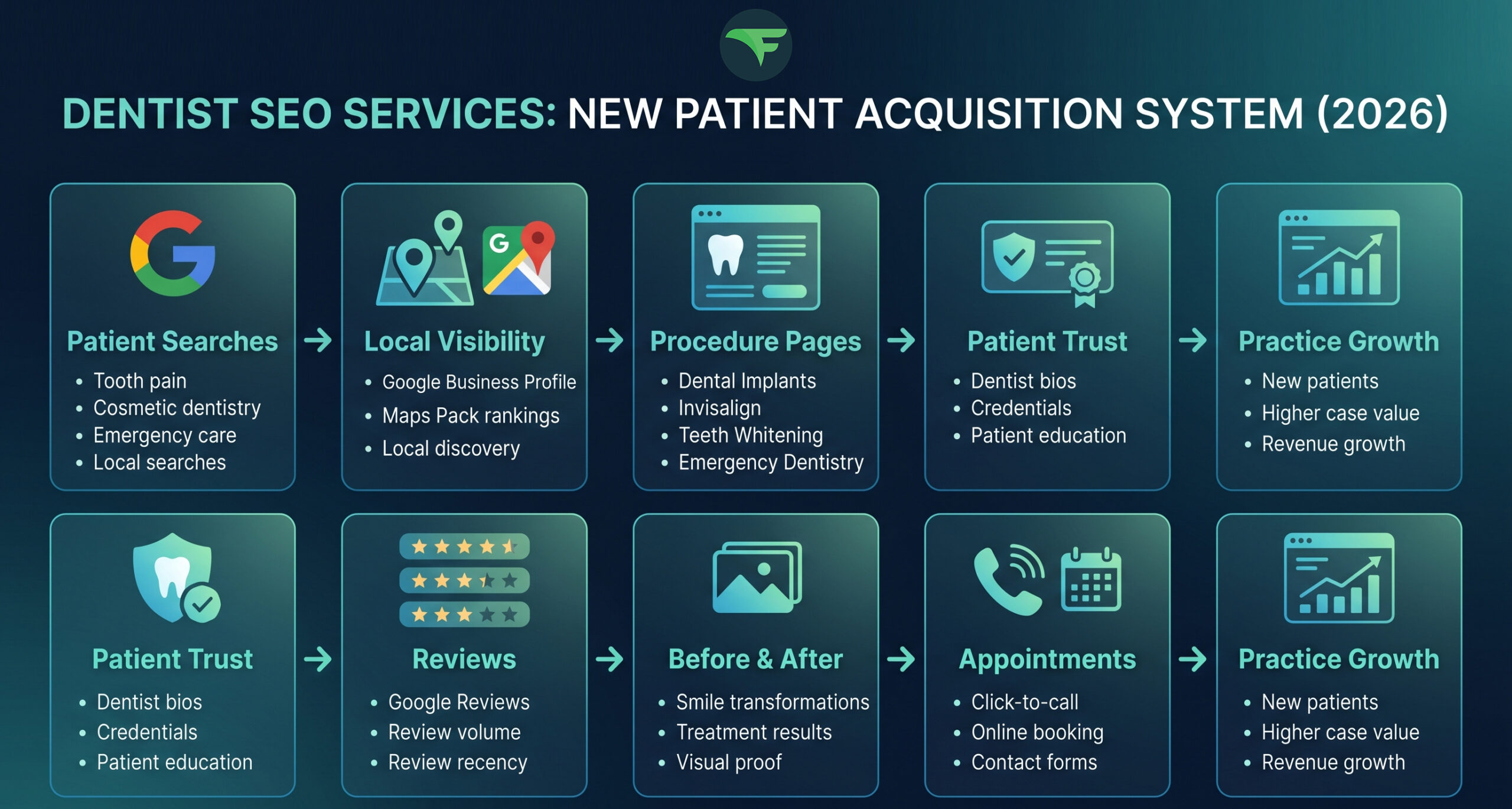
How Today’s Patients Find Their Dentist
Patients don’t rely exclusively on referrals to find dental care anymore. The journey starts with a search — typically a local query on a mobile device — followed by a fast comparison of results based on proximity, reviews, and visible credibility signals. The practices that appear prominently in that initial search capture the first contact.
A 2025 cross-sectional study published in BMC Oral Health found that 70.1% of female patients and 56.4% of males said a dentist’s social media presence encouraged them to choose that provider. Viewing pre- and post-treatment cases was identified as a direct influence on provider selection — making visual content an acquisition asset, not just a marketing nicety.
The Digital Patient Decision Journey
Search is the entry point. A patient experiencing tooth sensitivity, looking for a cosmetic consultation, or seeking a new primary dentist will open Google before doing anything else. What they find in those first results determines which practice gets called.
Reviews and website content are the trust filters. Once a patient has a shortlist from local search results, they compare reviews, read about procedures, and evaluate whether the practice feels credible enough to contact. The practice that covers all three touchpoints — visibility, reviews, and content depth — consistently wins that comparison.
SEO Strategies That Drive New Patient Inquiries
Effective dental SEO starts with the same groundwork the U.S. Small Business Administration recommends for competitive analysis: understanding which audience segments are closest to converting and mapping your content strategy to their specific intent. In dentistry, that means matching your page structure to how patients actually search.
Not all dental keywords carry equal weight. A patient searching “tooth pain causes” is early in their decision process. One searching “teeth whitening cost Newport Beach” is actively comparing options. One searching “dentist near me open Saturday” is ready to book. Procedure pages built to address commercial and transactional queries drive inquiry volume that informational content alone can’t produce.
Keyword Intent Mapping
Informational keywords attract early-stage researchers but convert at low rates. Commercial and transactional keywords — tied to specific services, locations, and cost queries — attract patients who are already in selection mode.
A practice with separate, optimized pages for dental implants, Invisalign, emergency care, and routine cleanings will consistently outrank a practice with a single generic “services” page for any of those procedures. Specificity in page structure mirrors specificity in patient intent.
Local SEO and the Maps Pack
Google’s local pack — the map-based results that appear before organic listings for “near me” and location-based queries — drives a disproportionate share of new patient calls. Ranking in that pack depends on three signals: relevance, distance, and prominence.
Link building contributes directly to prominence. Google Business Profile optimization — accurate procedure categories, consistent citations, review volume, and regular content updates — handles the rest. For practices that are already well-regarded locally but not capturing search demand, Maps Pack positioning is often the fastest path to measurable inquiry growth.
Converting Search Traffic Into Booked Appointments
Ranking without converting produces dashboards, not revenue. A 2025 systematic review published in Dentistry Journal found that digital communication tools — teledentistry, mobile apps, social media, and online scheduling — strengthen patient engagement, build trust, and directly improve the quality of care relationships. Practices that offer seamless digital contact points generate more first-contact conversions from equivalent traffic.
Phone calls convert at significantly higher rates than web forms in dental patient acquisition. Practices with prominent click-to-call buttons, after-hours messaging options, and online booking functionality consistently convert more of their search traffic than those relying on a buried contact form.
Trust Signals That Drive Patient Conversions
A study in Dentistry Journal surveying 1,121 patients and 77 dentists identified the factors most strongly linked to patient satisfaction and loyalty: treatment quality, trust in clinical decisions, clear explanations, and the sense that the dentist genuinely understood the patient’s concerns.
These factors don’t materialize on a website automatically. Credential visibility, detailed procedure pages, dentist bios with clear explanations, and an accessible tone all contribute to the digital equivalent of that trust. Patients evaluating two practices of similar proximity will choose the one whose online presence answers their questions and reduces their anxiety first.
Visual Content and Before/After SEO
Research in Scientific Reports found that 29.37% of patients who underwent aesthetic dental treatment said social media influenced their decision. Before/after content is among the most persuasive formats in this vertical — and it doubles as an SEO asset when properly optimized.
Content marketing built around visual procedure results — with descriptive file names, keyword-relevant alt text, and dedicated gallery pages by procedure type — ranks for long-tail searches while simultaneously functioning as a patient trust mechanism. Most practices treat these images as social content only. Treating them as indexed, searchable page assets closes a meaningful competitive gap.
Flying V Group: Built for Dental Patient Acquisition
We’ve worked with practices across professional services and high-trust consumer verticals — categories where the decision cycle is long, the stakes feel personal, and conversion depends on credibility before it depends on anything else. Every dental engagement starts with a full audit: technical SEO health, procedure page structure, local pack positioning, and conversion performance across contact touchpoints.
Technical Approach
Our SEO work is led by Sean Fulford, Director of SEO and Senior SEO Solutions Architect, with over nine years of experience in organic search and generative engine optimization (GEO). GEO matters for dental practices because AI tools — Google AI Overviews, Perplexity, ChatGPT — increasingly answer patient questions directly, without a click through to a practice’s website. Practices whose content isn’t structured for AI citation lose a growing share of discovery volume to that channel every quarter.
We integrate technical SEO, local optimization, content strategy, link acquisition, and GEO into a unified program — not isolated service lines that don’t communicate with each other.
Why We Stand Out
Flying V Group has served 400+ clients since 2016, grown to become one of Orange County’s fastest-growing companies, and built our pipeline almost entirely through client results and referrals. Our client testimonials reflect a 12-month retention rate above 90%.
Most agencies report rankings. We report what rankings produce: call volume, new patient inquiries, and revenue that traces directly back to the marketing investment.
Evaluating Your Next Step
Dental practices evaluating SEO providers face a wide range of options, from local boutique agencies to national platforms. The question that matters most: can they show you specific inquiry growth data for a comparable practice, with a traceable timeline and a clear attribution methodology?
If your practice isn’t converting its online visibility into a measurable flow of new patient calls, contact Flying V Group to see what a patient acquisition strategy — built for dental search, not generic rankings — looks like for your practice.
Frequently Asked Questions
How long does dental SEO take to produce more new patient inquiries?
Dental SEO typically produces measurable ranking movement within three to four months, with inquiry growth becoming visible by months five to seven. Practices that also optimize their Google Business Profile often see local pack visibility and call volume improve faster than organic rankings alone. Competitive procedure keywords in dense metro markets may take longer to break through.
What keywords should a dental practice prioritize first?
Commercial and transactional keywords — those indicating a patient comparing options or ready to book — produce the highest conversion rates. Procedure-specific terms like “dental implants [city]” or “teeth whitening cost [area]” outperform generic informational terms for inquiry volume, even at lower search volume. Emergency and same-day appointment keywords also carry unusually high conversion rates.
How important is Google Business Profile for dental patient acquisition?
It’s critical. Google Business Profile controls whether your practice appears in the local Maps Pack, which appears above organic listings for location-based searches. Optimizing it for the right procedure categories, maintaining consistent citations, and actively managing reviews all affect local pack positioning and are among the most direct levers for increasing new patient call volume.
What’s the difference between dental SEO and paid ads for new patient growth?
Paid search produces faster visibility but stops generating leads when the budget stops. SEO builds compounding organic traffic that continues producing inquiries without incremental cost per click. Most dental practices benefit from running both: paid campaigns for immediate patient flow while organic rankings develop over six to twelve months. The combination consistently outperforms either channel used in isolation.
How do online reviews affect dental SEO performance?
Reviews contribute to the prominence signal in Google’s local ranking algorithm and function as a direct conversion factor when patients are comparing practices. Practices with a higher volume of recent, detailed reviews consistently outperform those with thinner review profiles in local pack results. A structured review generation approach — not passive collection — compounds this advantage over time.
What should a dental practice’s website include to convert more visitors?
High-performing dental websites include service-specific pages for each major procedure, prominent click-to-call buttons and online booking options, dentist bios that convey credentials and personal communication style, patient reviews visible without scrolling, and before/after imagery where relevant. Each of these elements addresses a specific point in the patient trust-building process.
Can dental SEO help attract patients for specific high-value procedures like implants or Invisalign?
Yes — and this is often where the ROI is strongest. Procedure-specific landing pages optimized for high-intent queries like “dental implants cost [city]” or “Invisalign consultation [area]” attract patients who are already researching that specific treatment. These pages convert at higher rates than general dental pages and can generate significant revenue per acquired patient relative to the SEO investment required.