
Most brands that invest in SEO have spent years optimizing for a single outcome: ranking high enough that users click their link. That model is under real pressure. When ChatGPT, Perplexity, or Google’s AI Overviews generate a direct answer, users often get what they need without clicking anything. The brands that appear inside those answers aren’t necessarily the ones ranking first — they’re the ones AI systems have learned to trust as sources.
AI visibility optimization is the discipline of becoming one of those sources. Flying V Group’s GEO practice is built around this shift — helping brands move from chasing rankings to earning citations in the AI answers their audiences are already reading.
Why Ranking First Is No Longer Enough
The source sets that AI search engines draw from and the sources that rank in traditional Google search are largely different populations. A large-scale study comparing Google Search, Gemini, and AI Overviews across 11,500 real user queries found the overlap between AI-cited sources and organic search results sits below 0.2 average Jaccard similarity. The two systems are pulling from almost entirely different pools.
Google’s own documentation on AI features confirms that AI Overviews draw from existing search systems — but the weighting, selection logic, and content signals involved differ from standard organic ranking. There is no special AI optimization tag to add. The implication is that brands need to satisfy a different set of signals, not just rank higher on the ones they already track.
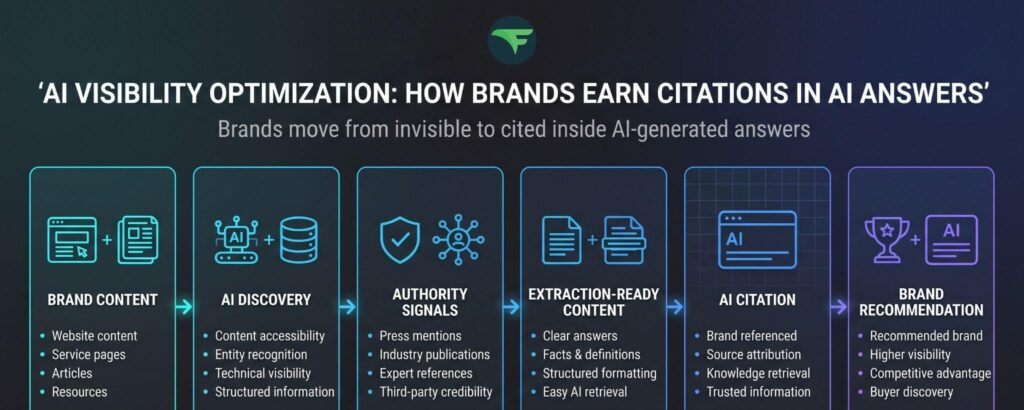
The AI Citation Funnel
Before choosing tactics, it helps to diagnose where the breakdown is occurring. AI citations don’t happen in a single step — they follow a progression, and most brands fail at one of five stages:
| Stage | Question |
| Discoverability | Can AI crawlers find and access your content? |
| Understanding | Can AI systems identify what your brand does and who it serves? |
| Authority | Do credible third-party sources mention your brand? |
| Citation | Is your content included in AI-generated answers? |
| Recommendation | Is your brand suggested over competitors for relevant prompts? |
Every AI visibility strategy should target a specific stage of this funnel. Publishing more content addresses Discoverability. Structured data addresses Understanding. Earned media addresses Authority. Declarative, extraction-ready writing addresses Citation. Competitive Share of Model analysis reveals gaps at the Recommendation stage.
AI Search Prefers Earned Media Over Brand Content
This is the single finding most AI visibility strategies underweight. Research published on arXiv examining GEO across multiple verticals found that AI search engines show a systematic and overwhelming bias toward earned media — third-party, authoritative sources — over brand-owned content and social media. Traditional Google search draws from a more balanced mix; AI systems tilt heavily toward independent references.
LinkSurge’s analysis of AI citation patterns puts a number on this: roughly 91% of AI-generated citations come from sites other than the brand being cited. A brand’s own website accounts for approximately 9% of the citations mentioning it. The practical implication is that the most important work in AI visibility optimization happens off your own domain — in the form of press coverage, analyst mentions, industry publications, and authoritative third-party references that establish your brand as a recognized entity in its category.
Help AI Systems Understand Your Brand
Earning citations requires that AI systems first understand who you are and what you do. Google’s structured data documentation explains that structured markup helps search systems understand organizations, products, people, services, and locations — the entity types that AI systems need to classify correctly before they can recommend a brand with confidence.
Entity clarity extends beyond on-page markup. It includes consistent brand descriptions across all external sources, unambiguous category definitions, and named individuals associated with specific areas of expertise. AI systems build a picture of a brand from everything they can find about it — not just what the brand publishes about itself. When that picture is consistent and specific, the probability of accurate citation increases. When it’s fragmented or contradictory, the brand often gets omitted in favor of cleaner alternatives.
Write for Extraction, Not Just Engagement
Adobe’s research on LLM optimization draws a useful distinction: traditional SEO optimizes for ranking; LLM optimization focuses on making facts easy for AI systems to extract and synthesize. The writing style that serves AI citation is different from the writing style that drives engagement metrics.
Extraction-ready content has specific characteristics. Declarative sentences that stand alone as complete claims. Specific entities, numbers, and named methodologies embedded directly in sentences rather than implied through surrounding context. Short paragraphs organized around a single idea. Clean heading hierarchies that allow AI systems to locate and attribute sections without parsing the entire document.
TechRadar’s analysis of agentic search notes that as AI agents increasingly handle multi-step research tasks on behalf of users, the brands included in synthesized recommendations are those whose content can be cleanly parsed and attributed. Content that requires context to be meaningful is content that gets left out.
The 6 Factors That Influence AI Citations
Onely’s research framework on AI visibility identifies six factors that determine whether a brand gets cited:
Retrieval-ready content — technically accessible pages with clean rendering, fast load times, and no crawl barriers for AI bots.
Platform-specific optimization — different LLMs weight signals differently. What surfaces in Perplexity answers may differ from what appears in Google AI Overviews. Monitoring both is the starting point for platform-specific adjustments.
Entity authority — how consistently and specifically your brand is defined across its entire web presence, including third-party sources.
Technical performance — page speed, mobile rendering, and Core Web Vitals remain relevant because AI crawlers encounter the same access barriers as search crawlers.
Third-party citations — earned mentions from authoritative sources, industry publications, and recognized analysts. This is the factor with the highest leverage and the longest lead time.
Measurement systems — tracking citation frequency, Share of Model, and AI-referred traffic. Without measurement, optimization has no feedback loop.
SEO vs. AI Visibility Optimization
The tactical differences between traditional SEO and AI visibility optimization are worth stating plainly, since most content in this space treats them as the same discipline with a new name:
| Traditional SEO | AI Visibility Optimization |
| Rankings | Citations |
| Keywords | Entities |
| Backlinks | Mentions + authority signals |
| CTR | Recommendation rate |
| Position tracking | Share of Model |
| Search volume | Prompt coverage |
Google’s guidance on generative AI content emphasizes that content quality, accuracy, and expertise remain the foundational requirements — but the mechanism by which quality content earns visibility has changed. Building topical authority through fewer, more authoritative pieces tends to outperform publishing high volumes of keyword-targeted articles in AI citation environments.
Position Digital’s 2026 AI SEO statistics note that brands cited in AI-generated answers see significantly higher click-through rates on those citations than on equivalent organic positions — making each citation more valuable per impression than a standard ranked link.
The Goal Is Not to Rank in AI Search
The reframe that changes how AI visibility strategy gets built is this: the goal is not to rank inside AI search. The goal is to become the source AI systems trust enough to cite.
Ranking implies a position in a list. Citation implies recognition as an authority. The brands that will own AI visibility over the next few years are not the ones adding the most schema tags or publishing the most content — they’re the ones building genuine entity authority, earning independent third-party mentions, and structuring their content so AI systems can extract and use it cleanly.
If your brand isn’t appearing in the AI answers your prospects are reading, Flying V Group’s GEO and SEO services are built to close that gap — from technical accessibility audits to earned media strategy to content structured for AI extraction. Contact us to see what an AI visibility audit looks like for your specific category.
Frequently Asked Questions
What is AI visibility optimization?
AI visibility optimization is the practice of making your brand more likely to be cited, mentioned, or recommended in responses generated by AI systems like ChatGPT, Perplexity, Google AI Overviews, and Gemini. It differs from traditional SEO in that it focuses on citation and entity authority rather than keyword rankings and link equity.
Why doesn’t ranking #1 in Google guarantee appearing in AI Overviews?
Research comparing Google Search and AI Overviews found the source sets have less than 0.2 average Jaccard similarity — meaning the two systems surface almost entirely different content. AI systems apply different weighting logic than organic search, favoring entity clarity, earned media, and extraction-ready content over ranking signals alone.
What is the single highest-leverage action for improving AI visibility?
Earning third-party mentions from authoritative, independent sources. Research shows roughly 91% of AI citations come from sites other than the brand itself — so off-site authority building (press coverage, analyst mentions, industry publication references) has more impact on AI citation frequency than on-page optimization alone.
How long does it take to see results from AI visibility optimization?
The technical and structural changes — structured data, content formatting, crawl accessibility — can influence AI citations within weeks. Earned media and entity authority take longer, typically three to six months before consistent citation frequency increases. The two tracks should run in parallel, not sequentially.
What is prompt coverage and why does it matter?
Prompt coverage refers to the range of queries or prompts for which your brand appears in AI-generated answers. It’s the AI-era equivalent of keyword coverage in traditional SEO — instead of tracking which keywords you rank for, you track which prompts your brand is cited in response to. A brand with narrow prompt coverage is only visible for a small slice of the questions its potential customers are asking.
How do AI systems handle brands they don’t have strong signals about?
When entity signals are weak — inconsistent descriptions, limited third-party mentions, ambiguous category classification — AI systems typically default to established brands with clearer authority profiles rather than attempting to include less-defined entities. The practical result is that newer or smaller brands are excluded from AI answers not because their content is worse, but because their entity definition is thinner. Structural clarity and off-site presence are the remedies.
Is AI visibility optimization relevant for local businesses, not just national brands?
Yes. Local businesses appear in AI-generated answers for location-specific and category-specific prompts, and the same citation factors apply — entity clarity, third-party mentions (local press, directories, review platforms), and extraction-ready content. The competitive set is smaller, which means a local business with strong entity authority can achieve AI citation rates that a national brand with weaker signals cannot.