
Ranking on page one no longer guarantees your brand gets seen. When a user asks ChatGPT, Perplexity, or Google’s AI Overviews for a recommendation, the answer they receive may never include a single link from your site — even if you hold the top organic position. That gap between ranking and being cited is where AI brand visibility tools operate, and closing it is quickly becoming one of the more consequential decisions a marketing team can make in 2026.
Flying V Group’s GEO practice is built around exactly this shift — helping brands understand not just where they rank, but whether they’re being recommended by the systems increasingly driving purchase decisions.
Why Traditional Rank Tracking Is No Longer Enough
Search behavior has changed structurally, not incrementally. Pew Research found that Google users shown an AI-generated summary are measurably less likely to click through to any linked website. When the answer is delivered inside the search interface, the downstream traffic doesn’t materialize — regardless of where your site ranks beneath it.
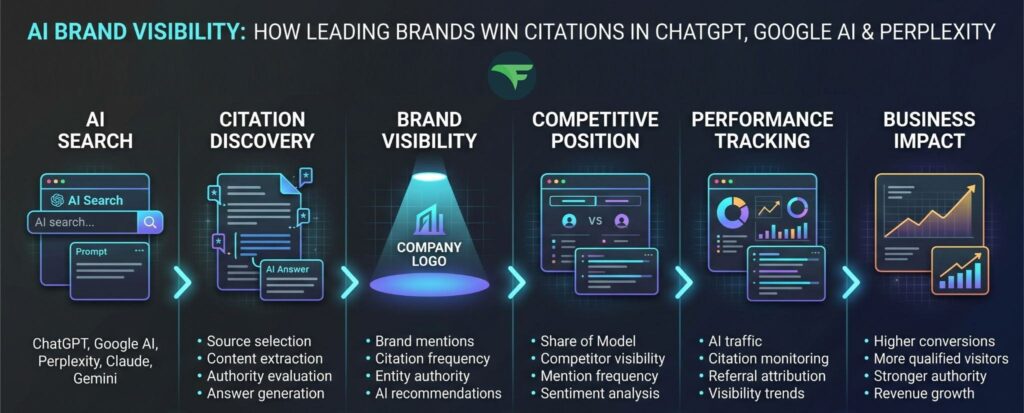
Brands now need to track whether they rank, whether they’re cited inside AI-generated answers, whether they’re mentioned by name, and whether competitors are being recommended in their place. A rank tracker answers the first question and ignores the other three.
AI Visibility Is a Revenue Metric, Not a Vanity Metric
Adobe Analytics data from Q1 2026, drawn from over one trillion visits to U.S. retail sites, found that AI-referred visitors converted 42% better than non-AI traffic — a complete reversal from March 2025, when AI traffic converted roughly 38% worse. Revenue per visit from AI referrals ran 37% higher than non-AI sources, with visitors spending 48% more time on site and engaging at a 12% higher rate. The channel that was the weakest performer in retail twelve months ago is now the strongest.
That shift changes how AI visibility should be categorized internally. It is not a brand awareness metric — it warrants the same measurement rigor applied to paid search or email.
AI Search Does Not Use the Same Sources as Traditional Google
A common assumption is that ranking well in Google organic search translates to AI citation. Research suggests otherwise. A large-scale study comparing Google Search, Gemini, and AI Overviews across 11,500 real user queries found that the sources retrieved by AI-generated answers and traditional organic results share less than 0.2 average Jaccard similarity — meaning the two source sets are almost entirely different. Traditional Google search weights government and institutional sources more heavily; AI systems surface a different distribution of sources entirely.
This has a direct operational implication: a brand optimizing exclusively for organic rankings is optimizing for a signal set that AI engines largely ignore. Visibility in AI answers requires a separate strategy, and measuring it requires separate tooling.
What AI Visibility Tools Should Actually Track
The 5 Metrics That Matter
Most AI visibility tools track some subset of the following. The strongest tools track all five:
Citation Frequency — how often your domain is cited as a source inside AI-generated answers. This is the most direct signal of whether your content is being used as evidence by LLMs.
Brand Mentions — how often your company name appears in AI responses, with or without a citation link. Mentions without citations still influence perception and can precede citation as authority builds.
Share of Model — how frequently your brand appears across AI-generated answers relative to named competitors. Yotpo describes Share of Model as the AI-era equivalent of Share of Voice: a competitive benchmark that shows whether your brand or a competitor’s is becoming the default recommendation inside a given category.
Sentiment — whether AI-generated mentions of your brand are positive, neutral, or negative. Visibility without sentiment tracking can be actively misleading; a brand mentioned repeatedly in a negative comparative context is not benefiting from that exposure.
AI-Referred Traffic — sessions originating from ChatGPT, Perplexity, Gemini, Claude, and similar platforms, tracked through analytics integration. This closes the loop between visibility and outcome. Platforms such as Yozigo report all five per prompt and per engine — citation frequency and brand mentions for each tracked prompt, Share of Model against named competitors, the sentiment of each mention, and AI-referred traffic captured at the bot level — across ChatGPT, Gemini, Perplexity, Google AI Overviews, Google AI Mode, Microsoft Copilot and Claude, by region.
Why Monitoring Citations Matters Beyond Simple Counting
AI systems generate inaccurate or unsupported citations more often than the industry typically acknowledges. Research published in arXiv evaluating four generative search engines — including Bing Chat, Perplexity, and YouChat — found that only 51.5% of generated sentences were fully supported by the citations provided. AI systems frequently produce statements attributed to sources that don’t actually support them, or cite outdated versions of content.
For brands, this creates a monitoring need that goes beyond tracking positive mentions. An AI visibility tool should surface incorrect attributions, outdated information being cited as current, and hallucinated claims associated with your brand name. Correcting the record with LLMs requires knowing the error exists first.
Not Every AI Mention Is Positive
A BrightEdge study on AI brand sentiment found that Google AI Overviews surface more negative brand mentions than ChatGPT does — a finding with meaningful implications for brands that assume all AI visibility is beneficial. An AI visibility tool that only counts mentions without categorizing sentiment by platform gives an incomplete and potentially misleading picture.
The practical implication is that competitive analysis inside AI visibility platforms should examine not just how often your brand appears, but what context it appears in. Being mentioned as the example of what to avoid is not equivalent to being cited as the recommended option.
What Makes LLMs Choose Certain Brands
Understanding why AI systems select some brands over others is as important as measuring whether they do. Onely’s research framework on AI visibility factors identifies several determinants:
- entity authority (how clearly and consistently your brand is defined across the web)
- third-party citations (whether credible external sources reference you)
- structured content (whether your pages use clear headings, definitions, and declarative claims that AI models can extract)
- technical accessibility (whether AI crawlers can actually read your pages)
- brand consistency (whether your name, category, and positioning are described the same way across sources)
Of these, technical accessibility deserves specific attention. Adobe’s AI Content Visibility Checker found that homepages averaged 75% visibility to LLMs and product pages averaged 66% — meaning roughly a quarter of retail content is entirely unreadable to AI systems. A brand can have strong entity authority and still be invisible to AI engines if its content isn’t structured for machine parsing.
Turning Visibility Data Into Measurable Outcomes
An AI visibility measurement practice is only useful if it connects to outcomes. FELD M’s technical guide on detecting AI traffic outlines how to identify sessions originating from major AI platforms in analytics — a prerequisite for attributing revenue and conversions to AI channel performance rather than bucketing it into “direct” or “referral” miscellaneously.
The workflow this enables is straightforward: track which AI platforms are citing your brand, identify which citations are driving sessions, and measure what those sessions do. Flying V Group’s SEO and GEO services incorporate AI visibility tracking as a standard component of search strategy — built around the position that where a brand appears in LLM answers is as measurable and as consequential as where it ranks in organic results.
Is Your Brand Showing Up Where Decisions Are Made?
Ranking well remains important. But the brands that understand AI visibility — which platforms cite them, how often, in what context, and with what sentiment — are measuring a different and increasingly decisive layer of search performance.
If your team is evaluating whether your brand is being recommended by the AI engines your customers are using, Flying V Group’s GEO practice is built to answer that question with data.
Frequently Asked Questions
What is AI brand visibility and how does it differ from SEO rankings?
AI brand visibility measures how often and how favorably your brand appears in responses generated by AI systems like ChatGPT, Perplexity, Google AI Overviews, and Gemini. Unlike traditional rankings, which track position in a list of links, AI visibility tracks whether your brand is cited or recommended in conversational answers — a distinction that matters because AI-generated summaries measurably reduce click-through on the links shown beneath them.
What is Share of Model and why does it matter?
Share of Model measures how frequently your brand appears across AI-generated answers compared to named competitors in the same category. It functions as the AI-era equivalent of Share of Voice — and unlike traditional Share of Voice, it’s platform-specific. Your brand may dominate ChatGPT responses while being absent from Perplexity’s entirely.
Do AI visibility tools work with platforms like ChatGPT and Perplexity, not just Google?
The better platforms monitor brand mentions and citations across multiple LLMs simultaneously — ChatGPT, Perplexity, Claude, Gemini, and Google AI Overviews. Coverage varies by tool, and the gap between platforms matters: BrightEdge research found that Google AI Overviews and ChatGPT surface meaningfully different sentiment profiles for the same brands.
How often should a brand audit its AI visibility?
Most practitioners recommend weekly monitoring for brand mentions and sentiment, with monthly competitive Share of Model analysis. AI-generated answers are dynamic — the same query can produce different results as models update or competitor content changes — so frequency should increase during an active GEO campaign.
Can a brand improve its AI visibility without redesigning its website?
Often yes. Structured content, clear entity definitions, and consistent brand descriptions across external sources can be improved through content strategy alone. That said, Adobe’s data shows roughly 25–34% of retail content is unreadable to LLMs due to technical rendering issues, so a technical audit is worth running before assuming content is the only bottleneck.
What analytics setup is needed to track AI-referred traffic?
Tracking AI-referred sessions requires configuring referral source identification for ChatGPT, Perplexity, Gemini, and Claude — through UTM parameters, referral domain filtering, or bot-pattern identification. In Google Analytics 4, several AI referral sources default to “direct” traffic without custom channel grouping, meaning most brands are currently underreporting AI-driven sessions.
Is AI visibility only relevant for e-commerce brands?
No. The Adobe Analytics data comes from retail, but the underlying dynamic — AI answers concentrating traffic toward cited sources — affects any brand where AI systems generate answers. B2B services, legal, financial, and local businesses are all subject to the same shift; e-commerce simply has the clearest attribution data at scale.