
Search engine optimization was built around a specific system: a crawler indexes pages, an algorithm assigns rankings, and users choose from a list of links. Language models don’t work that way. When someone asks ChatGPT, Perplexity, or Google’s AI Mode a question, the system retrieves sources, evaluates them, synthesizes an answer, and attributes claims — all before the user sees a single link. The brand that appears in that answer isn’t necessarily the one that ranked highest. It’s the one the model trusted enough to cite.
LLM SEO is the practice of earning that trust. Flying V Group’s GEO services are built around this shift — helping brands move from optimizing for position to optimizing for citation across the AI systems their audiences use daily.
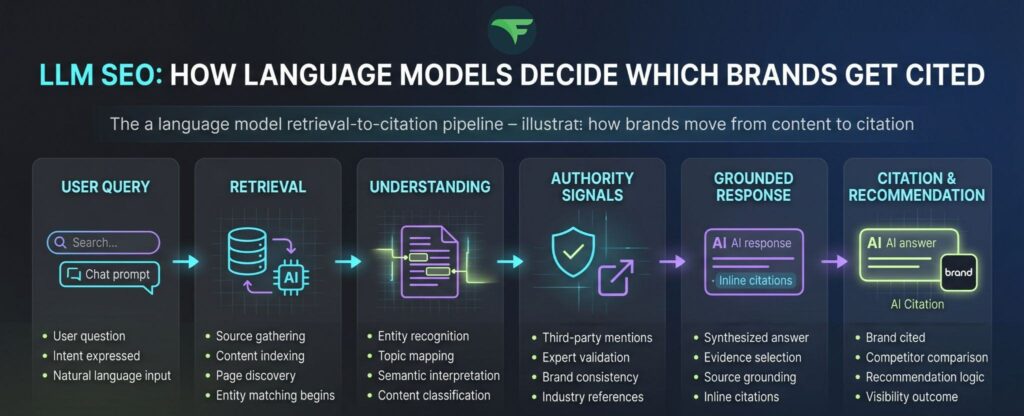
How an LLM Search Engine Actually Works
Most marketers treat LLM search as a black box, which leads to either over-engineering (adding every possible schema tag) or dismissal (assuming it’s just Google with a chat interface). Neither is accurate.
When a user submits a query to an LLM-powered search system, the process follows a recognizable sequence:
| Stage | What Happens |
| Query | User submits a question |
| Retrieval | System gathers candidate sources |
| Ranking | Sources evaluated for relevance and authority |
| Grounding | AI selects evidence to support its answer |
| Generation | Answer is written from selected sources |
| Citation | Sources are attributed inline |
Traditional SEO focused almost entirely on the Ranking stage. LLM SEO requires performing at every stage. A page that fails at Retrieval — because it’s technically inaccessible to AI crawlers — never reaches Grounding, regardless of how well it ranks. A page that fails at Grounding — because its claims aren’t structured for extraction — may be retrieved but not cited.
Google’s Biggest Message: AI Search Is Still Search
Before addressing what’s new, it’s worth anchoring to what hasn’t changed. Google’s official AI optimization guide is explicit: there is no special AI-only optimization framework. The fundamentals — helpful content, technical accessibility, demonstrated expertise — remain the foundation. Google states that the same signals used to evaluate content for standard search apply to AI features.
Google’s guidance on succeeding in AI search reinforces this: clear headings, concise definitions, structured data, and factual accuracy all improve performance in AI-generated experiences. Not because AI requires special formatting, but because those properties make content easier to retrieve, parse, and extract. The brands already doing strong foundational SEO have a head start. The ones relying on manipulation tactics don’t.
Why Old SEO Tactics Are Losing Effectiveness Fast
LLM-enhanced search systems have changed the risk profile of manipulation. Research published on arXiv examining black-hat SEO attacks against LLM search engines found that these systems blocked over 99% of traditional SEO manipulation attempts — keyword stuffing, thin content scaled for rankings, link schemes — that had partial effectiveness in legacy search. The mechanisms that made those tactics work against older algorithms simply don’t transfer to retrieval-augmented generation systems.
This matters for brands currently investing in low-quality link acquisition, AI-generated content at volume, or exact-match keyword targeting as primary strategies. Those approaches aren’t just less effective in LLM search — they’re increasingly counterproductive, as the systems are specifically trained to deprioritize content that exhibits manipulation signals.
Entities Matter More Than Keywords
Google’s structured data documentation describes how search systems use structured markup to understand organizations, products, people, locations, and concepts — the entity types that AI systems connect and cross-reference when building answers. LLM retrieval increasingly works through entity matching rather than string matching.
The practical difference: a traditional keyword strategy targets the phrase “corporate law firm Chicago.” An entity strategy ensures that your firm is clearly defined as a legal entity, associated with corporate law as a practice area, and consistently described that way across your own site and every external source that mentions you.
When a user asks an LLM about corporate law firms in Chicago, the model isn’t searching for keyword matches — it’s retrieving entities that match the query’s intent. Brands with weak entity signals get omitted in favor of those with stronger ones.
LLMs Evaluate Intent, Not Just Terms
Research on intent-driven generative search engine optimization found that LLMs evaluate user intent, semantic relationships, and contextual relevance rather than relying on the surface-level term matching that drove traditional keyword strategy. Generative search engines powered by RAG (Retrieval-Augmented Generation) operate in a fundamentally different retrieval context than keyword-indexed systems.
The implication for content strategy is that answering the underlying question clearly matters more than repeating a target phrase. A page that answers “what should I look for when choosing a corporate attorney” will surface for a broader range of related prompts than a page optimized to rank for the phrase itself. Comprehensiveness and clarity of answer are the signals that transfer to LLM retrieval; keyword density is not.
Why AI Search Prefers Third-Party Validation
Large-scale GEO research found that AI search engines show a systematic bias toward earned media — authoritative third-party sources, independent reviews, and industry publications — over brand-owned content. LinkSurge’s analysis of AI citation patterns puts the ratio at roughly 91% of AI citations coming from sites other than the brand being discussed. A brand’s own website accounts for approximately 9% of the citations mentioning it.
This is the single biggest structural difference between traditional SEO and LLM SEO. Ranking on your own domain remains useful, but the citations that build entity authority in LLM systems come predominantly from what other credible sources say about you. Press coverage, analyst mentions, industry publication features, and independent review platforms are LLM ranking signals in a way they never fully were in traditional search.
Traditional SEO vs. LLM SEO
The differences are worth stating plainly rather than implied through general GEO discussion:
| Traditional SEO | LLM SEO |
| Keywords | Entities |
| Rankings | Citations |
| SERP position | Recommendation frequency |
| Backlinks | Authority signals + mentions |
| Click-through rate | Inclusion in answers |
| Search volume | Prompt coverage |
| Meta optimization | Retrieval optimization |
The arXiv study comparing Google Search and AI Overviews found the source overlap between the two systems sits below 0.2 Jaccard similarity — confirming these aren’t parallel tracks of the same discipline. They pull from different source pools, reward different signals, and require different optimization logic. Running the same strategy for both and hoping for crossover is not a reliable approach.
What Doesn’t Work in LLM SEO
A few specific myths worth correcting:
llms.txt alone does not improve citation frequency. The file helps AI agents understand site structure but is not a citation signal. Google’s AI optimization guide makes no reference to it as a ranking or citation factor.
AI-specific schema isn’t required. Standard Organization, Product, Article, and FAQ schema already help AI systems parse entity relationships. Adding proprietary AI markup layers on top adds complexity without documented benefit.
Publishing more content at volume doesn’t scale AI visibility. LLM retrieval favors authoritative, well-structured pages over content quantity. A smaller number of genuinely authoritative pieces consistently outperforms high-volume keyword targeting in AI citation environments.
The Real Goal of LLM SEO
The goal isn’t to rank inside an LLM search interface. The goal is to become the source a language model retrieves, grounds its answer in, and cites. That distinction changes which investments make sense — more authoritative content, stronger off-site entity signals, better technical accessibility for AI crawlers, and measurement systems that track citation frequency rather than keyword position.
Flying V Group’s SEO and GEO services treat LLM visibility as a measurable, improvable channel — not a theoretical future state. If your brand isn’t appearing in the AI answers your prospects are reading, contact us to find out what’s blocking citation and what a structured LLM SEO strategy looks like for your category.
Frequently Asked Questions
What is LLM SEO and how is it different from regular SEO?
LLM SEO optimizes content and brand signals so that language model-powered systems — ChatGPT, Perplexity, Gemini, Google AI Overviews — retrieve and cite your brand in generated answers. It targets the full retrieval-to-citation pipeline rather than keyword rankings, weighting entity authority, earned media, and extraction-ready content over link equity and keyword density.
Do keywords still matter in LLM SEO?
They matter less as exact-match targets and more as indicators of intent. LLMs evaluate semantic relationships and contextual relevance rather than string matches, so content that thoroughly answers the underlying question outperforms content optimized for a single phrase. Entity signals and topical authority carry more weight than keyword repetition.
What is retrieval-augmented generation (RAG) and why does it matter for SEO?
RAG is how LLM search systems pull external sources at query time to ground answers in current information rather than training data alone. It means AI systems are actively retrieving and evaluating content — making technical accessibility, content structure, and authority signals directly relevant to whether your brand gets cited.
How does Google decide what to include in AI Overviews?
Google’s documentation states AI Overviews draw from the same signals as standard search — helpfulness, expertise, accuracy, and accessibility — with no separate AI-only optimization layer. High organic rankings help but don’t guarantee inclusion, since AI Overviews apply additional grounding and citation logic on top of standard ranking.
Is there a way to address an inaccurate AI-generated mention of my brand?
There’s no single fix, but publishing clear, correctly attributed content gives AI systems an accurate source to retrieve instead. Structured data that defines your brand’s attributes reduces misattribution risk, and regular monitoring through AI visibility tools lets you catch errors before they compound.
How long does it take for LLM SEO changes to show up in citations?
Technical changes — crawl accessibility, structured data, content restructuring — can influence citations within weeks. Authority-based changes — earned media, third-party mentions — typically take three to six months. Both tracks should run simultaneously.
Does LLM SEO apply to Perplexity and ChatGPT the same way it applies to Google AI Overviews?
The core principles apply across all platforms, but retrieval logic differs. Perplexity surfaces more niche sources; Google AI Overviews weight content already performing in standard search; ChatGPT’s browsing mode draws from a separate index. A complete LLM SEO strategy monitors each platform individually rather than treating them as one channel.