
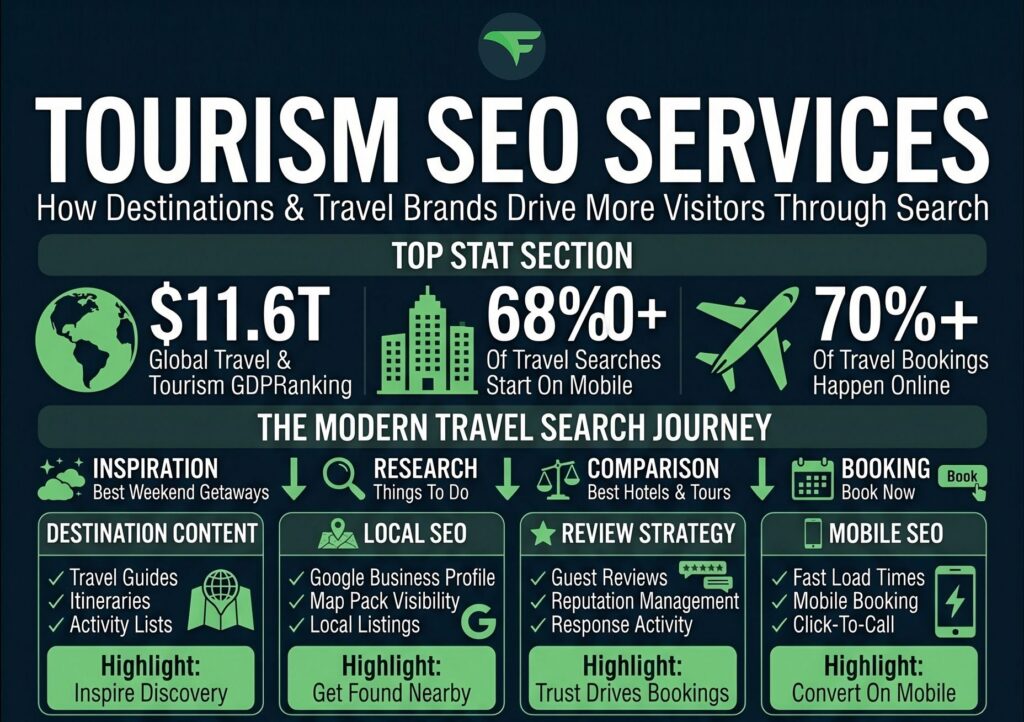
Travel & Tourism contributed a record $11.6 trillion to global GDP in 2025, growing nearly 50% faster than the broader economy. That growth means more destinations, hotels, tour operators, and attractions are competing for the same travelers — and those travelers start with a search. Over 70% of all travel bookings were made online in 2025, with 68% of travel searches now originating on mobile devices. If your destination isn’t ranking for the queries travelers type before they decide where to go, you’re losing business to operators who are.
Flying V Group builds SEO and content marketing strategies for tourism businesses that generate bookings, not just traffic. Contact us to discuss what a tourism SEO programme looks like for your property or destination.
Tourism SEO Starts Earlier Than Most Businesses Realise
The biggest mistake tourism operators make is treating SEO as a booking tool. It is, eventually — but the traveler’s decision cycle starts long before a booking page ever loads. A traveler planning a Pacific Coast road trip first searches “best stops along the PCH,” then “coastal camping California,” then “Big Sur resorts with ocean views.” By the time they’re ready to book, they’ve already shortlisted based on what appeared during inspiration and research queries.
Tourism SEO that only targets transactional keywords (“book hotel in [city]”) misses the top of that funnel entirely. The destinations and operators that appear during inspiration and planning searches build a familiarity advantage that brand-aware travelers carry all the way to checkout.
The Modern Travel Search Journey
| Stage | What Travelers Search | SEO Asset |
| Inspiration | “best weekend getaways near me,” “hidden gems in [region]” | Destination guides, itinerary content |
| Research | “things to do in [destination],” “family activities [city]” | Service pages, attraction guides |
| Comparison | “best resorts in [destination],” “[property] reviews” | Review profiles, comparison content |
| Booking | “[property name] book,” “tours in [destination]” | Landing pages, Google Business Profile |
| In-destination | “restaurants near [attraction],” “day trips from [city]” | Local content, maps integration |
The Core Components of Tourism SEO
Destination and Discovery Content
The highest-value content for tourism SEO is not a room description or a service page. It is the kind of editorial content that answers discovery-stage searches: seasonal activity guides, local itineraries, neighbourhood explainers, event calendars, and visitor planning resources. These pages rank for non-branded searches — “things to do in [destination]” — that attract travelers who haven’t chosen a property yet.
This content also performs well in AI search environments. Research published in 2025 confirmed that AI-powered engines like Google AI Overviews and ChatGPT heavily favour third-party authoritative content and earned citations. A well-sourced destination guide that genuinely helps travelers plan carries far more AI visibility weight than a promotional property page.
Google Business Profile and Local SEO
For most tourism businesses, Google Business Profile visibility generates more direct inquiries than any other organic channel. The Map Pack captures the majority of clicks for searches like “tours near me” or “hotels in [city],” and appearing there requires a different set of optimisation signals than traditional organic rankings.
Key local SEO factors for tourism businesses:
- Complete service area and category configuration
- Consistent photo uploads showing experiences, not just facilities
- Review velocity and response rate — 95% of travelers read reviews before booking, and 93% say those reviews influence their decisions
- Google Posts to signal active profile management
- Location pages for every service area or property site
Reviews deserve particular attention. Properties that respond to reviews consistently — including negative ones — generate more booking inquiries than those that don’t. Travelers under 40 are 80% more likely to pay a premium for accommodation with stronger reviews, making review management one of the highest-ROI activities in tourism marketing.
Mobile-First Technical SEO
With 63% of all online travel bookings now happening on mobile, a tourism website that loads slowly or breaks on a phone screen is not a minor inconvenience — it is a direct revenue problem. Google’s mobile-first indexing means page speed and mobile usability are ranking signals, not optional improvements.
Core technical requirements for tourism sites:
- Mobile load time under 3 seconds
- Click-to-call and click-to-book buttons above the fold on mobile
- Compressed images (WebP format, lazy loading for galleries)
- Structured data markup for hotels, tours, events, and local businesses
- Clear navigation to service-specific pages without requiring the homepage as an entry point
PageSpeed Insights scores below 60 on mobile are common on tourism sites built with image-heavy themes, and they directly suppress both rankings and conversion rates.
Seasonal and Long-Tail Keyword Strategy
Tourism is inherently seasonal, and keyword strategy should reflect that. A resort in Vermont optimising only for “ski resort Vermont” in January is missing spring hiking traffic, fall foliage inquiries, and summer wedding venue searches that represent entirely separate revenue streams.
Long-tail keywords serve a second function: they attract travelers at a more specific stage of intent. “Pet-friendly cabins near Asheville with hot tub” converts at a significantly higher rate than “cabins near Asheville” because the searcher has already narrowed their criteria. Tourism operators with pages targeting specific queries — by group type, activity, season, or amenity — capture that high-intent traffic that generic competitors leave on the table.
Tourism SEO vs. Paid Advertising: The Real Comparison
Most tourism operators use some combination of OTA listings, Google Ads, and platform spending. Each has a place, but the economics are structurally different:
| Channel | Cost Model | Lead Quality | Long-Term Value |
| Organic SEO | Time + monthly investment | High (self-qualified) | Compounds over time |
| Google Ads | Cost per click (paid continuously) | High (high-intent) | Stops when budget stops |
| OTA listings (Booking.com, Expedia) | Commission per booking (15–30%) | High | No brand equity built |
| Social media ads | CPM / CPC | Variable | Limited compounding |
SEO is the only channel that builds an owned asset. An operator ranking organically for “eco-lodge [destination]” or “family tours [city]” generates traffic and bookings without paying per click or surrendering a commission on each transaction. That structural advantage compounds over years in a way that no paid channel replicates.
Tourism SEO Works for Every Business Type in the Industry
Most tourism SEO content focuses on hotels. The reality is that the same organic search principles apply across the full spectrum of travel businesses — and several categories are significantly underserved from an SEO standpoint, which means the competitive gap is easier to close.
| Business Type | High-Value SEO Opportunity |
| Tour operators | Activity and experience searches; “things to do in [city]” content |
| RV parks and campgrounds | Seasonal and trip-type queries; “RV camping near [destination]” |
| Vacation rentals | Amenity and group-type targeting; “cabin for large groups [destination]” |
| Attractions and museums | Visitor planning content; local search and Map Pack visibility |
| Adventure companies | Long-tail activity searches; “guided hiking tours [region]” |
| Destination marketing organisations | Regional discovery content; AI citation authority |
| Event venues | Occasion and location searches; “outdoor wedding venues [state]” |
Operators in these categories often face less direct SEO competition than hotels and resorts, and a modest content investment — a handful of well-structured service pages and a maintained Google Business Profile — can establish first-page visibility within a realistic timeframe.
Build Organic Visibility That Compounds Over Time
Flying V Group builds tourism SEO programmes covering content marketing, local SEO, GEO, and web design for travel businesses that want consistent organic lead flow. Contact us to see what that looks like for your destination.
Frequently Asked Questions
What are tourism SEO services?
Tourism SEO services are search engine optimisation strategies tailored to the unique discovery and booking patterns of the travel industry. They typically include destination content production, Google Business Profile optimisation, local citation building, technical SEO, review management, and increasingly, GEO, thus structuring content to appear in AI-powered search recommendations from engines like ChatGPT and Google AI Overviews.
How does SEO help tourism businesses attract more visitors?
Tourism SEO attracts visitors by positioning a business across the full traveler journey — from inspiration and research searches through to booking queries. Operators that only appear for branded or transactional searches miss the majority of travel queries, most of which happen before a traveler has chosen where to go or stay.
Is SEO worth it for small tourism operators and independent properties?
SEO is particularly valuable for independent operators because it reduces dependence on OTA commissions, which typically run 15–30% per booking. A small resort or tour operator that generates consistent organic traffic owns that acquisition channel permanently, versus paying a platform fee on every transaction indefinitely.
How long does tourism SEO take to produce results?
Most tourism SEO campaigns begin generating measurable organic traffic within 3 to 5 months. Seasonal destinations may see faster results for off-peak searches and slower initial movement for high-competition peak keywords. Google Business Profile optimisation and review strategy can produce local visibility improvements within 4 to 8 weeks.
What keywords should tourism businesses target?
High-value tourism keywords fall into two categories: discovery-stage queries (“things to do in [destination],” “best weekend trips from [city]”) and booking-stage queries (“[property type] in [destination],” “tours in [city]”). Long-tail keywords targeting specific amenities, group types, or activities — “pet-friendly glamping [destination],” “private sailing tours [city]” — typically convert at higher rates due to searcher specificity.
How does AI search affect tourism marketing?
AI-powered search engines — Google AI Overviews, ChatGPT, Perplexity — are increasingly answering travel planning queries directly, recommending destinations and operators without requiring a click to a website. Research published in 2025 found these systems favour authoritative, earned media over brand-owned content. Tourism businesses with strong review profiles, editorial destination content, and consistent third-party citations are better positioned to be recommended by AI engines than those relying solely on their own website.
How do you measure the success of a tourism SEO campaign?
Beyond keyword rankings, meaningful tourism SEO metrics include organic booking volume, inquiry form submissions, Google Business Profile actions (calls, direction requests, website clicks), cost per organically acquired booking compared to OTA and paid channels, and Map Pack visibility for primary service-area searches.