
SEO in 2026 is a dual-channel discipline. Ranking on Google still matter, but as does appearing in the AI-generated answers that 47% of consumers are now using to research purchases. One also needs to strategize regarding responses on ChatGPT, Perplexity, and Google AI Overviews that frequently never send users to a website at all.
Keyword research remains the foundation of any serious strategy. But keyword research disconnected from how those same queries fanout across AI platforms gives you an incomplete picture of where your buyers are forming opinions. An agency optimizing purely for traditional rankings is solving half the problem while Gartner projects 70% of enterprise queries will shift to AI platforms.
The agencies worth evaluating are the ones that have built infrastructure for both channels and can connect that work directly to your revenue.
Flying V Group’s SEO engagements begin with a full diagnostic before any strategy is proposed. For one health sciences institution, that approach produced a 284% increase in direct phone inquiries and grew monthly organic traffic from 13,000 to 34,500 visits — with estimated monthly traffic value reaching $80,000. See what a revenue-focused engagement looks like.
Models of Partnership: What You Are Actually Buying
The engagement model should match your internal resources and growth stage, not just your budget.
Full-service retainer is the most common structure. The agency owns strategy and execution — technical SEO, content production, link acquisition, and GEO — under a single monthly fee. This works best for companies without in-house SEO resources and a clear revenue case for organic growth. It is also the model most prone to becoming transactional if the agency lacks a real diagnostic culture. FVG’s engagement with most clients tends to rest on this model.
SEO consulting separates strategy from execution. The agency develops the roadmap; your internal team or a separate vendor executes it. This works when you have capable in-house resources but lack the strategic depth to prioritize correctly. The risk is diffuse accountability — when results stagnate, the consultant built the plan and the internal team ran it, and neither fully owns the gap.
Project-based engagements are scoped to a defined deliverable: a technical audit, a site migration, a content architecture overhaul. These make sense when a specific problem is well-bounded. They are not a substitute for an ongoing partner relationship if organic search is a meaningful revenue channel.
Fractional SEO places a senior strategist part-time inside your marketing team, typically without execution resources. It suits companies that need strategic leadership but are not ready to fund a full-service retainer. The limitation is bandwidth — fractional relationships tend to work in a maintenance phase, not a growth phase.
Revenue share ties agency compensation directly to the organic revenue it generates, replacing or supplementing the flat retainer with a percentage of attributed growth. The model aligns incentives more tightly than any other structure — the agency only gets paid when the client wins. In practice it is rare because attribution is genuinely hard: a prospect who researches on Perplexity, returns via branded search three weeks later, and converts on a paid retargeting click is difficult to credit cleanly to SEO. Revenue share works best in e-commerce or direct-response verticals where conversion tracking is clean and the attribution chain is short. In B2B services, where sales cycles run months and involve multiple touches, the model tends to create disputes rather than alignment. Contact
The model determines accountability. A full-service retainer partner has no one to blame but themselves if the strategy underperforms. Consulting and fractional models distribute accountability in ways that can obscure whether the strategy or the execution is the problem. Revenue share forces the clearest alignment of all — but only where measurement infrastructure can support it.
Five Questions That Separate Strong SEO Partners From Weak Ones
Bring these into any evaluation conversation. The answers will tell you more than any proposal deck.
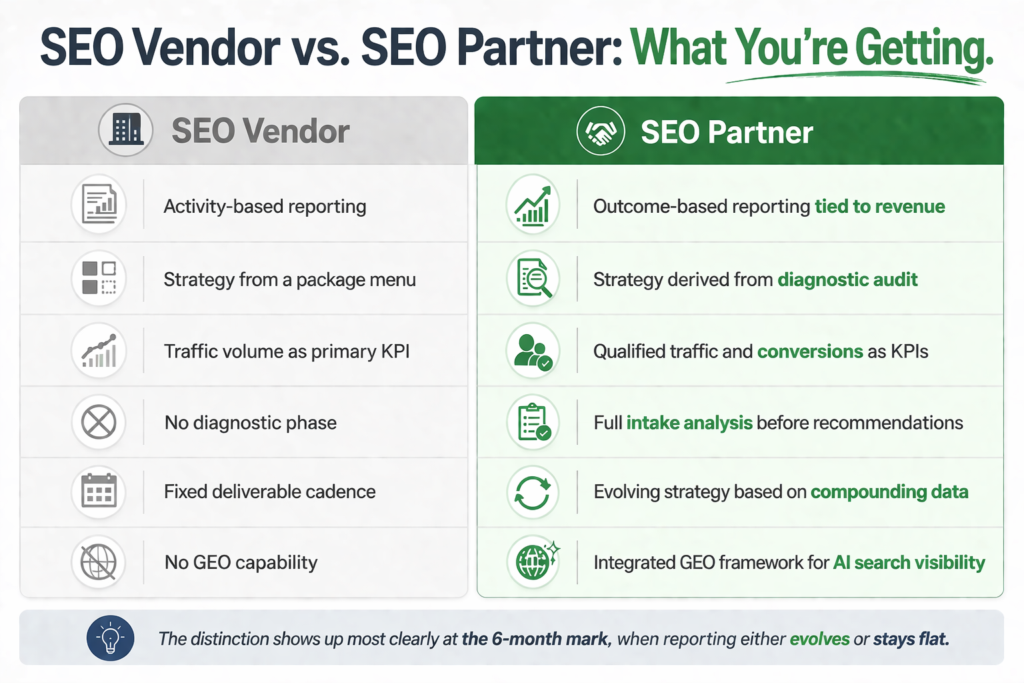
- How do you connect SEO work to revenue? If the answer leans on traffic volume and ranking positions without a clear pathway to business outcomes, that is a signal worth noting. A serious SEO partner can describe the attribution chain from organic traffic to qualified lead to closed revenue — and has reporting in place to track it.
- What does your intake and diagnostic process look like? Agencies that move directly to a strategy proposal without a real diagnostic are proposing solutions before they understand the problem. The depth of the intake process is a reliable proxy for how the entire engagement will run.
- How are you accounting for AI-powered search in your strategy? This question sorts agencies quickly. A specific answer — naming the platforms, describing the methodology, explaining how GEO interacts with traditional SEO — indicates an agency building for where search is going. A vague reference to “AI optimization” as a line-item add-on indicates the opposite.
- Can you walk me through a client result where SEO contributed to measurable business growth? Look for specificity: the attribution chain, the timeline, and the strategy that drove the outcome. A 284% increase in direct phone inquiries for a health sciences client over a defined engagement period is a different kind of claim than “we significantly improved their visibility.” The former is verifiable. The latter is not.
- What does your reporting look like at month six, not month one? Early reporting from most agencies looks similar — initial ranking movement, crawl fixes, content published. The differentiation shows up later, in whether reporting evolves to reflect compounding outcomes or stays fixed on the same surface metrics indefinitely. Ask for a sample report from an existing engagement at the nine-to-twelve-month mark.
The Time Horizon Every SEO Partner Should Set Upfront
One of the most common mismatches in SEO partnerships is misalignment on how long sustainable results take.
Meaningful organic growth for a competitive keyword set typically becomes visible somewhere between four and six months into a well-executed engagement. The compounding effect that makes SEO genuinely powerful as a channel usually shows up in the nine-to eighteen-month range.
Agencies that promise fast results in high-competition spaces are either targeting low-value keywords that do not move business forward, using techniques that carry long-term risk, or both.
This does not mean accepting an agency that cannot explain what early indicators of progress look like. A good SEO partner provides leading indicators that give you confidence in the direction of the work before the lagging revenue outcomes arrive.
Flying V Group retains over 90 percent of clients beyond the twelve-month mark. That number reflects what happens when an agency’s methodology is genuinely aligned with client outcomes rather than deliverable cadences.
If you are ready to work with an SEO partner that sets honest expectations and builds toward real business growth, see how Flying V Group approaches SEO engagements.
Making the Right Call on Your Next SEO Partner
Choosing an SEO partner is not a tactical procurement decision. It is a strategic one.
The partner you select will shape how your brand competes for organic visibility over the next several years. Getting it wrong does not just cost you the retainer; it costs you the compounding value of the time spent not building on a foundation that works.
Look for a partner that starts with diagnosis, reports on outcomes, covers both traditional SEO and the GEO landscape, and has the retention numbers to back their claims.
Frequently Asked Questions
What does an SEO partner do?
An SEO partner manages the strategy and execution behind your organic search performance. That includes technical SEO, content strategy, keyword research, authority building through earned links, and increasingly, Generative Engine Optimization to ensure your brand appears in AI-powered search results.
The difference between a true SEO partner and a vendor is that a partner ties all of that work directly to your business outcomes rather than reporting on activity for its own sake.
How long does it take to see results from an SEO partner?
Most businesses begin seeing meaningful organic movement between four and six months into a well-run engagement. The compounding growth that makes SEO genuinely powerful as a channel typically becomes visible in the nine-to-twelve-month range.
Timelines vary based on your domain authority, how competitive your target keywords are, and how much technical remediation is needed before content can perform. Any SEO partner that claims to deliver significant results within 30 to 60 days in a competitive market should be approached with caution.
What should I look for when choosing an SEO partner?
The most important thing to evaluate is whether the agency connects its work to revenue, not just rankings.
Look for a partner that starts with a diagnostic audit before recommending anything, reports on qualified traffic and conversions rather than keyword positions alone, has a clear methodology for both traditional SEO and GEO, and can show specific client results with attribution. Retention rate is also a reliable indicator of real-world performance.
How much does it cost to work with an SEO partner?
A comprehensive SEO engagement covering technical SEO, content strategy, link acquisition, and GEO typically runs between $2,500 and $8,000 per month, depending on scope and market competitiveness.
Retainers priced well below that range often involve templated execution, high client volume with limited individual attention, or deliverable-based models not designed around your revenue goals. The more useful framing is: what is the revenue value of ranking competitively for your highest-intent keyword clusters?
How do I know if my current SEO partner is underperforming?
Watch for these signals:
- monthly reports that focus on activity rather than outcomes,
- no clear connection between strategy decisions and the organic growth you have seen,
- no mention of AI-powered search or GEO in any strategy conversation,
- and more than six months of engagement without compounding momentum.
Poor early results do not always indicate a bad partner. Poor results at the twelve-month mark with no clear explanation for what is blocking progress usually do.
What is the difference between an SEO partner and an SEO agency?
The terms are often utilized interchangeably, but they describe different relationship models.
An SEO agency typically operates as a service vendor executing a defined scope of work. An SEO partner functions as a strategic extension of your team, involved in how organic search connects to your broader revenue model, what gets prioritized and why, and how the strategy evolves as your business grows.
The distinction matters most when results plateau and someone needs to make a judgment call about what changes.
If You Are Ready to Commit, Start Here.
Most businesses that come to Flying V Group are not starting from zero. They have tried SEO before, seen inconsistent results, and are now asking harder questions about why it did not work. That is exactly where a real diagnostic conversation starts.
Flying V Group’s SEO engagements begin with a full audit of your current organic position, competitive gaps, and technical health before any strategy is suggested. No templated pitches. No package menus. Just a clear picture of where you are, what is holding you back, and what a realistic path to organic growth looks like for your business.
If your current SEO situation is not producing the results your business needs, talk to Flying V Group’s SEO team and find out what a revenue-focused engagement looks like from day one.