

The fitness industry is booming—and that’s creating pressure on individual gyms. According to the 2025 Global Fitness Industry Report, the global fitness market continues to expand, with commercial fitness clubs facing intensifying competition for members.
The fitness marketing landscape just shifted. Membership acquisition costs are climbing. Algorithm changes have gutted organic reach on platforms that used to be free lead machines. Meanwhile, AI-powered search is fragmenting where your prospects discover gyms—no longer just Google, but ChatGPT and Perplexity. At Flying V Group, we specialize in building “future-proof” growth systems that capture demand where it lives today, not where it lived three years ago.
Why Most Gym Marketing Agencies Are Struggling
As the L.E.K. Consulting State of the Fitness Market 2025 report reveals, while North American membership has surged to a record 77 million, but the “leaky bucket” has never been more expensive to fill. The 2025 HFA Benchmarking Report confirms that median member retention sits at just 66.4%, meaning one out of every three members you pay to acquire will likely churn within the year.
The market changed faster than most agencies adapted. We’ve entered a new “demand generation” reality defined by the 2026 ACSM Worldwide Fitness Trends, where success is no longer about generic “weight loss” ads, but about dominating the #1 trend of wearable technology and the massive surge in exercise for weight management and mental health. You’re at a decision point: chase last year’s playbook or partner with a marketing agency that actually understands how to turn these 2026 shifts into sustainable, high-LTV growth.

1. Flying V Group — Revenue-First Fitness Marketing
Best For: Multi-location chains and ambitious gyms with $50K+ monthly budgets
Flying V Group approaches gym marketing like a CFO: every dollar must produce measurable returns. Founded in 2016, they’ve served 400+ clients across verticals, including deep expertise in fitness and wellness.
How They Work
They optimize for revenue per member—how much each person pays over their lifetime, not just first month. Their proprietary systems track LTV:CAC ratios (lifetime value to customer acquisition cost) across channels, killing underperforming campaigns before they drain budget.
Director of SEO Sean Fulford leads their search engine optimization strategy beyond keywords, capturing high-intent searches across emerging platforms like ChatGPT and Perplexity where fitness prospects now research gyms.
Core Capabilities
- Gym lead generation and demand generation: SEO, pay per click advertising, social, content, email
- Website design for conversion optimization
- Revenue-per-member modeling and LTV:CAC optimization
- Multi-channel attribution and cohort analysis
- Meta ads for gyms, Google ads for gyms, and emerging channel expertise (AI search, GEO)
- Instagram marketing for gyms and social media marketing optimization
- Fractional CMO consulting
Why We Stand Out
FVG has worked with Fortune 500 companies across a myriad of industries while scaling boutique fitness brands. Over 90% of clients stay longer than 12 months because they generate measurable revenue growth. The team operates globally with contracts from Kazakhstan to Southern California.
Most agencies optimize for rankings. Flying V Group optimizes for P&L impact. We think like CEOs because we measure like CEOs: revenue in, revenue out. Our approach to branding in marketing and marketing strategies to increase market share help gyms stand out in crowded fitness markets.
GEO: Beyond Traditional SEO
We developed Generative Engine Optimization (GEO) using our proprietary GEO Genius tools which can improve gym visibility across AI platforms, where 15-20% of high purchase intent searches occur.
When prospects query ChatGPT about “best gyms near me with personal training” or ask Perplexity about “CrossFit vs. traditional gym benefits,” GEO strategies determine which gyms appear in AI-generated responses.
Our Director of SEO Sean Fulford runs dual optimization:
Traditional SEO: Keyword rankings, local pack visibility, zero-click optimization
GEO Strategy: Citation difficulty scoring, query fanout simulation, LLM influence across ChatGPT, Perplexity, Claude, and Gemini
GEO Genius analyzes fitness query performance across AI platforms, identifying citation gaps and optimization opportunities. For gym chains, this captures demand across traditional and AI-driven search.
We segment fitness advertising by acquisition funnel economics: first-time gym memberships (high LTV, longer sales cycles), CrossFit converts (shorter cycles, immediate revenue), corporate wellness searches (bulk contracts, predictable revenue). Different unit economics demand different channel allocation.
We’ve implemented GEO strategies for multi-location fitness brands as parallel revenue channels—not Google replacements, but expansions of where gyms appear during high-intent prospect research.
2. Two Brain Marketing — Data-Driven + Coaching
Best For: Small-to mid-sized gyms wanting gym membership marketing education alongside execution
Two Brain flips the traditional fitness marketing agency model: instead of being order-takers, you understand and refine strategy together. They combine detailed analytics with content strategy so you’re building marketing literacy while campaigns run.
Their focus on ROI analysis means your investment directly ties to gym lead generation metrics: member acquisition cost, retention rates, and lifetime value. Community-driven approach has built strong loyalty among independent owners who appreciate transparency.
If you want a personal training marketing or gym membership marketing agency that teaches as much as it executes, Two Brain delivers.
3. GloFox Marketing — Integrated Platform + Strategy
Best For: Gyms wanting marketing and member management software in one system
GloFox merges gym management software with marketing capabilities. CRM tools, retention strategies, and branding create a closed-loop system where campaigns feed directly into operations software.
Leads drop into your member database automatically, retention sequences trigger based on engagement, and performance data flows into one dashboard. For gyms managing five different tools, this consolidation saves hours weekly.
They’ve built deep integrations specifically for fitness—class schedules, membership tiers, attendance patterns—rather than forcing generic software onto your operations.
4. Loud Rumor — Performance Social & Gym Lead Generation
Best For: Local gyms and regional chains with $10K-$40K budgets focused on social media marketing
Loud Rumor specializes in gym TikTok marketing, Instagram marketing for gyms, and Facebook ads for gyms—the channels gym owners actually use. They translate fitness messaging into social creative that doesn’t feel corporate—understanding motivation, transformation, and community.
Lead generation funnels for gyms convert trials into memberships. Consistent case studies show strong gym lead generation results. They avoid vanity metrics (likes, follows) in favor of member acquisition cost and trial-to-membership conversion.
5. Gym Launch — Growth Systems + Sales Coaching
Best For: Ambitious gyms with $40K+ budgets ready to scale aggressively; CrossFit gym marketing and yoga studio marketing specialists
Gym Launch combines marketing with sales funnels and lead conversion tactics. They help gyms sell more memberships faster, not just generate traffic. Paid acquisition pairs with high-touch sales systems, typically for premium/high-ticket fitness models.
They provide coaching alongside execution, helping gym owners understand how to get more gym members through systematic approach. They’ve helped numerous chains scale from single to multi-unit operations, managing 8-figure marketing budgets.
How to Choose the Right Gym Marketing Agency
The U.S. Small Business Administration emphasizes that market research and competitive analysis are essential for business growth. For gyms, this means understanding your competitive landscape and choosing marketing partners who can help you stand out.
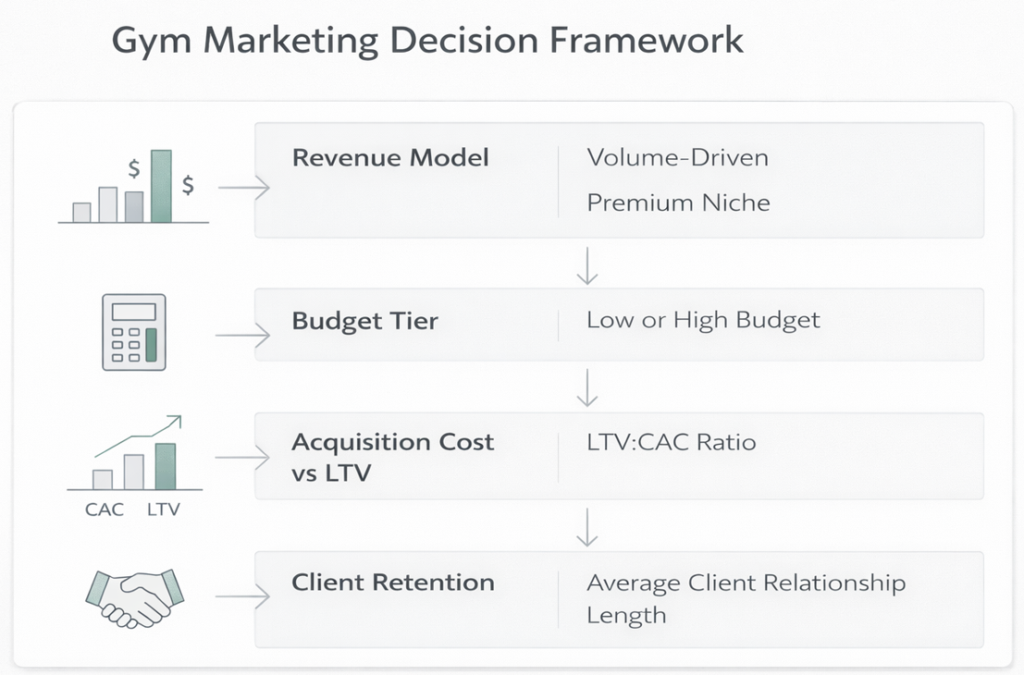
Understand Your Revenue Model
High-volume gyms (budget fitness, CrossFit) need fitness advertising agencies obsessed with low-cost-per-acquisition and funnel velocity. Premium/boutique gyms (yoga studios, Pilates studios, boxing gyms) need agencies commanding higher trial costs but converting at higher rates. Enterprise chains need multi-location attribution and complex mix modeling.
Misalignment here is why gyms hire marketing agencies and see no results.
Listen to the Explanation
Most gym owners don’t fire their gym marketing agency because gym lead generation doesn’t work—they fire them because no one explains why it isn’t working. If your fitness marketing agency can’t walk you through their attribution model or show exactly where member acquisition cost increased, that’s a red flag.
Demand LTV: CAC Performance
A good gym ads management agency should explain previous gym clients’ lifetime value to customer acquisition cost ratios and how they optimized them. If they’re discussing “engagement” without connecting to gym revenue, keep looking.
Ask: “Show me how your previous gym clients’ member LTV changed under your management and your target LTV:CAC ratio for our business.”
Check Client Retention
An agency’s best credential is how long clients stay. Ask: “What’s your average client relationship length for fitness studios and gyms?” Under 12 months signals problems.
FVG reports 90%+ retention over 12 months. Two Brain’s community-driven model builds loyalty. Agencies with high churn hide it.
Qualify on Budget Honestly
The right agency should match your budget tier—boutique operators serve gyms with tighter budgets, mid-market agencies handle growing operations, and enterprise agencies serve chains with complex scaling needs. Budget transparency matters because overpaying for unused systems is worse than underpaying and getting incomplete gym lead generation results.
The Most Common Mistake Gym Owners Make
Most gym owners hire agencies before clarifying three critical numbers:
- Average membership value
- Break-even cost per lead
- Whether they need volume or higher-ticket members
Without clarity, even good agencies struggle. You’re asking someone to hit a target you haven’t defined. Know these three numbers before contacting any agency.
Which Agency Type Fits You?
Volume + Price-Driven: 1-2 locations selling mostly on price? Loud Rumor or Two Brain offer hands-on attention and budget efficiency.
Class-Based + Retention: Runs on classes, tiers, and automation? GloFox’s integrated platform keeps member data connected to marketing.
Multi-Location/Franchise: Managing multiple locations? Flying V Group’s enterprise systems handle multi-location attribution at scale.
Premium + Aggressive Growth: Selling premium packages ready to scale? Gym Launch’s coaching model supports rapid expansion.
Start Your Search Today
Ready to transform your gym’s marketing? The right agency means the difference between spinning your wheels and scaling with confidence.
At Flying V Group, we help gyms achieve measurable revenue growth through strategic website design, search engine optimization, PPC campaigns, and integrated demand generation. If you’re managing multiple locations or ready to scale, let’s discuss how we can help.
Frequently Asked Questions
What exactly is a fitness marketing agency?
A fitness marketing agency specializes in gyms, personal training businesses, and wellness centers. They understand fitness buyer psychology, fitness-specific channels, and key metrics like member acquisition cost and lifetime value. A general agency may run ads well; an agency with a specialization in fitness understands why someone scrolling Instagram at 6 AM joins a gym at 6:15.
Why hire an external agency instead of building an in-house team?
Agencies have institutional knowledge across dozens of gyms; your internal hire has one. Agencies execute across channels immediately; building a team takes months and $200K+ in salary.
Agencies provide fractional CMO-level thinking that junior marketers can’t match. Most gyms benefit from agencies at sub-$100M revenue scale.
Contact Flying V Group Today
What services do fitness marketing agencies offer?
Core services: social media management and paid ads (Facebook, Instagram, TikTok), SEO and paid search, content creation, email marketing, lead generation, website design, reputation management. Premium agencies add: multi-channel attribution, LTV:CAC optimization, fractional CMO consulting, member retention strategy, emerging channel expertise (AI search, answer engines).
How does agency compensation affect service quality?
Most agencies use retainers, project-based fees, or performance commissions. Retainers support long-term partnerships; project-based models often turn and burn. Performance-only models can misalign incentives. The key test: does the agency grow when your business grows? FVG combines retainers with performance incentives—they win when you win.
What questions should I ask before signing?
Ask: (1) “Can you show your last three fitness clients’ LTV:CAC improvement?” (2) “What’s your average client retention rate?” (3) “How do you track multi-channel attribution?” (4) “When will we see initial results?” (5) “If results plateau, how do you adjust?” Confident agencies answer directly. Vague answers signal they’re not measuring what matters.
How long before I see results?
Most agencies need 8–12 weeks to assess your situation and launch initial campaigns. Real optimization occurs in months 3–6 once enough data is available. Don’t expect big first-month wins—expect clarity on lead sources and costs. By month 6, a good agency should show measurable improvements in acquisition cost or trial-to-membership conversion.