
Most brands now understand that appearing in AI-generated answers matters. What fewer understand is how visibility in those answers gets measured — what the tools are actually tracking, where the data comes from, and which metrics are worth paying attention to versus which ones look impressive in a dashboard but tell you nothing about business impact. The category of AI brand visibility checkers is expanding fast, and the gap between tools that genuinely measure citation performance and those that surface vanity counts is already significant.
Flying V Group’s GEO practice works with AI visibility measurement as a core component of search strategy — and the evaluation criteria we apply to these tools directly shapes the recommendations we make to clients.
Why Traditional SEO Tools Can’t Answer This Question
Rankings Measure Position. AI Visibility Measures Inclusion.
Rank trackers were built for one problem: where does a URL appear in a list of results for a given keyword? AI-generated responses don’t work that way. There’s no position 1 through 10 — there’s a synthesized answer that may cite your brand, mention it without citation, reference a competitor, or omit the category entirely.
Google’s documentation on AI features confirms that AI Overviews draw from the same underlying search index as organic results, but the selection logic for what gets cited differs from standard ranking. A page that ranks first may not be cited. Standard rank tracking has no mechanism to detect that gap.
The Click Behavior Shift Makes This Urgent
Pew Research found that users encountering AI-generated summaries click through to linked websites at measurably lower rates. A brand can hold strong organic rankings and still be losing audience to AI answers that don’t include it — a problem rank tracking will never surface.
What AI Brand Visibility Checkers Actually Measure
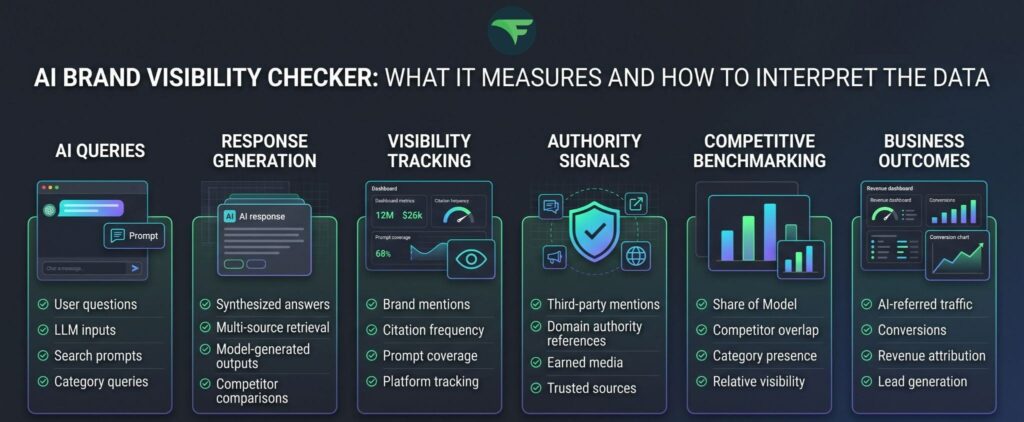
The better tools in this category track a defined set of metrics. Most track some subset of the following; the strongest platforms track all of them:
| Metric | What It Measures | Why It Matters |
| Citation Frequency | How often your domain is cited as a source | Direct AI visibility signal |
| Brand Mentions | How often your name appears in answers | Awareness without citation |
| Share of Model | Your visibility relative to named competitors | Market position in AI answers |
| Sentiment | Whether mentions are positive, neutral, or negative | Reputation, not just presence |
| Prompt Coverage | Which queries your brand appears in response to | Discoverability across topics |
| Citation Source Mix | Which of your pages get cited most | Content strategy signal |
| AI-Referred Traffic | Sessions originating from AI platforms | Connects visibility to outcomes |
The distinction between Brand Mentions and Citations is worth pausing on. Research published on arXiv examining GEO citation patterns found AI search engines heavily favor authoritative third-party sources over brand-owned content. A mention means your brand name appeared. A citation means your content was used as supporting evidence. Many tools blur this distinction; the ones that separate them give you materially more actionable data.
Brand Mentions vs. Citations: Why the Difference Matters
A brand can be mentioned frequently in AI-generated answers without being cited as an authoritative source — and these two outcomes have very different implications. Being mentioned might mean an AI system has enough awareness of your brand to include it in a comparison. Being cited means the model treated your content as credible evidence worth referencing directly.
The arXiv study on citation accuracy in generative search engines found that only 51.5% of AI-generated sentences are fully supported by the citations provided. This creates a monitoring need beyond simple mention tracking: visibility tools should flag incorrect attributions, outdated citations, and hallucinated references that associate your brand with claims your content doesn’t make. A checker that only counts positive mentions will miss this entirely.
The Industry Still Lacks Standardized Metrics
No Universal Measurement Framework Exists Yet
The category has no universally accepted measurement standards. The OECD’s AI governance research identifies the absence of consistent evaluation frameworks as a persistent challenge across AI applications, and AI visibility measurement is no exception. Different tools use different prompt sets, LLMs, refresh frequencies, and citation detection methods — meaning a Share of Model score from one platform isn’t comparable to the same metric from another.
Buyers should treat AI visibility metrics as trend indicators and relative benchmarks, not absolute values. Ask vendors specifically how prompt selection, citation detection, and refresh cadence work before drawing conclusions from their dashboards.
Adoption Is Outpacing Measurement Infrastructure
The Stanford HAI 2026 AI Index Report found organizational AI adoption reached 88%. The measurement infrastructure for understanding how those deployments affect brand visibility is still catching up — which is precisely why methodology transparency matters when evaluating tools.
The Best Tools Connect Visibility to Business Outcomes
Citation Counts Are a Leading Indicator — Not the Destination
Citation counts are a leading indicator. What they lead to is what matters. Adobe Analytics Q1 2026 data found AI-referred visitors converted 42% better than non-AI traffic, with revenue per visit running 37% higher. That data only exists because someone configured their analytics to track AI referral sources separately.
Closing the Loop Between Visibility and Revenue
FELD M’s guide to detecting AI traffic in Adobe Analytics outlines how to identify sessions from ChatGPT, Perplexity, Gemini, and other platforms through referral domain filtering, UTM configuration, or bot-pattern identification.
A visibility checker that integrates with your analytics platform is worth considerably more than one reporting citation counts in isolation. A tool that tells you Share of Model improved 12% is useful context. One that connects that shift to AI-referred sessions and revenue per visit is actionable intelligence.
Questions to Ask Before Buying an AI Visibility Tool
Most evaluation frameworks for this category focus on feature lists. The more useful questions are about methodology:
How many prompts are monitored, and how were they selected? A tool monitoring 50 branded queries gives a very different picture than one tracking 5,000 category-level prompts. Prompt coverage determines whether you’re measuring niche visibility or genuine market presence.
Which LLMs are tracked? Coverage across ChatGPT, Perplexity, Gemini, Claude, and Google AI Overviews matters because structured data research from Google confirms each platform weights entity signals differently. A tool covering only one platform will miss cross-platform citation gaps.
How often are results refreshed? AI-generated answers are dynamic. Weekly refresh rates are adequate for trend analysis; daily rates are needed for active campaign monitoring.
Does it separate citations from mentions? If the tool conflates the two, the metric is less useful than it appears.
Can it measure Share of Model against specific competitors? This is the metric that converts visibility data into competitive intelligence.
Does it connect to your analytics platform? The tools that bridge visibility to traffic and conversion data are the ones worth paying for at scale.
The Three Questions a Visibility Tool Should Answer
Are You Being Cited, or Just Mentioned?
The best AI brand visibility checker isn’t the one with the most features or the most data points in its dashboard. It’s the one that reliably answers three questions: Is your brand being mentioned by AI systems? Is it being cited instead of competitors? Is that visibility generating measurable business results?
Most Tools Only Answer One
Most tools in the current market answer the first question adequately. Fewer answer the second with competitive granularity. Very few answer the third without requiring significant manual analytics integration on the buyer’s side. Evaluating tools against those three questions, rather than feature count, will narrow the field considerably.
If your organization is building an AI visibility measurement practice and needs guidance on what to track, how to configure attribution, and which tools fit your category, contact Flying V Group — our GEO and SEO services include AI citation tracking and Share of Model analysis as part of a structured search strategy.
Frequently Asked Questions
What is an AI brand visibility checker?
An AI brand visibility checker is a tool that monitors how often and in what context your brand appears in responses generated by AI systems like ChatGPT, Perplexity, Gemini, and Google AI Overviews. Unlike rank trackers, which measure position in a list of links, visibility checkers track citations, brand mentions, sentiment, and Share of Model across AI-generated answers.
Are AI visibility metrics accurate?
They’re directionally useful but not universally standardized. Different platforms use different prompt sets, LLMs, and citation detection methods, so numbers aren’t directly comparable across tools. Treat them as trend indicators and relative competitive benchmarks rather than absolute values, and ask any vendor to explain their methodology before drawing conclusions from their data.
What’s the difference between a brand mention and a citation in AI answers?
A mention means your brand name appeared in an AI-generated response. A citation means your content was used as supporting evidence — the AI system retrieved your page and attributed a claim to it. Citations indicate stronger authority signals than mentions alone, and the two should be tracked separately. Research shows only about 51.5% of AI-generated citations fully support the claims they’re attached to, making citation accuracy monitoring just as important as citation frequency.
How do AI visibility tools detect citations from platforms like ChatGPT?
Most tools work by submitting a defined set of prompts to the monitored AI platforms at regular intervals, then parsing the responses for brand names, domain references, and citation links. Some platforms also analyze AI-referred traffic through analytics integration to cross-reference what sessions and conversions originated from AI platforms.
Does Share of Model replace Share of Voice as a KPI?
It supplements rather than replaces it. Share of Voice measures brand presence in paid and organic media; Share of Model measures how frequently your brand appears in AI-generated answers relative to competitors for the same category of prompts. Both metrics matter — they track visibility in different channels that increasingly operate in parallel rather than in sequence.
What should small businesses prioritize when starting with AI visibility measurement?
Start with prompt coverage — identify the 20 to 50 queries most relevant to your category and run them manually across ChatGPT, Perplexity, and Google AI Overviews monthly. Track whether your brand appears, whether competitors appear instead, and whether citations link to your site or a third-party source. That baseline is more actionable than a paid tool’s dashboard if you don’t yet have the volume to justify the cost.
How is AI-referred traffic tracked in Google Analytics?
In GA4, traffic from AI platforms often defaults to the “direct” channel without custom configuration. Accurate tracking requires either adding the major AI referral domains to your channel grouping rules or using UTM parameters on any links your brand controls in AI contexts. FELD M’s technical guide on detecting AI traffic outlines the specific configuration steps for both GA4 and Adobe Analytics setups.