
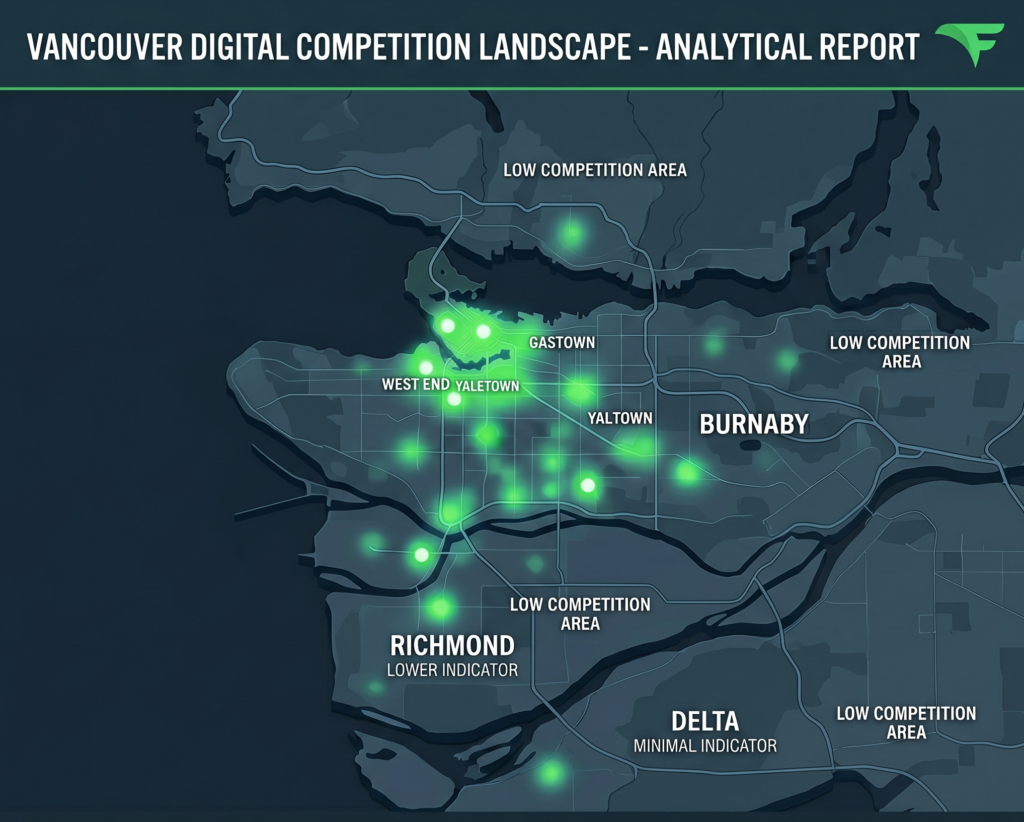
Vancouver’s search competition is concentrated. The professional services sector alone, spanning legal, accounting, financial, and medical firms, fills the first page with well-resourced competitors bidding for the same commercial terms. Add a strong tech and SaaS presence and an active real estate market, and most high-intent keywords face serious resistance.
Two structural shifts compound that pressure. AI Overviews now appear on a large and rising share of Google searches, pushing traditional results down and absorbing clicks that once reached websites. At the same time, a growing portion of informational and research queries never touches Google at all, moving instead to ChatGPT, Perplexity, and AI Mode.
The practical consequence is that a page can rank in the top three and still lose the click. Ranking and visibility have come apart, and Vancouver’s density means the businesses that adapt first take share from those still optimizing for 2023.
Moving organic search from a cost center to a revenue line in a market this competitive takes a deliberate model rather than a checklist. If you would rather have it executed end to end, Flying V Group’s SEO and GEO practice runs on GEO Genius, proprietary tooling built to win visibility in AI search, a capability most agencies still lack.
The Two Channels You Now Optimize For — Search and Citation
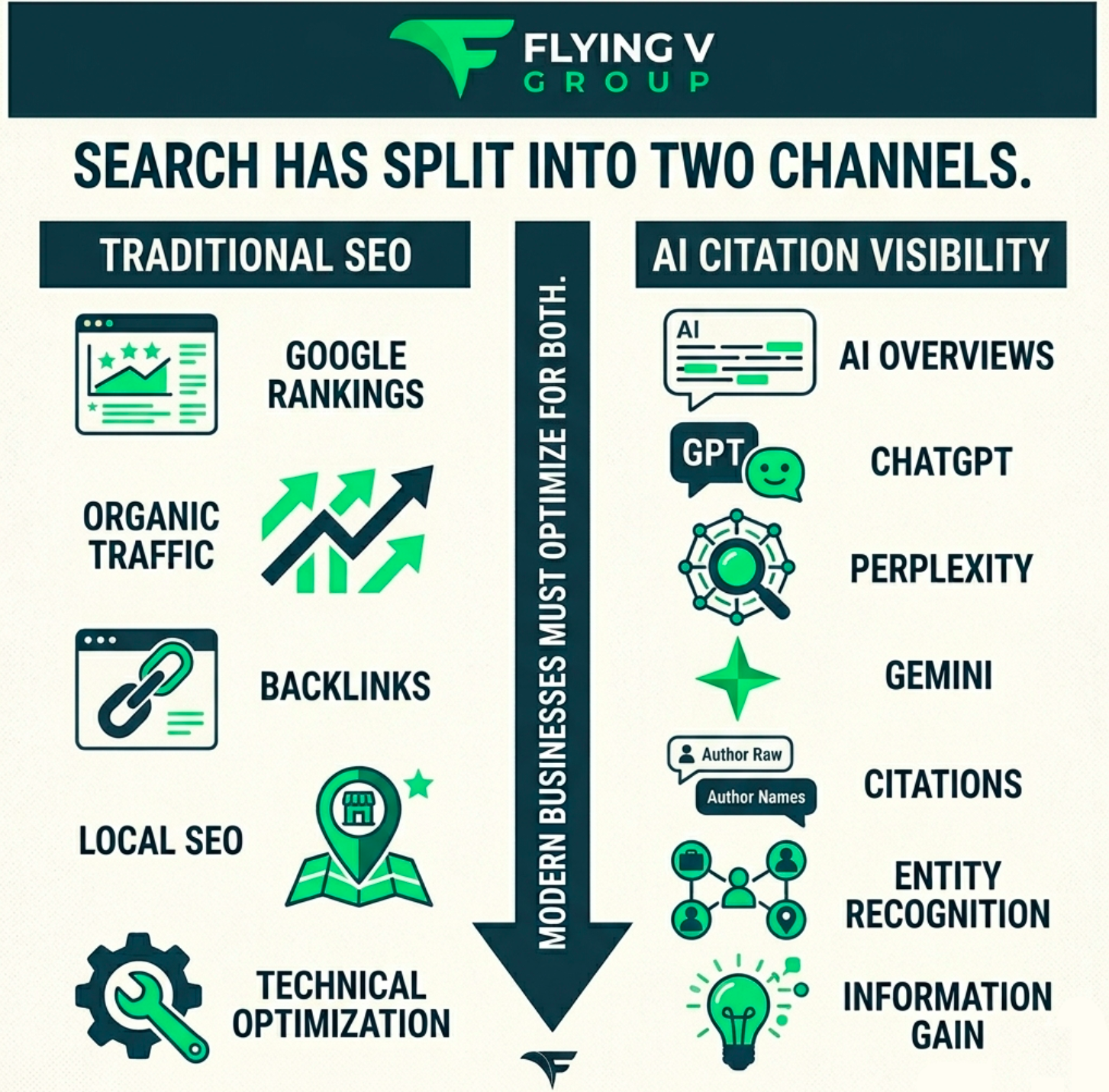
Modern visibility runs on two tracks at once. The first is traditional organic ranking: earning a position in Google’s standard results through relevance, authority, and technical quality. The second is citation in AI-generated answers: being the source a model pulls from when it composes a response in an AI Overview, ChatGPT, or Perplexity.
These channels reward overlapping but distinct work. It is widely thought that strong traditional SEO still underpins everything, because most AI systems draw from pages that already rank and carry authority. However LLM search adds a layer of complexity in terms of commodity vs. non-commodity content. Commodity content, the consensus answer to a common question, is what an AI system can now assemble on its own, so ranking first for it often means the AI answers the query and keeps the click. Non-commodity content is the opposite: proprietary data, a distinct framework, a first-party result the model cannot produce without you. That is the content it has to cite.
To see where your own content sits in terms of AI visibility, we can run a GEO assessment that scores your citation opportunities and maps the AI queries worth winning in your market.
Technical and On-Page Foundations — What Still Decides Rankings
Nothing downstream works if search engines and AI crawlers cannot access and understand your site. These fundamentals still decide most rankings: a clean crawl path, logical site architecture, fast Core Web Vitals, and correct indexation.
Furthermore, structured data continues to matter as schema types such as Article, Service, FAQPage, and LocalBusiness help Google interpret pages, and also make content easier for AI systems to parse and cite. The goal is to mark up entities, not just keywords.
On-page, match intent precisely. A query like “vancouver seo” carries blended commercial and local intent, so the ranking page has to demonstrate expertise, show local relevance, and answer the practical questions a buyer asks, all in a structure a machine can lift cleanly.
It also helps to remember that AI systems do not all reach the web the same way. ChatGPT leans on the Bing index (ChatGPT queries the Bing Search API amongst Shopify, and its own search engine for URL discovery), Gemini draws from Google’s own index, and Claude partially retrieves through Brave Search, so being findable now extends beyond Googlebot.
What does this mean for Vancouver businesses? A checklist of on-page and technical implementations as well as content that can rank across a broad-spectrum of models.
Local Signals That Drive the Map Pack — GBP, Citations, and Local PR
For any business serving a physical area, the Local Pack is often the highest-value real estate on the page.
Three inputs move it: a complete and active Google Business Profile, consistent NAP citations across directories, and a steady flow of genuine reviews. In a Vancouver context that also means presence on Yelp Canada and YellowPages.ca, with category and service-area data matching exactly across every listing so Google reads one coherent entity rather than several conflicting ones.
While Vancouver is obviously a large city, the pool of credible local sources is small enough that a handful of placements can shift how both Google and AI Overviews attribute relevance to a Vancouver brand, which makes local PR citations important rather than a vanity exercise. Earning backlinks in a defined set of regional outlets carries disproportionate weight, so coverage or links from the Vancouver Sun, Daily Hive, Vancouver Is Awesome, or Business in Vancouver tend to move authority faster than a comparable mention in a national title.
Multilingual search matters more here than in most North American markets. In the City of Vancouver, Cantonese and Mandarin are the dominant non-official languages: Cantonese is the second most common first language in the city at about 4.25 percent of residents. Punjabi is a major Metro-wide signal, but it concentrates outside the city core, with Surrey home to roughly two-thirds of Metro Vancouver’s Punjabi speakers. Businesses targeting Vancouver proper should weight Chinese-language content and GBP fields first; those expanding toward Surrey or Delta should weight Punjabi accordingly.
Surrounding municipalities are not uniform. Burnaby, Coquitlam, and the Tri-Cities offer lighter competition and a practical path to build regional authority before contesting core Vancouver terms. Richmond is the exception, since it holds around 23 percent of Metro’s residents who grew up speaking Chinese languages, making it a dense Chinese-language commercial market in its own right that demands the same multilingual rigour as the city centre, not less.
Content and Topical Authority — Information Gain Over Volume
Ranking for a competitive term like “vancouver seo” is rarely about a single page. It comes from topical authority: a cluster of content that covers the subject more completely than competitors, linked intelligently around a central page.
Information gain is the differentiator. Pages that add something the rest of the results omit, whether original data, a sharper framework, or a genuinely useful answer, earn both rankings and citations. Pages that restate the consensus get skipped by Google’s ranking systems and by the models deciding what to quote.
For AI citation specifically, structure carries as much weight as substance. Clear headings, direct answers near the top of each section, defined entities, and clean formatting make a page retrievable. This is where traditional content strategy and GEO converge.
Generative Engine Optimization — Earning Citations in AI Answers
Generative Engine Optimization is the discipline of making content eligible for inclusion in AI-generated responses. It is not a separate content type. It is a set of structural and authority practices layered onto sound SEO.
At Flying V Group, GEO is led by Sean Fulford and runs on the proprietary GEO Genius toolset, which includes Citation Difficulty Scoring, Query Fanout Simulation, and Citation Velocity Tracking. The toolset identifies which queries a given Vancouver business can realistically earn citations for, models how AI systems expand a single query into many related ones, and tracks how quickly a domain starts getting cited after changes ship.
The method is deliberately efficient. Rather than building toward citations blindly, it audits what is already within reach given a site’s current authority and content, then compounds from there. More on the framework lives at the GEO Genius site.
Measure Revenue, Not Rankings
The most common mistake in Vancouver SEO is reporting on positions and traffic while ignoring whether the work produces customers. Rankings are an input. Revenue is the output that matters.
A serious program ties keyword targets to revenue potential and measures organic against the same yardstick as any other channel: cost per acquired customer, lifetime value relative to acquisition cost, and contribution to pipeline. For a transactional business with a short sales cycle, that means modeling what a first-page position returns over a quarter. For a longer cycle, it means valuing the authority that compounds over months.
This framing also clarifies GEO’s payoff. A citation in an AI Overview or a ChatGPT answer is worth measuring not by impressions but by the qualified visitors and customers it sends.
When to Bring in a Partner
Choosing how to resource SEO demands a clear-eyed look at your revenue model and internal bandwidth. A business with the in-house skill to run technical SEO, content, local signals, and GEO in parallel can keep it internal. Most cannot, because the work now spans four disciplines that used to be one.
The questions to ask any partner are direct. Which of my keyword clusters will generate revenue in six months? How do you measure success against AI Overviews, not just rankings? Can you show an organic revenue trajectory for a comparable client rather than a traffic chart?
Flying V Group works with Vancouver businesses on exactly this: organic and AI search scoped against the P&L. To map what ranking in your vertical would take, start a conversation with the team.
FAQ
How long does SEO take to show results in Vancouver?
Initial movement on moderate-competition keywords usually appears within 8 to 12 weeks of technical fixes and targeted content. Meaningful organic revenue in competitive Vancouver verticals generally takes 4 to 6 months of sustained work, since the market’s density means authority has to be earned rather than bought. AI citation can move faster, with well-structured content sometimes appearing in AI Overviews or chatbot answers within 4 to 8 weeks, which is one reason to build GEO into a program from the start rather than bolting it on later. Any provider promising page-one rankings in 30 days is either targeting keywords with no real volume or using tactics that invite penalties.
What does SEO cost in Vancouver?
Pricing varies with scope and competition. Freelance consultants typically charge CAD $75 to $150 per hour. Agency retainers for small and mid-sized businesses generally run CAD $1,500 to $5,000 per month, depending on whether content production, local SEO, and GEO are included. Enterprise and national programs run higher. Treat sub-$750 monthly proposals for a market as competitive as Vancouver with caution, since that budget rarely covers the technical work, content, and link acquisition required to move rankings. The more useful question is not the monthly fee but the projected return: what a given investment should produce in pipeline and revenue.
What is GEO, and is it different from SEO?
Generative Engine Optimization is the practice of making content eligible to be cited in AI-generated answers such as Google’s AI Overviews, ChatGPT, and Perplexity. It overlaps heavily with SEO but is not identical. Traditional SEO earns rankings in standard search results, while GEO earns inclusion when an AI system composes an answer. The two share a foundation, because most AI systems draw from pages that already rank and carry authority, but GEO adds structural work: clear entity definition, direct answers, and formatting that machines can extract and attribute cleanly. In 2026, optimizing for one without the other leaves visibility unclaimed.
Can a business outside Vancouver rank for Vancouver searches?
Yes, with the right local signals. The technical and content components of SEO are geography-agnostic, so a capable team anywhere can execute them. What requires local fluency is the rest: understanding Vancouver’s competitive density, building citations in regional directories, earning links from local publications, and accounting for multilingual search in certain verticals. A business or partner that handles those signals deliberately can compete for Vancouver terms regardless of head-office location. The reverse also holds, since a Vancouver address alone will not rank you if the underlying signals are weak.
Do I still need traditional SEO if AI search is growing?
Yes, as much as ever. SEO acts as a necessary foundation for AI search.
How do I measure whether SEO is working?
Track outcomes, not vanity metrics.
Rankings and traffic are useful diagnostics, but the figures that matter are revenue-linked: organic-sourced pipeline, cost per acquired customer, and lifetime value relative to acquisition cost. Set up attribution so organic and AI-referred visitors are tracked through to conversion, which is harder now because a meaningful share of AI-influenced traffic is misattributed in standard analytics. A program that can show a revenue trajectory for comparable clients, rather than a chart of position changes, is measuring the right things. If your reporting stops at rankings, it is answering the wrong question.