

When prospects ask ChatGPT “which companies handle [your service]” or use Perplexity to research vendors in your category, does your company get mentioned?
Most businesses have no idea. They’re tracking Google rankings while 47% of consumers now use AI tools like ChatGPT and Perplexity to research purchases, Gartner projects 70% of enterprise queries will shift to AI platforms. Your competitors might be getting cited by Claude, recommended by ChatGPT, or listed by Perplexity, and you’d never know because none of this shows up in Google Analytics.
The companies getting AI citations aren’t waiting for it to happen organically. They’re using systematic approaches to influence what LLMs say about them, similar to how traditional SEO influenced Google rankings, but requiring entirely different infrastructure.
Flying V Group is one of the pioneers of Generative Engine Optimization (GEO) in 2023 when Director of SEO Sean Fulford identified the attribution gap most agencies still can’t see. We built proprietary tools that systematically test what triggers LLM citations, scoring systems that track mentions across platforms, and attribution models connecting AI visibility to revenue months later. While other agencies add “AI optimization” to service menus, we’ve spent years engineering the infrastructure that actually shapes what ChatGPT and other LLMs recommend.
What GEO Actually Requires (Not What Agencies Claim)
Most agencies retrofitted “AI optimization” onto existing SEO packages sometime in late 2024. They’re charging premiums for generic schema markup, some content reformatting, and crossing their fingers that LLMs notice.
It’s the equivalent of claiming you can influence Google rankings without ever building backlinks or fixing technical SEO—hoping algorithmic magic happens because you asked nicely.
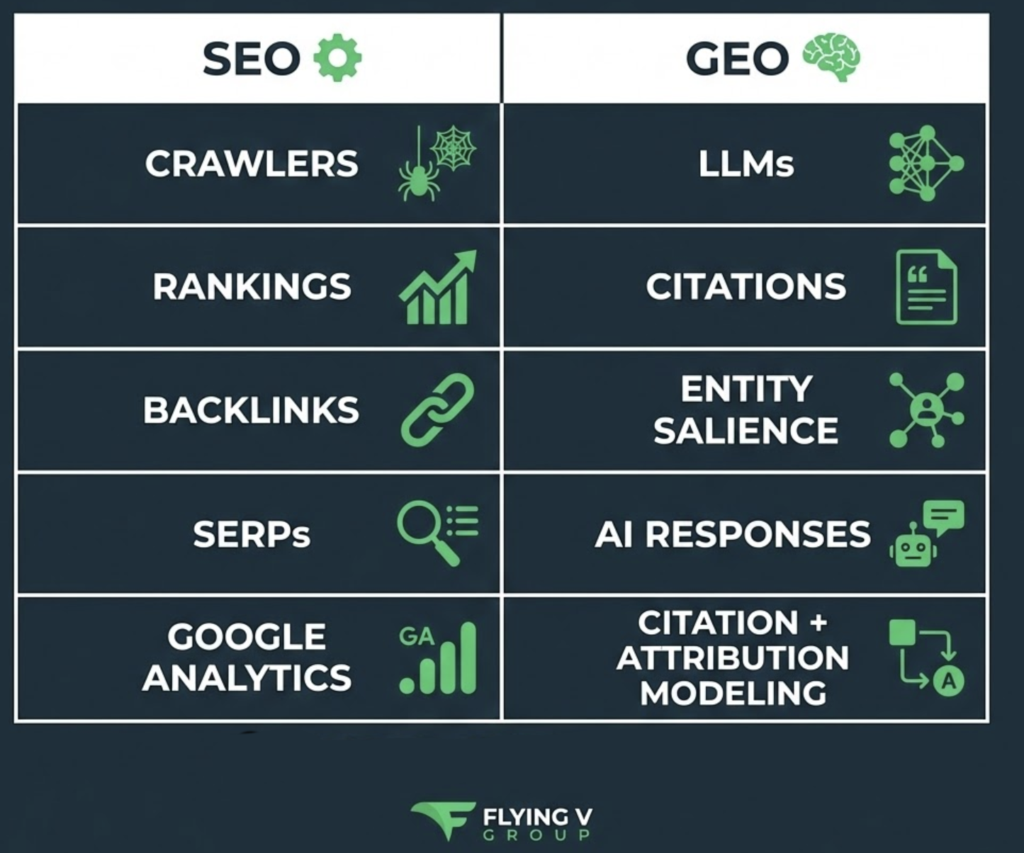
GEO demands three infrastructure layers most agencies don’t have and can’t build without significant R&D investment:
LLM Influence Infrastructure
Proprietary tools that systematically test what triggers citations across ChatGPT, Perplexity, Claude, and Gemini. Query response mapping identifies which content structures LLMs prioritize when constructing answers—not guessing based on blog posts about “how AI works,” but running hundreds of query variations to measure actual citation patterns.
Entity relationship engineering builds the semantic connections AI platforms recognize as authoritative. Training data positioning ensures your content enters the citation consideration set before LLMs generate responses. This is not content optimization.
It’s systematic testing infrastructure that refines what makes LLMs recommend you over competitors. Very often we build out content based on these inquiries.
Citation Architecture
We create content structured for RAG (Retrieval Augmented Generation) systems—the actual mechanism LLMs use to pull information. Entity relationships that establish topical authority.
Fact verification signals (data sourcing, credentials, update timestamps) that LLMs weigh when evaluating trustworthiness. This goes beyond “write good content”—it’s technical structuring that makes your content retrievable and citable by AI systems.
Measurement Infrastructure
Citation scoring tracks when and how your content surfaces in AI responses across platforms. Response influence tracking measures changes in LLM output following content updates—connecting optimization efforts to citation frequency shifts. Assisted conversion modeling connects AI visibility to pipeline 6-12 weeks later, since prospects research on ChatGPT then convert via branded search weeks afterward. Brand search lift analysis measures secondary effects: citation increases correlating with branded search volume spikes.
Without tools to influence LLM outputs, you’re hoping AI platforms organically discover your content among millions of competing sources. With proprietary influence systems, you’re engineering citation probability through systematic testing and refinement. The sophistication gap: businesses making growth decisions with 60% visibility into actual discovery channels while competitors track and optimize the invisible 40%.
GEO Implementation: How We Built the Infrastructure
The attribution gap in LLM search is obvious. Solving it required building GEO Genius—a proprietary tool built by Flying V Group that systematically influences what LLMs say about clients.
GEO Genius: Proprietary LLM Influence Tools
Traditional SEO waits for Google to crawl. GEO requires active testing across fundamentally different systems. GEO Genius runs automated experiments measuring which content structures, entity mentions, and data presentations increase citation probability across ChatGPT and other prominent LLMs.
Citation Difficulty: a new metric measuring how hard earning citations actually is based on source concentration and trust dynamics, not backlink metrics. Traditional keyword difficulty fails in AI environments because a small number of highly trusted sources often dominate answers, making topics appear “low competition” when they’re nearly impossible to penetrate. Our Participation vs. Influence analysis shows which topics are winnable before investing resources.
Query Fanout Simulation: modelling how AI platforms break queries into parallel sub-queries. Prompt Mapping simulates hundreds of real-world queries prospects actually ask. Citation Research identifies which prompts trigger retrieval, assesses competitive intensity, and flags low-hanging opportunities. Citation Influence Percentage quantifies how much cited sources shape outputs versus training data.
Non-Retrieval Attribution: Using token-level analysis identifying which training concepts shaped outputs when no explicit citations appear—critical for understanding brand positioning in LLM knowledge bases. Page Optimizer analyzes URLs and generates recommendations for LLM readability. LLM Render shows how AI platforms actually parse web pages, highlighting content that may not be indexable. Familiarity Checker estimates how well models know specific brands or topics.
The competitive moat: most agencies can’t build this infrastructure. We’ve developed tools that measure and refine LLM influence while competitors guess what “AI optimization” even entails.
Citation Scoring and Tracking
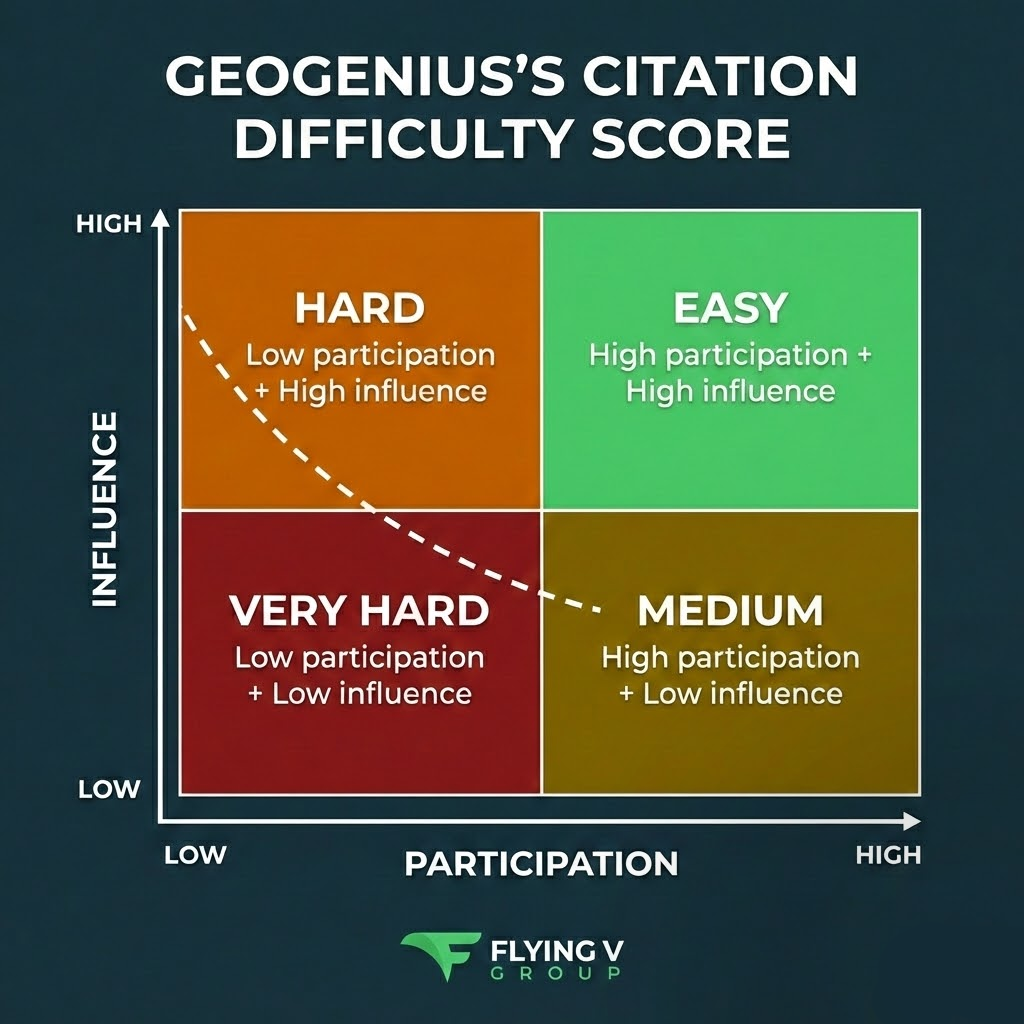
GEO Genius tracks client mentions across platforms using query taxonomy mapping which business problems trigger citations. Competitive benchmarking measures citation share versus competitors. Temporal tracking connects citation frequency changes to content updates.
What we measure: direct citations (explicit mentions), indirect visibility (content referenced without attribution), citation context quality (positioned as leader versus generic list inclusion), cross-platform consistency, response position (cited first versus later).
Attribution Model Rebuild
Traditional attribution tracks first click, last click, linear, time decay. None account for: prospect researches on ChatGPT → brand search 3 weeks later → direct traffic conversion.
Our solution: brand search lift analysis comparing baseline search volume to post-citation spikes. Cohort tracking monitoring conversion rates for prospects in high AI visibility markets versus low visibility markets. Survey integration asking “how did you first learn about us?” with AI platform options. Qualitative signal tracking from sales teams on prospects who “already knew our positioning.”
Results: 15-20% of qualified pipeline showing previously invisible AI platform assists. Higher close rates for prospects with AI-citation exposure. Shorter sales cycles when discovered via LLM versus traditional search. Citation frequency improvements of 30-40% following GEO Genius optimizations.
Who This Works For
Companies where attribution complexity matters—Fortune 500s and growth-stage companies where invisible pipeline sources create forecasting problems. Industries with long consideration cycles—B2B services, high-ticket B2C where AI research precedes direct contact by weeks.
Geo Genius is made for early movers looking to capture compounding advantages. Early citation authority establishes positioning that reinforces over time.
Client case studies—attribution data, citation improvements, pipeline impact—are available during consultations under NDA.
The Alternatives (And Why They Lack the Infrastructure)
As interest in AI visibility grows, several categories of providers have rushed to position themselves as “GEO” solutions. While each offers partial value, none address the core challenge: systematically influencing how large language models choose and repeat citations.
The “AI Optimization Add-On” Agencies
What they promise: “We’ll optimize your site for AI search.”
What they deliver: Generic schema markup, minor content reformatting, repurposed SEO best practices reframed as “AI-ready.”
The gap: These agencies lack proprietary tools to test what actually affects LLM citation behavior, any ability to influence or measure model preference over time, and proof that their changes alter AI outputs in a repeatable way. In practice, this is SEO with new language—not AI optimization.
Enterprise SEO Platforms Adding “AI Visibility”
Platforms like BrightEdge and Conductor have introduced AI visibility features.
What they do well: Monitor mentions, surface AI-generated references, provide passive reporting.
What’s missing: Active influence on LLM outputs, citation difficulty modeling, tools that shape which sources AI systems prefer and repeat. These platforms observe outcomes—but do not change them.
DIY with AI Monitoring Tools
What’s emerging: ChatGPT response trackers, Perplexity mention monitors, lightweight AI visibility dashboards.
The limitation: Visibility without influence. You can see if you’re cited—but you can’t systematically improve your odds, diagnose why one source dominates, or engineer repeatable citation wins. Monitoring ≠ engineering. Watching ≠ shaping.
Why Flying V Group’s Infrastructure Stands Apart
Flying V Group approaches GEO as an engineering problem, not a branding exercise.
The distinction matters: most agencies track whether citations occur. We engineer the probability that they will. GEO Genius doesn’t monitor AI outputs—it systematically tests content variations across query sets, measures which structural elements increase citation likelihood, then implements those patterns at scale. The feedback loop: test → measure → refine → deploy. Repeat until citation frequency shifts measurably.
Client results such as attribution data showing previously invisible pipeline sources, citation frequency improvements, brand search lift correlating with AI visibility, are available during consultation. Where applicable, we share case studies matching your industry and business model to show what systematic GEO implementation actually delivers.
Making the Decision
Traditional SEO remains appropriate for:
- Simple conversion paths where prospects move directly from search to action
- Short sales cycles measured in days
- Occasional markets where AI platform research hasn’t penetrated your category
- Budget constraints under $1500/month
GEO with proprietary tools makes sense for:
- Industries facing younger demographics that are more inclined to AI search
- Complex sales with multi-stakeholder decision processes
- High CAC ($5,000+) where attribution precision drives strategy
- Existing sophisticated attribution infrastructure ready for additional measurement layers
- Categories where competitors are building AI visibility (passive approaches lose ground)
- Available first-mover advantages (early citation authority creates compounding returns)
The Compounding Cost of Delay
If competitors are engineering systematic citation probability while you optimize for organic discovery then you are potentially missing . Attribution models missing 15-20% of pipeline sources, creating forecasting errors. First-mover dynamics in LLM influence: early topical authority establishment reinforces through training data cycles.
Ready to measure what percentage of your pipeline originates from AI platforms? Schedule a consultation to review how GEO Genius tracks discovery channels traditional analytics can’t see.
Frequently Asked Questions
What exactly is Generative Engine Optimization?
GEO is systematic optimization for how LLMs select and cite sources when generating responses. Traditional SEO engineered visibility in search results. GEO engineers citation probability in AI-generated answers.
The discipline exists because LLMs use fundamentally different selection mechanisms—entity salience, source credibility markers, RAG system compatibility—rather than PageRank and backlink graphs. You’re optimizing for retrieval and citation, not crawling and ranking.
How does GEO differ from SEO technically?
SEO optimizes for crawlers, ranking algorithms, and SERP positioning through backlinks, keyword targeting, and technical site architecture. GEO optimizes for retrieval-augmented generation systems through entity relationship engineering, credibility signaling, and content structures that increase extraction probability during LLM response generation.
The measurement infrastructure differs entirely: SEO tracks rankings and organic sessions; GEO tracks citation frequency, influence distribution, and AI-assisted conversions appearing weeks later as branded search or direct traffic.
If I already rank well on Google, why do I need GEO?
Because LLMs don’t use Google’s ranking signals. Strong SERP positions don’t translate to ChatGPT citations—the systems evaluate authority through different mechanisms. High domain authority and quality backlinks matter less than entity salience and source credibility markers LLMs weight during retrieval.
Companies with sophisticated SEO often discover 15-20% of qualified pipeline has invisible AI platform assists when measurement infrastructure gets built. Google visibility and AI visibility are increasingly divergent channels requiring separate optimization.
What’s the realistic investment required?
$3,000-$5,000/month with 6-month minimum commitment. The premium reflects proprietary infrastructure development costs—GEO Genius isn’t available as SaaS, and building equivalent tools internally would require 18+ months R&D investment. Package includes systematic query testing across ChatGPT/Perplexity/Claude/Gemini, monthly citation audits, quarterly attribution analysis connecting visibility to pipeline, and content optimization informed by tool-generated citation probability data. Not positioned as SEO expansion but as separate discovery channel engineering with distinct measurement requirements.
How long until we see measurable results?
4-6 months for initial citation establishment, 6-12 months for attribution impact measurement. LLM training cycles mean content changes don’t immediately reflect in responses—systematic testing accelerates this but can’t eliminate the lag. Brand search lift typically appears 8-12 weeks after citation frequency increases. Attribution modeling requires sufficient conversion volume to identify patterns statistically—minimum 3-4 months of tracked data. Long sales cycles (6+ months) need 12-18 months for full impact visibility since early citations assist deals closing much later. The proprietary tools compress optimization cycles but can’t change fundamental measurement timeframes.
Can you share client case studies?
Full case studies with attribution data, citation frequency improvements, and pipeline impact metrics available during consultation under NDA. We protect client competitive intelligence—detailed GEO results reveal market positioning strategies and discovery channel performance competitors would exploit. General patterns: 15-20% of qualified pipeline showing previously invisible AI assists, citation frequency improvements of 30-40% following systematic optimization, measurable brand search lift within 8-12 weeks of citation increases. For prospects evaluating GEO investment seriously, we provide confidential access to case studies matching your industry and business model.
Is this relevant beyond B2B?
Most valuable for complex B2B sales, but increasingly critical for high-consideration B2C. Real estate (prospects researching agents on ChatGPT before contact), healthcare (patients using AI for provider comparisons), professional services (clients vetting firms through AI research), high-ticket purchases (buyers using AI to narrow vendor options). The pattern: anywhere extensive pre-contact research occurs, AI platforms now participate. Simple e-commerce and local services with immediate conversion paths probably don’t justify proprietary LLM influence tools yet—prospects still browse product pages or search “near me.” Any business with $3,000+ CAC should evaluate whether their pipeline has AI assists.
What happens if AI search doesn’t grow as predicted?
The technical foundations of GEO—entity-based content architecture, structured data, credibility signaling, sophisticated attribution—improve traditional SEO performance regardless. Query testing and response analysis from GEO Genius provide insights strengthening Google optimization simultaneously. The infrastructure investment delivers value across all discovery channels. Risk isn’t “wasted investment if AI search plateaus”—risk is competitors systematically engineering citations while you optimize for last year’s discovery patterns. First movers in LLM influence establish positioning that compounds through training data cycles.
How does this integrate with existing marketing infrastructure?
GEO adds a measurement layer to existing attribution models rather than replacing them. Works alongside traditional SEO, paid media, and content marketing—not as replacement but as discovery channel with distinct optimization requirements. The attribution rebuild connects AI visibility to existing pipeline tracking, revealing previously invisible assists. For companies already doing multi-touch attribution, GEO extends measurement to platforms traditional analytics miss. Integration challenge: connecting research happening on ChatGPT to conversions appearing weeks later as branded search requires infrastructure most analytics platforms don’t provide.




0 Comments