
The job description for an SEO content agency changed significantly between 2023 and 2026. Ranking #1 in Google used to be the clearest measure of success. It still matters, but it no longer guarantees the outcome it once did. Research from the University of Washington, published in 2026, found that Google’s AI Overviews reduce click-through to source pages, even when content ranks well organically. The goal has shifted from earning a top position to becoming a cited source inside AI-generated answers.
The agencies navigating that transition most effectively are not abandoning SEO. They are expanding what it means, building content that satisfies traditional ranking signals while also meeting the authority, structure, and depth requirements that make AI systems cite them rather than paraphrase them without attribution.
What This List Measures
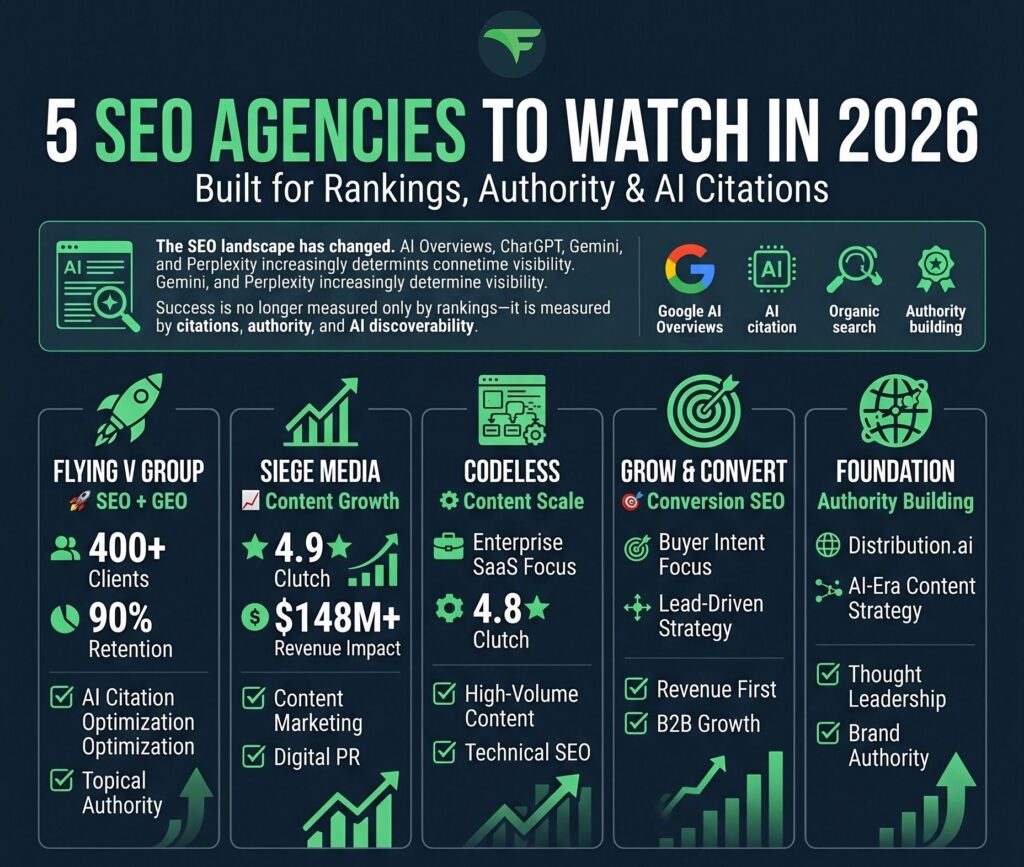
Flying V Group’s VP of SEO and GEO, Sean Fulford, leads this list as a practitioner building both organic and AI search visibility for clients. The four agencies that follow are strong performers across content quality, client results, and adaptability to AI-era search requirements.
Why SEO Content Work Is Changing in 2026
Research measuring Google AI Overviews across activation rates, source quality, and publisher impact documents a clear pattern: AI systems do not simply surface the pages that rank first. They select sources based on authority signals, structural clarity, and factual precision. A page can hold a top organic position and still be absent from the AI-generated answer a user reads.
Content built on genuine expertise, original data, and clear structure is increasingly cited in contexts where it would never have appeared in traditional organic results. Content built on keyword density and domain authority alone is losing ground it cannot easily recover.
The Shift From Rankings to Citations
Google’s Helpful Content guidelines have consistently emphasised people-first content built on genuine experience and expertise. In the AI search context, those signals carry additional weight. AI systems evaluate content for factual reliability and structural clarity when deciding which sources to include in generated answers.
An agency that understands both traditional E-E-A-T signals and the emerging GEO disciplines is operating with a real competitive advantage.
5 SEO Content Companies to Watch in 2026
1. Flying V Group — Revenue-Focused SEO Content for Growth Businesses
Best For: B2B, professional services, SaaS, and e-commerce businesses that measure content performance against organic traffic growth and pipeline, not just rankings.
Founded in 2016 and headquartered in Newport Beach, Flying V Group serves clients nationally across competitive verticals where content authority directly drives lead generation. SEO and GEO strategy is led by Sean Fulford, VP of SEO and GEO, with over nine years of experience building organic programmes for Fortune 500 companies, multi-location franchises, and growth-stage SMBs. Every content engagement starts with keyword and entity mapping, a topical authority audit, and a GEO structuring review: the process of formatting content so AI tools including Google AI Overviews, Perplexity, and ChatGPT can cite it in generated responses.
Core Specialties
Blog writing strategy, content marketing for SEO, topical authority cluster development, GEO optimisation, and content programmes built to serve both traditional rankings and AI search citation simultaneously.
Community and Track Record
Flying V Group has served 400+ clients since 2016 and maintains a 12-month client retention rate above 90%. Growth runs primarily on client results and referrals rather than outbound sales.
Ideal Client: Businesses treating content as a compounding revenue channel, not a recurring line item.
2. Siege Media — SEO-Focused Content Marketing at Scale
Best For: Mid-market and enterprise brands in competitive categories seeking content-led SEO with documented revenue attribution.
Siege Media is an Austin-based content marketing agency with a 4.9/5 rating on Clutch, recognised on Inc.’s Best Workplaces list and Inc. 5000 five consecutive years. Their client portfolio includes Zillow, Shutterfly, and TripAdvisor, with documented results exceeding $148 million in content-attributed revenue across clients. Their methodology pairs SEO content production with digital PR and link acquisition, treating organic visibility as a compounding asset rather than a campaign deliverable.
Ideal Client: Brands with the budget for a full content and link programme and an existing SEO footprint to build from.
3. Codeless — SEO Content Production for SaaS and Enterprise
Best For: SaaS, service, and affiliate businesses needing to scale high-quality SEO content output without sacrificing editorial standards.
Codeless is a Colorado-based content production agency with a 4.8/5 Clutch rating. They have worked with monday.com, Zapier, and ActiveCampaign, among others, building systematic content production processes that maintain quality at volume. Their stated approach balances keyword targeting with genuinely useful content, recognising that competing in SaaS content requires both depth and scale. For companies needing to publish dozens of optimised articles monthly without quality degradation, Codeless has one of the more proven operational frameworks in the category.
Ideal Client: SaaS and enterprise brands that need to scale content output significantly while maintaining technical SEO quality.
4. Grow and Convert — Conversion-Focused Content Strategy
Best For: Businesses frustrated with content that generates traffic but not leads or revenue.
Grow and Convert, founded by Devesh Khanal and Benji Hyam, occupies a specific niche: SEO content built explicitly for conversion rather than traffic volume. Their Pain Point SEO methodology targets keywords that indicate buyer intent rather than informational curiosity, producing content designed to convert organic visitors into customers rather than building audience. This focus makes them particularly relevant for businesses where previous SEO content programmes generated impressive traffic metrics without proportional pipeline impact.
Ideal Client: B2B and SaaS companies where previous content investments produced traffic without proportional lead generation.
5. Foundation Inc — Content Authority and Distribution for the AI Era
Best For: Brands investing in content authority as a long-term asset, particularly in B2B and technology sectors where thought leadership influences AI citation.
Foundation Inc, led by Ross Simmonds, focuses on content strategy, creation, and distribution with an explicit emphasis on building brand authority that persists across search and AI platforms. Their Distribution.ai practice addresses a specific AI-era challenge: content that earns authority signals through strategic distribution and brand mention accumulation is more likely to be cited by AI systems than content that ranks but lacks a distributed authority footprint. Their work spans B2B, SaaS, and technology brands seeking long-term organic and AI search compounding.
Ideal Client: B2B brands building content programmes measured over 12 to 36-month horizons, where authority accumulation is the strategic objective.
What These Agencies Share in 2026
The pattern across all five is the same: content built to satisfy multiple evaluators simultaneously. Traditional ranking signals, AI citation requirements, and genuine reader value are converging in ways that reward agencies doing the work correctly and increasingly punish those optimising for only one layer.
The agencies succeeding in 2026 are building content that earns citations, not just positions. The measurement frameworks are different. The underlying craft requirements are higher.
What Separates Effective SEO Content Agencies in 2026
| Capability | Why It Matters Now |
| GEO structuring | Formats content for AI citation, not just ranking |
| Entity and topical authority mapping | Connects content to Knowledge Graph signals AI systems use |
| Original data and proprietary research | Creates content AI cannot easily replicate from aggregated sources |
| Conversion-intent targeting | Ensures traffic generates pipeline, not just sessions |
| Distribution and authority building | Increases AI citation probability across multiple platforms |
Building Toward the Right Partner
The agencies above represent a range of approaches to SEO content in 2026: from full-service content and link programmes, to conversion-first methodology, to AI-era authority building. Match your selection to your actual content objective, whether that is scaling output, building topical authority, or converting existing traffic into revenue.
Contact Flying V Group to see how a content strategy built around both traditional SEO and AI search citation applies to your business.
Frequently Asked Questions
How much does working with an SEO content agency typically cost?
SEO content retainers range from $3,000 to $8,000 per month for boutique and mid-market agencies, and $8,000 to $20,000 or more for full-service programmes including content production, link acquisition, and strategy. The most useful benchmark is organic traffic growth and cost-per-acquired-customer relative to the retainer, not production volume alone.
What makes an SEO content company effective in 2026?
The most effective agencies in 2026 build content that earns citations from AI systems alongside traditional organic rankings. This requires original research, clear structural formatting AI systems can extract and attribute, author credentials establishing topical authority, and distribution strategies that build brand mention volume across authoritative sources.
How do these agencies approach AI search visibility differently?
Each takes a distinct angle. Flying V Group integrates GEO structuring into every deliverable. Siege Media builds link authority that strengthens domain-level signals AI systems evaluate. Grow and Convert focuses on conversion intent signals. Codeless scales content at volume while maintaining citation quality. Foundation Inc focuses on distribution that builds the brand mention footprint AI systems track.
Does ranking first still matter if AI Overviews appear above organic results?
It matters less exclusively than it once did. Research from the University of Washington shows AI-generated summaries reduce click-through even when source content holds strong organic positions. Ranking first remains valuable, but it needs to be combined with AI citation optimisation to maintain full-funnel brand visibility.
What is GEO and why do SEO content agencies need to understand it?
GEO (Generative Engine Optimization) structures content so AI systems including Google AI Overviews, ChatGPT, Perplexity, and Gemini can cite it in generated responses. Agencies need to understand GEO because AI-generated answers increasingly appear before traditional organic results, and being cited in those answers provides brand visibility that rankings alone cannot guarantee.
How should businesses evaluate SEO content agencies in 2026?
Ask for documented results in your vertical with attribution between content and organic traffic or lead outcomes. Ask how the agency approaches AI search visibility alongside rankings. Ask whether content is built around topical authority clusters or individual keywords. Agencies that cannot answer these questions clearly are optimising for yesterday’s search environment.
How long does SEO content take to produce measurable results?
SEO content typically produces measurable ranking movement within three to four months and meaningful organic traffic growth by months five through eight. AI citation visibility can become apparent faster for content built with explicit GEO structuring from publication. Agencies that set realistic timelines from the start are more reliable partners than those promising rapid results.