Weddings, corporate retreats, and private celebrations all begin the same way — with a search. Cvent’s event industry statistics show events are among the fastest-growing spending categories globally, with venue demand consistently outpacing supply in most major metro areas.
What’s less obvious is how that demand gets distributed. Research on SEO implementation across event venue websites documents widespread failures in basic local search optimization — a visibility gap that well-positioned venues can own before competitors understand the opportunity. Flying V Group’s full-service digital programs are built to close that gap, from search discovery through booking conversion.
The Economics of Venue Visibility
The wedding industry alone contributes roughly $100 billion annually to the U.S. economy, making weddings one of the highest-value emotional purchase categories in consumer spending. Corporate events and social functions add substantially to that figure.
Event marketing ROI research shows in-person experiences drive higher purchase intent and brand loyalty than virtually any other marketing channel. Venues that position themselves as experience brands — not just rentable spaces — command premium pricing and generate repeat referrals.
Local SEO: The Booking Engine No Venue Can Ignore
Academic research on consumer venue selection demonstrates that groups choose event spaces primarily based on travel friction, proximity, and coordination convenience — not solely on aesthetics or price. That finding has a direct SEO implication: hyper-local visibility outperforms general branding for the majority of venue searches.
Venue sourcing behavior data from G2 shows a significant share of event planners discover venues through Google search and social communities rather than through directories or referral networks alone. Venues that don’t appear in local map searches are invisible to that discovery layer entirely.
Google Business Profile for Event Spaces
Google’s local ranking documentation applies directly to venue marketing: relevance, distance, and prominence determine whether a venue surfaces in “wedding venues near me” or “corporate event space [city]” searches. The primary category matters — a venue listed only as “Event Venue” surfaces in fewer filtered searches than one configured with “Wedding Venue” and “Corporate Event Venue” simultaneously.
Photo frequency, virtual tour links, and active review responses all contribute to the prominence signal. Venues treating their GBP as a static listing rather than an active marketing asset consistently lose local pack placement to competitors who don’t.
The SEO Gap Most Venues Haven’t Closed
Many event venues struggle with the same SEO oversights: missing schema markup, unoptimized landing pages for specific event types, thin local content, and a lack of structured FAQ data. For a savvy competitor, these common implementation gaps represent a clear path to outranking the local market.
Flying V Group’s SEO programs address all of these gaps — from structured data implementation to neighborhood-specific pages that intercept searches before a competitor with better aesthetics but weaker technical infrastructure ever surfaces.
Your Venue Website as a Conversion Machine
Traffic alone doesn’t book events — the website does. Venue market research from Bonnie Hawthorne identifies underserved niches — luxury micro-events, cultural celebrations, corporate wellness retreats — where venues can build targeted content strategies that outrank generalist competitors without competing for the same broad terms.
Website design for event venues should treat every page as a conversion pathway. Gallery pages need inquiry CTAs. Partial pricing transparency reduces drop-off. Event-type landing pages — weddings, corporate, social — should each carry distinct content, distinct keyword targeting, and distinct proof points rather than being collapsed into a single generic services page.
Visual Content and Social Discovery
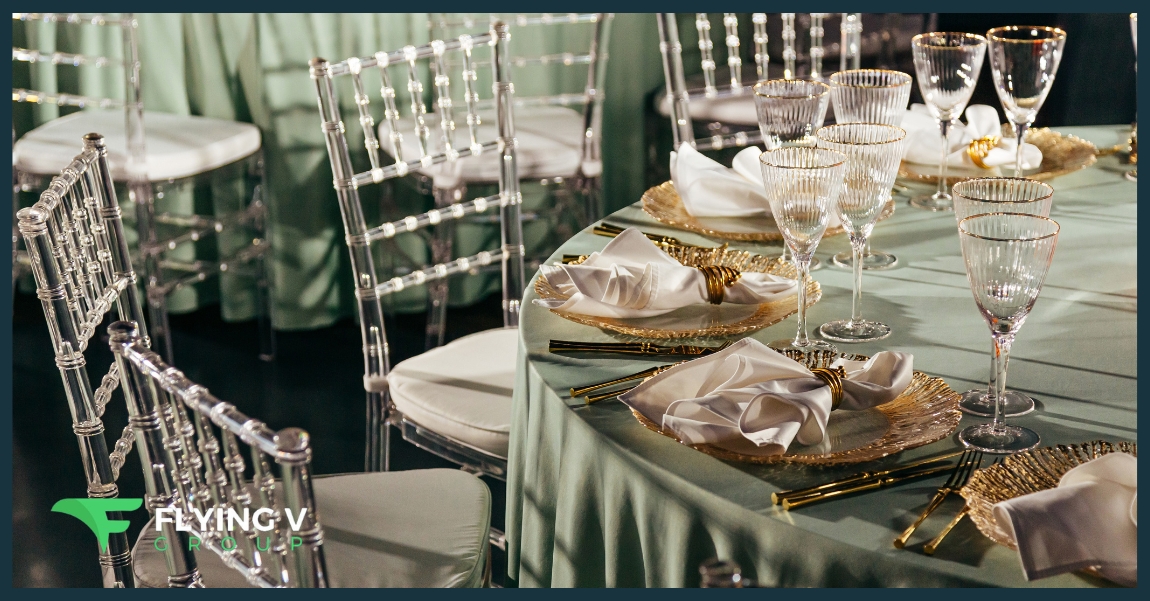
Experiential marketing research shows a strong correlation between immersive visual branding and booking intent. Venue walkthroughs, event transformation videos, and styled shoot content all generate emotional engagement that static imagery alone cannot produce. Venues that invest in sensory-rich social content build booking intent before a prospect has even made an inquiry.
The right channels vary by event type:
| Event Type | Primary Discovery Channel | SEO Term Format | Visual Priority |
| Weddings | Pinterest, Instagram, Google Maps | “wedding venue [city]” | High — styled shoots, real events |
| Corporate events | Google Search, LinkedIn, GBP | “corporate event space [city]” | Medium — professional, clean imagery |
| Social celebrations | TikTok, Instagram Reels | “birthday venue near me” | High — transformation videos |
| Micro/intimate events | Google Maps, neighborhood SEO | “intimate event space [neighborhood]” | Medium — ambiance and detail |
Pinterest and Instagram for Wedding Venues
Cvent’s wedding venue marketing data shows millions of users engage with Pinterest for wedding planning annually — making it a search engine as much as an inspiration platform. Venues that build keyword-optimized boards around ceremony styles, venue transformations, and floral pairings generate evergreen discovery traffic that Instagram alone doesn’t produce.
Content marketing built around real events — behind-the-scenes preparation, day-of transformations, vendor spotlights — consistently outperforms generic promotional content across both platforms and contributes to the branded search signals that strengthen overall local authority.
Partnerships and the Referral Ecosystem
The SBA’s small business marketing guidance identifies referral networks as one of the highest-ROI customer acquisition channels for service businesses. Event venues sit at the center of one of the most active referral ecosystems in local business — the vendor network.
Wedding planners, photographers, florists, caterers, DJs, and AV companies all refer venues regularly. Venues that formalize those relationships — preferred vendor lists, co-created content, and cross-promotional social partnerships — build referral infrastructure that generates bookings independent of any single marketing channel.
AI Discovery and the Next Wave of Venue Search
Location-aware venue recommendation research shows AI-driven systems increasingly personalize venue suggestions based on user behavior, review patterns, and contextual relevance — not just keyword matching. Venues with rich, structured data are far more likely to surface in these systems than those with thin web presence.
Analysis of AI Overviews in venue marketing identifies AI-generated search results as a rapidly growing discovery channel — one that requires structured FAQs, local business schema, and authoritative content to appear in. Venues optimizing for traditional search alone are leaving a growing share of high-intent discovery traffic uncaptured.
Building the Strategy Behind the Space
Flying V Group, founded in 2016 and headquartered in Newport Beach, California, builds marketing programs for event venues and hospitality businesses competing across high-intent local markets. Our SEO and web design packages address the full stack: venue schema implementation, event-type landing pages, GBP optimization, visual content strategy, and partnership-based authority building.
Technical Approach
Every venue engagement begins with an SEO gap audit, a GBP precision review, and a keyword map built around event types, neighborhoods, and occasion-specific searches. Website conversion pathways — inquiry forms, gallery CTAs, and virtual tour integrations — are reviewed alongside technical infrastructure to ensure traffic translates into actual bookings.
Your City Has a Go-To Venue. Make Sure It’s Yours.
Most venues compete on aesthetics while losing on visibility. The gap between a venue that’s fully booked and one that’s perpetually underbooked is rarely about the space itself — it’s about whether the right searches find it first. If your venue isn’t capturing the local search traffic its location and experience deserve, get in touch with our team to discuss what a booking-focused digital strategy looks like for your space.
Frequently Asked Questions
How long does it take for local SEO to increase venue bookings?
Most event venues begin seeing measurable improvement in local pack rankings and organic inquiry volume within 60 to 90 days of a structured optimization effort. Full competitive ranking gains for high-intent terms like “wedding venue [city]” typically take four to six months, depending on existing domain authority and how aggressively competitors in the same market are optimizing.
Should event venues focus on SEO or paid advertising first?
Local SEO and Google Business Profile optimization should precede paid advertising for most independent venues — SEO builds a compounding asset while paid campaigns require continuous spend to maintain traffic. Paid search makes sense as a complement once foundational visibility is in place, particularly for seasonal pushes around peak booking windows.
How do venues appear in AI-generated recommendations?
AI systems like Google AI Overviews, ChatGPT, and Perplexity pull from structured data sources: GBP completeness, schema markup, FAQ content, review signals, and authoritative web mentions. Venues that implement local business and event schema and publish well-structured FAQ content are significantly more likely to appear in AI-generated recommendations than those relying on unstructured web presence.
What is the highest-converting page on a venue website?
Event-type landing pages — wedding, corporate, or social — are typically the highest-converting pages on a venue website. These pages should include event-specific photography, capacity and pricing transparency, a visible inquiry CTA, and FAQs addressing the most common questions for that event type. Generic homepage copy cannot substitute for them in either conversion performance or search ranking.
How do venues handle SEO across multiple event types?
Venues offering multiple event types should build distinct landing pages for each category with separate keyword targeting, distinct photography, and event-specific social proof. A corporate client’s evaluation criteria — AV capacity, parking, and downtown accessibility — differ significantly from a wedding couple’s priorities, and content that attempts to address both audiences on one page typically fails to convert either.
What review strategy works best for event venues?
The most effective approach involves prompting clients immediately after event completion — when the emotional experience is freshest — and distributing requests across both Google and event-type-specific platforms such as The Knot and WeddingWire for weddings. Responding to every review within 48 hours compounds both ranking impact and the social proof value for prospects still in the evaluation stage.
How do venues differentiate from hotel ballrooms in local search?
Venues differentiate by building content that emphasizes what hotel ballrooms can’t offer: dedicated event infrastructure, customizable layouts, exclusive vendor access, and venue-specific experiences. Targeted content around “exclusive event venue [city]” and “dedicated wedding venue vs. hotel ballroom” captures comparison-stage searches from prospects who have already ruled out alternatives and are actively evaluating standalone spaces.