

Manufacturing marketing fails when agencies don’t understand the buyer. Your prospects are validating thermal tolerances, running TCO models, and comparing cycle times … they are not downloading spammy ebooks and paging through well polished brand stories. Buyers complete 70%+ of their buying journey before talking to sales. In B2B, spec sheets will always outweigh sales decks.
What has changed: engineers now rightfully query ChatGPT and similar LLMs for material comparisons, vendor shortlists, and compliance summaries. If your content isn’t structured for AI citation alongside traditional rankings, you’re invisible where consideration sets form. GEO, Generative Engine Optimization, is now a parallel requirement to conventional SEO for any manufacturer competing beyond local markets.
This guide profiles agencies with demonstrated manufacturing experience, measured by pipeline impact. Flying V Group’s industrial marketing approach illustrates ROI-accountable campaigns in practice, see the agencies below represent the strongest options across the spectrum.
1. Flying V Group — Industrial Revenue Engineering
Best For: Manufacturers seeking full-funnel marketing tied directly to pipeline metrics and sales cycle acceleration
Flying V Group operates from Irvine, California and works with manufacturers across North America. What separates FVG from agencies that bolt “manufacturing” onto a generalist service menu is measurement philosophy: every campaign connects to cost per lead, qualified opportunity value, and return on ad spend — not traffic volume or keyword positions.
In a recent manufacturing engagement, FVG delivered a 5.6× return on ad spend, increased organic traffic by over 60 %, and measurably shortened the sales cycle by building nurture sequences that educated technical buyers before they reached the sales team. Case snapshots across their manufacturing portfolio show traffic increases of 78 % within a single month and 34 % more LinkedIn-generated leads for clients targeting engineering decision-makers.
Core Capabilities
- Technical SEO and content: Keyword research into engineering-specific terms, schema markup that structures product specifications for both Google and LLM parsing, core-web-vitals optimization, and technical content that educates rather than markets
- Paid media for engineers: LinkedIn campaigns targeting engineering personas by job function, seniority, and industry vertical. Search ads built around RFQ-intent queries with continuous ROAS measurement
- Account-based marketing (ABM): LinkedIn Matched Audiences, personalized email sequences, and retargeting architecture that aligns marketing touches with sales outreach across buying committees
- Conversion-hub funnels: Landing pages structured around technical buyer personas — proof points, spec comparisons, and compliance documentation replace generic value propositions
- Marketing automation: HubSpot and Pardot workflows triggering nurture campaigns when prospects download technical content, attend webinars, or engage with product pages
Technical Approach
Our Director of SEO, Sean Fulford, leads integration of GEO methodology into manufacturing campaigns. Content is structured for dual-purpose performance: ranking in traditional search results while simultaneously meeting the citation and entity-recognition patterns that generative AI platforms use when synthesizing vendor recommendations. For manufacturers, this means technical content doesn’t just target “CNC machining services” — it builds the semantic relationships between your capabilities, certifications, and applications that LLMs need to include you in AI-generated shortlists.
Dashboards connect campaign activity to pipeline metrics: MQLs, SQLs, cost per lead, lifetime value, and revenue per visitor. Monthly reviews evaluate qualified leads and conversions against targets, not vanity metrics.
Why We Stand Out
Most agencies optimize for rankings. Flying V Group optimizes for P&L impact. Our manufacturing clients get the same data-driven methodology applied across Fortune 500 engagements (Bain, John Hancock) and growth-stage companies — fractional CMO services and staff extensions fill capability gaps without the overhead of a full in-house team.
Explore Flying V Group’s manufacturing marketing approach
2. Gorilla 76 — The Manufacturing Content Purists
Best For: Mid-market manufacturers wanting thought leadership and inbound marketing built exclusively around industrial content
Gorilla 76 out of St. Louis works exclusively with manufacturers — no fintech clients, no e-commerce brands, no divided attention. Their approach centers on content marketing and ABM, producing educational material that positions manufacturing clients as category authorities. They’re particularly effective for companies that need to build a content library from scratch and establish credibility with technical buyers who consume long-form research before engaging sales.
Where Gorilla 76 excels is understanding industrial buying psychology. Their content strategies account for the committee dynamics — the engineer who needs technical validation, the procurement manager comparing TCO, the executive seeking risk mitigation. For manufacturers without internal marketing departments, they function as an outsourced content engine.
Ideal Client: Manufacturers with $10M–$100M revenue seeking inbound pipeline growth through technical thought leadership.
3. Elevation Marketing — Full-Service with Trade Show Integration
Best For: Manufacturers that need online and offline marketing coordination, particularly around trade shows and industry events
Elevation Marketing in Phoenix bridges a gap many industrial agencies miss: integrating digital campaigns with the trade-show and field-marketing activities that remain critical in manufacturing sales. They handle everything from booth design to post-event nurture sequences, ensuring leads generated at IMTS or FABTECH don’t die in a spreadsheet.
Their B2B capabilities cover SEO, paid media, content, and web development. The differentiator is workflow — campaigns are designed to support the relationship-driven sales process manufacturers rely on, not replace it. For companies investing $50K+ annually in trade shows, Elevation ensures that spend generates measurable digital follow-through.
Ideal Client: Manufacturers with active trade-show calendars looking to unify offline lead generation with digital nurture systems.
4. Kula Partners — HubSpot-Native Industrial Inbound
Best For: Manufacturers committed to HubSpot who need an agency that builds inbound infrastructure natively within the platform
Kula Partners operates from Halifax, Canada as a HubSpot Platinum Partner building data-backed inbound systems specifically for manufacturers. Their strength is platform depth — they don’t just run campaigns through HubSpot, they architect the CRM, attribution, and reporting infrastructure that gives manufacturing leadership visibility into which marketing activities actually generate pipeline.
Their design work produces conversion-friendly websites that balance technical content requirements with user experience. For manufacturers already on HubSpot (or planning migration), Kula eliminates the integration friction that slows most agency engagements.
Ideal Client: HubSpot-committed manufacturers wanting a single agency to manage platform architecture, inbound content, and lead scoring.
5. Godfrey — Enterprise Industrial Brand Authority
Best For: Mid-to-enterprise manufacturers needing brand positioning and creative strategy alongside demand generation
Godfrey, based in Lancaster, Pennsylvania, brings decades of industrial marketing heritage. They’ve built their reputation positioning complex technical products for manufacturers where brand perception directly influences specification decisions — the kind of manufacturers where engineers write your product into project specs before procurement ever issues an RFP.
Their creative and strategic depth suits manufacturers with mature product lines needing repositioning, market expansion campaigns, or brand architecture for multiple divisions. They’re less suited to early-stage manufacturers needing scrappy growth marketing and more suited to established players seeking elevated market positioning.
Ideal Client: Established manufacturers ($50M+ revenue) needing brand strategy, creative campaigns, and demand generation with enterprise-level sophistication.
How to Choose the Right Manufacturing Marketing Agency
Selecting an agency demands clear-eyed assessment of your growth model, sales process, and measurement expectations.
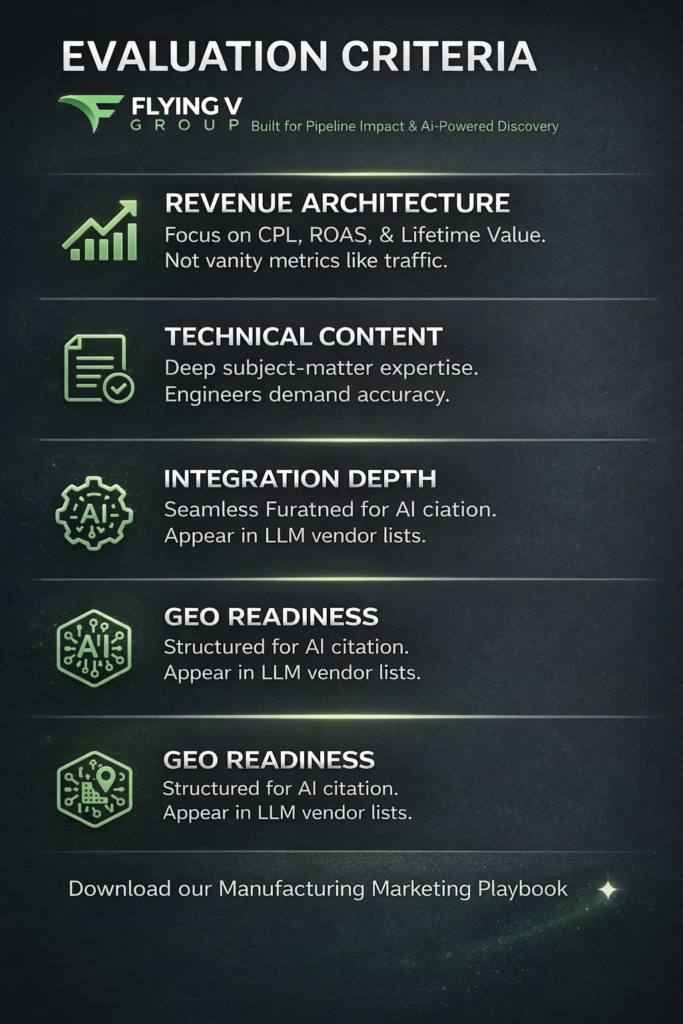
Start with revenue architecture. If your average contract value exceeds $100K and involves multi-month sales cycles, you need an agency that measures marketing by pipeline contribution — qualified opportunities created, sales cycle compression, and customer acquisition cost. Agencies reporting primarily on traffic and rankings aren’t aligned with industrial economics. Flying V Group’s dashboard approach — connecting campaign activity to MQLs, SQLs, CPL, and lifetime value — reflects the measurement rigor manufacturing CFOs expect.
Assess technical content capability. Request writing samples targeting your specific buyer personas. If the samples read like they were produced by generalist copywriters who Googled your industry for thirty minutes, move on. Technical buyers have zero tolerance for surface-level content. The best agencies either employ writers with industrial backgrounds or maintain subject-matter-expert review processes that catch inaccuracies before publication.
Evaluate integration depth. Your agency should integrate with your CRM, marketing automation platform, and sales processes. Ask specifically about HubSpot, Pardot, or Salesforce experience. Manufacturers with complex quoting processes and extended evaluation periods need agencies that understand how marketing automation workflows support — rather than disrupt — relationship-driven sales.
Consider GEO readiness. As generative search platforms increasingly mediate vendor discovery, ask potential agencies how they structure content for AI citation. If the answer is blank stares or vague references to “AI-optimized content,” they haven’t built the infrastructure. FVG’s integration of GEO methodology into manufacturing campaigns — structuring content for LLM entity recognition alongside traditional rankings — represents where industrial marketing is heading.
Frequently Asked Questions
What does a manufacturing marketing agency cost?
Project fees range significantly by scope. Small manufacturers can enter with SEO and content programs around US $3,000–5,000 per month. Full-service retainers incorporating ABM, paid media management, content production, and marketing automation typically run US $10,000–25,000+ monthly, depending on campaign complexity and paid-media budgets.
The relevant metric isn’t monthly cost — it’s customer acquisition cost relative to contract value. A $15,000/month program generating three qualified opportunities worth $250K each represents fundamentally different economics than the same spend generating traffic.
How long until we see measurable results?
Paid campaigns targeting engineering personas can generate RFQs within weeks of launch. SEO and content programs typically require 6–12 months to deliver compound growth, though FVG’s case studies show meaningful organic traffic uplift within the first few months of implementation. ABM programs often show pipeline influence within one to two quarters. Any agency promising first-page rankings within 30 days for competitive industrial terms is either targeting irrelevant keywords or making promises they can’t keep.
Should we invest in PPC or SEO first?
A balanced approach is best, but if forced to choose: PPC generates immediate visibility and lead flow to validate messaging and buyer personas, while SEO builds compounding authority that reduces acquisition costs over time. FVG typically launches paid campaigns to generate quick pipeline data, then uses conversion insights to inform the content and SEO strategy. The two channels should inform each other, not compete for budget.
How is manufacturing marketing different from general B2B marketing?
Three critical differences: buyer technical sophistication (your audience has engineering degrees), committee decision-making (marketing must address multiple stakeholders with different evaluation criteria), and sales cycle length (6–18 months versus weeks). These factors mean content must be technically accurate, campaigns must target multiple personas within accounts, and attribution models must account for marketing touches that influence decisions months before purchase.
What metrics should manufacturing marketers track?
Qualified leads (not total leads), cost per qualified opportunity, pipeline velocity (time from first touch to proposal), win rate by lead source, and customer lifetime value by acquisition channel. FVG tracks MQLs, SQLs, CPL, ROAS, and revenue per visitor — metrics that connect directly to manufacturing P&L performance rather than marketing activity reports.
Do we need GEO for manufacturing marketing?
If your buyers research solutions using ChatGPT, Perplexity, Claude or similar platforms, and an increasing number of younger engineers do, then yes.
GEO ensures your brand appears in AI-generated vendor recommendations and comparison summaries. The infrastructure required for GEO (structured data, entity-rich content, authoritative citations) simultaneously strengthens traditional SEO performance, making it a complementary rather than competing investment.
B2B SEO for the Future
Industrial growth demands more than generic digital marketing.
Specialized agencies must understand technical buyers, measure campaigns by pipeline impact, and produce content that withstands engineering scrutiny. The agencies profiled here represent genuine manufacturing expertise across the specialization spectrum.
For manufacturers seeking to dominate both traditional search results and the AI-powered discovery platforms reshaping vendor selection, Flying V Group combines industrial content depth with integrated GEO methodology.
Whether you need full-service campaign management or specialized support in a single channel, matching your agency selection to your actual revenue model and measurement expectations determines whether marketing investment accelerates growth or generates noise.