

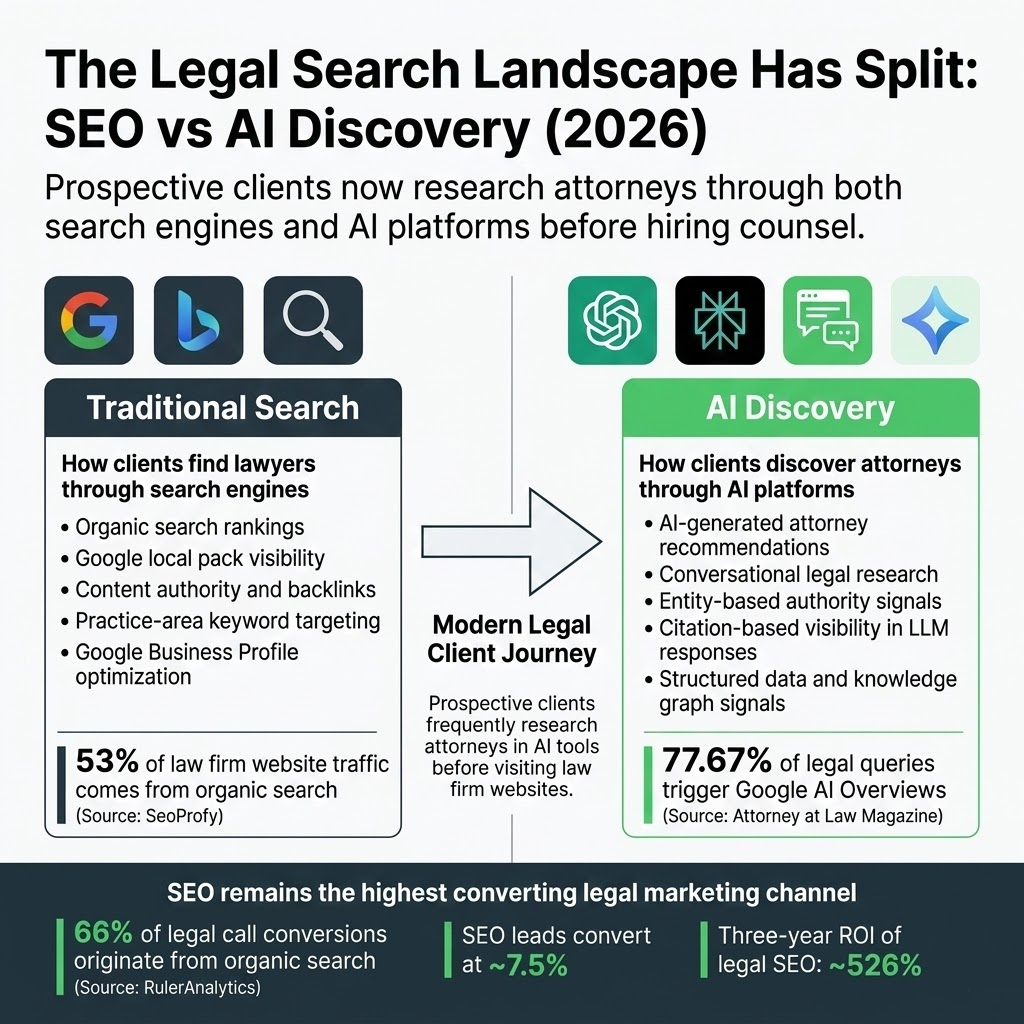
The search landscape for legal services split in two and most agencies haven’t caught up. LLM-referred traffic to legal websites more than doubled between early 2024 and mid-2025. Today, 77.67% of legal search queries trigger Google’s AI Overviews, the highest rate of any industry vertical (Attorney at Law Magazine). Prospective clients now research attorneys on ChatGPT and Perplexity before they ever type a query into Google.
That matters because organic search still drives over 53% of all law firm website traffic (SeoProfy) and generates 66% of call conversions (RulerAnalytics). SEO-generated leads convert at roughly 7.5%, more than three times the rate of paid channels. The three-year ROI for strategic legal SEO sits around 526%, and 64% of firms are increasing their optimization budgets heading into 2026. The question is whether those budgets are going to agencies that understand both channels or agencies still running a single-channel playbook.
This guide profiles agencies equipped for the dual-channel reality, evaluated on legal specialization, attribution depth, GEO capabilities, and documented case acquisition results.
1. Flying V Group — Revenue Attribution Across Search and AI Platforms
Flying V Group is a Newport Beach-based demand and revenue generation agency founded in 2016, serving over 400 clients internationally across professional services including legal, financial services, healthcare, and management consulting. The distinction here isn’t positioning; it’s infrastructure. We don’t bolt GEO onto existing SEO packages or rebrand last year’s content strategy with AI buzzwords. We’ve built proprietary systems including Citation Difficulty Scoring, Query Fanout Simulation, and Citation Velocity Tracking — that treat traditional search and AI platform visibility as integrated components of a single client acquisition engine.
Beyond organic, we operate full-stack advertising across paid search, paid social, and programmatic, managing millions in monthly media spend across client portfolios. For law firms, this means PPC campaigns built on the same attribution infrastructure as our SEO work: every paid click, like every organic impression, gets tracked through to consultation and signed engagement. The agencies that silo SEO from paid media create blind spots in their attribution. We don’t.
Core Capabilities:
- Full-stack SEO: technical architecture, content strategy, topical authority building, local optimization
- PPC and paid media management across Google Ads, LSAs, Meta, and programmatic channels
- GEO infrastructure: schema markup for LLM parsing, citation-optimized content architecture, entity relationship engineering
- Conversion system design: funnels averaging a 7.5x increase in conversion rates over baseline
- Multi-channel attribution connecting organic, paid, and AI platform visibility to actual case signings
- Flexible engagement models including pay-per-performance and profit-sharing arrangements
Technical Approach: Our SEO team, led by Director of SEO Sean Fulford, maintains mastery of traditional search fundamentals — technical architecture, entity optimization, topical authority — while simultaneously operating at the frontier of how LLMs reshape legal search behavior. Content is structured for retrieval-augmented generation (RAG) systems, meaning the same assets that rank on Google are architecturally designed to surface in AI-generated attorney recommendations.
In litigation specifically, we’ve demonstrated what intent-driven legal SEO looks like at scale. In 2025, we partnered with a litigation firm facing a behavioral challenge: when individuals received debt collection notices, their first instinct wasn’t to search legal concepts — it was to Google the company name on the letter. Instead of competing for high-volume generic terms, we built content hubs targeting the actual collection agencies people were searching, structuring each page to outline legal options at that precise decision moment. The results over the first year: organic traffic increased 94%, new users grew 137%, total clicks rose 457%, impressions climbed 511%, and average search position improved from 39.8 to 5.5. We have proven success in legal SEO, and can drive visibility at the exact point where someone decides whether they need an attorney.
Why We Stand Out: Most legal SEO agencies optimize for rankings. Flying V Group optimizes for P&L impact. Our consultant relationships with organizations including Bain and John Hancock demonstrate analytical depth that translates directly to law firms needing marketing spend tied to measurable case acquisition. Whether you’re a personal injury firm scaling nationally or a litigation practice capturing intent at the decision moment, our data infrastructure treats every marketing dollar as an investment that must demonstrate return.
Explore how Flying V Group drives legal client acquisition →
2. Rankings.io — The Personal Injury Powerhouse
Best For: PI and trial firms pursuing aggressive market domination in competitive metros
Rankings.io works exclusively with law firms and has built its reputation primarily in the personal injury space. Their approach is unapologetically aggressive — they limit client intake per market to avoid conflicts and focus on firms ready to invest at premium levels. An eight-time Inc. 5000 company, they combine technical SEO, custom WordPress design, and proprietary ranking analytics into a system built for firms where a single case can justify the entire annual marketing budget. Clients retain full ownership of all assets and there are no long-term contracts — a transparency signal that resonates with managing partners tired of underperforming relationships.
Why They’re Notable: Their “proof, not promises” positioning is backed by documented case studies showing significant organic traffic and lead generation improvements for PI firms in competitive markets. Singular legal focus means deep understanding of practice-area-specific competitive dynamics.
Ideal Client: Personal injury firms with monthly budgets of $10K+ ready to dominate their metro.
3. Consultwebs — The Long-Term Legal SEO Partner
Best For: Multi-practice firms seeking a trusted, transparent agency relationship with proven case growth
Consultwebs focuses exclusively on law firms and has been in legal marketing long enough to have navigated multiple algorithm generations. Their approach blends local SEO, conversion optimization, and content strategy with detailed reporting and ongoing strategic consultations. They limit client intake per geographic market to prevent conflicts — a practice that matters in legal where competing firms in the same city would undermine both campaigns. Clients consistently cite transparency and communication cadence as differentiators.
Why They’re Notable: Clients report an average 300% increase in signed cases, and their full-funnel attribution ties marketing activity to actual case acquisition rather than vanity traffic metrics.
Ideal Client: Mid-size firms across practice areas wanting steady, data-backed growth without aggressive sales pressure.
4. Hennessey Digital — Technical Mastery for Competitive Markets
Best For: Litigation-focused firms in hyper-competitive metros needing integrated organic and paid strategy
Founded by SEO expert Jason Hennessey, this agency has established itself as a premium option for trial lawyers and litigation firms seeking national visibility. Hennessey Digital blends technical SEO mastery with paid media and PR into a holistic digital strategy — recognizing that in competitive legal markets, organic alone isn’t enough to displace entrenched incumbents. Their Inc. 5000 recognition reflects sustained growth built on client results rather than aggressive sales operations.
Why They’re Notable: Documented results include 169% year-over-year organic traffic growth and 143% increases in lead form submissions for firms in competitive practice areas.
Ideal Client: Established litigation firms ready for premium investment in integrated digital strategy.
5. LawRank — Rapid Results for Growth-Ready Firms
Best For: Firms that need aggressive ranking improvements and are willing to invest for speed
LawRank specializes exclusively in legal SEO with a reputation for delivering rapid, measurable ranking improvements. Their services span link building, attorney-written content, local SEO, and Google Business Profile optimization. They also offer SEO services in Spanish — a meaningful differentiator for firms serving bilingual markets. Semi-exclusivity and full exclusivity options protect clients from intra-agency competition.
Why They’re Notable: Extensive attorney testimonials document dramatic lead generation improvements, and their legal marketing podcast provides ongoing education that demonstrates subject-matter expertise beyond the sales pitch.
Ideal Client: PI and criminal defense firms in competitive markets wanting fast, visible ranking gains.
Choosing the Right Legal SEO Partner in 2026
Selecting an agency demands a clear-eyed assessment of your firm’s actual growth model. A solo practitioner building local visibility has fundamentally different needs than a multi-office PI firm pursuing national share.
The financial framework that matters: calculate your average case value, multiply by your target monthly volume, and work backward to determine what acquisition cost makes economic sense. If a single PI case generates $50,000–$500,000+ in fees and your SEO investment runs $3,000–$5,000 monthly, the LTV:CAC math is among the most favorable in professional services. The mistake isn’t investing in SEO, it’s in selecting an agency that can’t connect that investment to measurable case acquisition.
Ask specifically how agencies attribute signed cases to channels — not just rankings or traffic. Verify they understand your state bar’s advertising ethics rules. Confirm you retain ownership of your domain, website, content, and analytics. And in 2026, ask what their GEO infrastructure looks like — because 77% of your prospective clients’ legal queries are already triggering AI-generated responses.
Ready to Turn Search Visibility into Signed Cases?
If your firm is evaluating SEO partners, the first step isn’t signing a contract. It’s understanding where your current digital presence actually stands, where your competitors are vulnerable, and which channels are generating cases you’re not capturing.
Flying V Group offers complimentary competitive audits that map your organic visibility, local pack positioning, and AI platform citation presence against the firms competing for the same cases in your market. No pitch deck. No generic proposal. A data-backed assessment of where your acquisition opportunities are and what it would take to capture them.
Request your competitive audit →
Frequently Asked Questions
How long does SEO take to generate cases for a law firm?
Timeline depends on three variables most agencies gloss over: your current domain authority relative to local competitors, the commercial intent density of your target keywords, and whether you’re building on an existing content foundation or starting from a bare domain.
Initial ranking movement for lower-competition terms (family law in mid-sized markets, estate planning, immigration) typically appears within 8–12 weeks. High-competition practice areas like personal injury in major metros can take 6–12 months before organic visibility translates to consistent case flow.
The critical distinction is between “ranking movement” and “case acquisition.” An agency can show you keyword position improvements in month two that don’t generate a single consultation. The meaningful metric is time-to-first-signed-case from organic, which for most firms falls in the 4–8 month window. Any agency guaranteeing page-one rankings within 30 days is either targeting keywords nobody searches or using link schemes that risk manual penalties.
SEO is a marathon, not a sprint.
What should a law firm budget for SEO monthly?
Budget ranges map directly to competitive density. A family law or estate planning practice in a mid-sized market can see meaningful results at $1,500–$3,000 per month.
Multi-practice firms in competitive metros typically need $3,000–$7,000. Personal injury in cities like Los Angeles, Houston, or New York, where a single “car accident lawyer” click costs $150+ in paid search, often requires $10,000–$20,000+ monthly at agencies that deliver.
We have delivered impressive results in legal SEO at the ~$2000 per month price range.
What is GEO and why should my firm care now?
Generative Engine Optimization is the practice of structuring your firm’s digital presence so that AI platforms (ChatGPT, Perplexity, Google AI Overviews, Claude) cite and recommend you when prospective clients ask legal questions.
This is not theoretical: 77.67% of legal search queries now trigger AI Overviews in Google, the highest rate of any industry vertical. When someone asks ChatGPT “do I need a lawyer after a car accident in Dallas,” the response includes specific firm recommendations. Those recommendations are drawn from signals most traditional SEO campaigns don’t address: structured entity data, content formatted for retrieval-augmented generation systems, citation authority across platforms like Avvo, Yelp, and legal directories, and attorney credential markup that LLMs recognize as authoritative.
The firms appearing in those AI responses now are building a compounding advantage. Each citation reinforces the model’s confidence in recommending that firm, making it progressively harder for competitors to displace them.
What does “owning your SEO assets” actually mean, and why does it matter?
This is where agency relationships go wrong more often than most firms realize. Ownership means your firm controls the domain registration, website hosting credentials, Google Analytics and Search Console access, Google Business Profile, and all published content. Some agencies register domains under their own accounts, build websites on proprietary platforms you can’t export, or retain admin-level access to your analytics as contractual leverage.
If you leave, you lose everything: your domain, your content, your ranking history, your reviews. Before signing with any agency, verify in writing that you retain full ownership and administrative access to every digital asset. If the relationship ends, you should be able to walk away with your website, content library, analytics data, and Google Business Profile intact. An agency confident in its results doesn’t need contractual hostage mechanisms.
How do ABA advertising ethics rules affect SEO and content marketing?
ABA Model Rules 7.1 and 7.2 form the foundation, and they apply to digital marketing as much as to billboards. Rule 7.1 prohibits false or misleading communications about a lawyer or their services.
This includes unsubstantiated claims like calling yourself a “specialist” or “expert” without board certification, publishing case results that could create unjustified expectations without appropriate disclaimers, and using superlatives like “best” or “top” that can’t be factually substantiated.
Rule 7.2 prohibits paying for recommendations, which has implications for how agencies handle testimonials, review generation, and referral arrangements. The nuance most agencies miss: these rules vary significantly by state. Florida requires lawyer advertisements to be filed with the bar 20 days before publication. New York has specific rules about testimonials and dramatizations.
California recently overhauled its advertising rules entirely. An SEO agency producing content for your firm needs to understand the specific requirements of every jurisdiction where you’re licensed and marketing. Generic disclaimers aren’t sufficient. Content that violates your state bar’s rules creates disciplinary liability for you, not for the agency that wrote it.
How does local SEO for law firms differ from general local SEO?
The mechanics are similar but the competitive dynamics are entirely different. Google’s local pack appears above organic results in 93% of searches with local intent, and law firms appearing in those three positions capture roughly 44% of user clicks. For legal, three factors determine local pack ranking: proximity, relevance, and prominence.
Proximity matters most for unmodified “near me” searches and matters less when users include city names. Relevance is controlled by your Google Business Profile category selection and website content alignment, and the most common mistake is selecting one broad primary category when specific secondary categories would better match high-value searches.
Prominence is the cumulative weight of your online authority: review count and velocity, citation consistency across legal directories (Avvo, FindLaw, Justia, Martindale-Hubbell), backlink quality from local and legal sources, and the depth of location-specific content on your site. The legal-specific distinction: review velocity matters more than total review count.
A firm with 40 reviews and 8 new reviews in the last 90 days will frequently outrank a firm with 200 reviews and none recently. Google interprets ongoing review activity as a signal of operational legitimacy. Agencies that focus only on accumulating total reviews rather than sustaining velocity miss this dynamic.