
Dental practices that relied on Google Maps proximity and a few five-star reviews to fill their chairs are discovering that those signals no longer do the heavy lifting alone.
AI Overviews now answer patient questions before a single click happens, LLM-powered platforms like ChatGPT and Perplexity are routing high-intent queries directly to cited sources, and zero-click behavior has accelerated across mobile search.
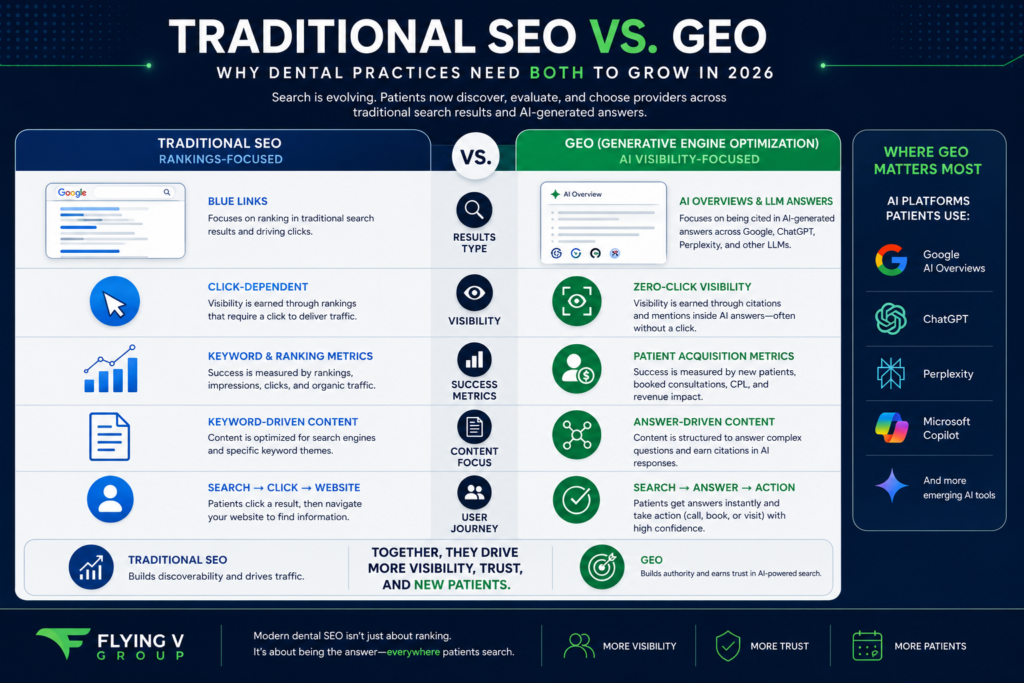
Organic visibility in 2026 requires dual-channel optimization: traditional ranking signals and GEO (Generative Engine Optimization) to surface in AI-generated responses.
Every dental SEO expert worth hiring currently splits their attention across two channels. The first optimizes for rankings and stops there, measuring success in keyword positions that may or may not translate to booked appointments.
The second connects organic search performance to patient acquisition costs, LTV:CAC ratios, and practice revenue, and builds a content architecture that earns citations in AI-generated answers. For practices serious about growth, the difference between those two camps is material.
This guide evaluates eight agencies and specialists with demonstrated expertise in dental SEO.
Flying V Group leads the list because its methodology explicitly bridges SEO performance and P&L outcomes, a distinction that matters when you’re evaluating marketing spend against chair time. Use this as a due diligence framework, not a shortlist to hire from blindly.
Explore Flying V Group’s dental SEO services and see how GEO integration drives bookings, not just rankings.
1. Flying V Group — Dental SEO Built Around Patient Acquisition, Not Rankings Alone
Best For: DSOs, multi-location dental practices, and growth-focused independent practices that measure marketing against revenue
Founded in 2016 in Newport Beach, California, Flying V Group was built on a premise that’s still rare in the dental marketing space: marketing should be measured against the P&L, not a rankings report.
While most dental SEO firms stop at page-one positions, FVG tracks organic search performance through to booked consultations, new-patient acquisition costs, and per-location revenue contribution. That methodology has produced results for clients ranging from Bain Consulting and John Hancock to regional dental groups and specialist practices.
Core Capabilities:
- Dental SEO strategy encompassing on-page optimization, technical architecture, local authority building, and multi-location schema deployment (LocalBusiness, Dentist, FAQPage, Service)
- GEO (Generative Engine Optimization) via FVG’s proprietary GEO Genius toolset, which includes Citation Difficulty Scoring, Query Fanout Simulation, and Citation Velocity Tracking — built specifically to position dental content for citation in AI Overviews and LLM platforms
- Content development at scale (1,000+ pieces per month across the client base), structured for both traditional ranking signals and AI citability
- Multi-channel integration: organic search coordinated with paid media and social to eliminate the attribution gaps that inflate CPL figures
- Fractional CMO consulting for practices evaluating marketing spend against growth targets rather than vanity metrics
Technical Approach
Director of SEO Sean Fulford brings 8+ years of SEO and GEO expertise to dental engagements. His approach to dental content architecture addresses a problem most agencies ignore: the query fanout problem in AI search.
When a patient asks an AI assistant, “What’s the best implant dentist near me,” the platform doesn’t return ten blue links; it synthesizes a response from sources it deems authoritative and citable.
Fulford’s GEO Genius methodology runs Query Fanout Simulations to map the full semantic space around high-value dental queries, then engineers content to satisfy multiple intent vectors within a single authoritative page. Citation Velocity Tracking monitors how quickly new content earns references across AI platforms, enabling iterative optimization rather than set-and-forget publishing.
Why We Stand Out
Most agencies optimize for rankings. We optimize for P&L impact. The practical difference shows up in how we structure reporting: instead of monthly keyword position updates, FVG clients see new patient attribution by channel, cost per acquired patient, and revenue contribution per content asset.
For multi-location dental groups, we deploy location-specific content silos with coordinated internal linking architecture, and each location page earns organic authority independently while the root domain builds category-level trust. We’ve worked with Fortune 500s and neighborhood practices, and the measurement discipline is identical regardless of scale.
Ideal Client: Dental practices, DSOs, and specialist groups (implants, orthodontics, oral surgery) with a genuine growth mandate and willingness to connect marketing metrics to revenue outcomes.
2. Dental Intelligence — Data-First Practice Growth Platform
Best For: Practices already using Dental Intelligence’s analytics suite who want integrated SEO visibility
Dental Intelligence operates primarily as a practice analytics platform, but its marketing layer incorporates SEO recommendations tied to practice performance data. The integration between appointment analytics and search performance is their differentiator; practices can see correlations between organic traffic growth and scheduling fill rates.
Core Capabilities: Practice analytics integration, local SEO recommendations, reputation management, patient reactivation workflows
Why They’re Notable: Their analytics infrastructure gives practices a cleaner view of which marketing channels are filling chairs. Less useful as a standalone SEO partner; more valuable if you’re already in their ecosystem.
Ideal Client: Data-driven practices prioritizing operational analytics alongside marketing visibility.
3. Rosemont Media — Healthcare SEO Specialists with a Dental Vertical
Best For: Specialty dental practices (implants, cosmetic, oral surgery) seeking a healthcare-credentialed SEO partner
San Diego-based Rosemont Media works exclusively in healthcare and has a dedicated dental practice. Their content team includes writers with dental industry backgrounds, which reduces the fact-checking overhead that generalist agencies create. Their local SEO work for multi-location dental groups has earned them recognition in healthcare marketing circles.
Core Capabilities: Healthcare content development, local SEO, dental website design, reputation management
Why They’re Notable: Vertical specialization means content doesn’t require the clinical review rounds that generalist agency content typically demands. Their focus stays within healthcare, so strategy doesn’t drift toward tactics borrowed from unrelated industries.
Ideal Client: Specialty dental practices where clinical credibility in content is a non-negotiable.
4. SmartBox Web Marketing — Patient Attraction System for Dentists
Best For: General dentists seeking a structured patient acquisition framework
SmartBox has spent over a decade developing what they call a “Patient Attraction System”, a methodology that packages SEO, content, and conversion optimization into a repeatable framework for dental practices. Their focus on general dentistry is deliberate: they’ve narrowed their scope to deepen expertise rather than spread across all healthcare verticals.
Core Capabilities: SEO, content marketing, conversion optimization, patient attraction methodology
Why They’re Notable: The systematized approach reduces ramp time for practices that want a structured program rather than a bespoke engagement. Founder Colin Receveur has published extensively on dental patient acquisition, providing the methodology with a traceable intellectual foundation.
Ideal Client: Independent general dental practices wanting a proven, packaged approach rather than a custom strategy.
5. TNT Dental — Dental-Exclusive Digital Marketing
Best For: Practices that want an agency working exclusively in the dental space
TNT Dental operates with a single vertical focus: they work only with dental practices. That constraint forces specificity; their keyword research, content templates, and local SEO tactics are built around dental patient search behavior specifically, not adapted from frameworks developed for e-commerce or SaaS.
Core Capabilities: Dental website design, SEO, content marketing, paid advertising, reputation management
Why They’re Notable: Their single-vertical model means dental practices aren’t subsidizing the learning curve that comes with an agency diversifying into a new niche. The trade-off is limited breadth: practices that need enterprise-level SEO architecture or GEO integration will find their capabilities constrained.
Ideal Client: Independent or small-group dental practices that prefer a dental-only agency over a broader digital marketing firm.
6. Delmain — Local SEO with Strong Dental Client History
Best For: Single-location and small-group practices focused on local organic and Maps visibility
Portland-based Delmain built its reputation in local SEO before developing a dental vertical. Their Google Business Profile optimization work and local citation strategy are methodologically sound, and their case study library includes documented ranking improvements for dental clients across multiple markets.
Core Capabilities: Local SEO, Google Business Profile optimization, citation building, on-page optimization
Why They’re Notable: Transparent case studies with before/after ranking data give prospective dental clients a realistic picture of timelines and results. Their local-first methodology is appropriate for practices where geographic proximity drives nearly all patient acquisition.
Ideal Client: Single-location practices in competitive markets where local pack visibility is the primary growth lever.
7. Dental Climax — SEO and Paid Search Hybrid for Dentists
Best For: Practices wanting integrated organic and paid search management under one roof
Dental Climax positions itself around the combination of SEO and Google Ads management for dental practices. Their argument that organic and paid search should share keyword intelligence and landing page architecture is sound, and practices that run both channels through a shared system avoid the coordination gaps that arise when SEO and PPC sit with separate agencies.
Core Capabilities: Dental SEO, Google Ads management, landing page optimization, local SEO
Why They’re Notable: Their integrated approach reduces the attribution confusion that plagues practices running organic and paid search through different vendors. Practices that have struggled with “organic cannibalizing paid” reporting problems may find value in the consolidated model.
Ideal Client: Practices running or planning to run paid search alongside organic, who want a unified strategy across both channels.
8. Crimson Media Group — Full-Service Dental Marketing with SEO Foundation
Best For: Practices seeking a full-service marketing partner anchored in organic search
Crimson Media Group works with dental and medical clients on comprehensive digital marketing programs in which SEO serves as the organic foundation.
Their approach to content development incorporates E-E-A-T signals, dentist credentials, clinical review attribution, and structured data, which aligns with how Google evaluates health-related content under its elevated scrutiny standards.
Core Capabilities: SEO, content marketing, social media, website development, E-E-A-T optimization for healthcare content
Why They’re Notable: Their explicit attention to E-E-A-T requirements for YMYL (Your Money or Your Life) content is relevant to dental SEO in ways that generalist agencies frequently underestimate. Medical and dental content is subject to stricter quality evaluation than most content categories.
Ideal Client: Practices that understand content quality signals matter and want an agency that builds those signals systematically rather than as an afterthought.
How to Choose a Dental SEO Expert
Choosing a dental SEO expert demands a clear-eyed assessment of your practice’s actual growth model, not a features comparison between agency websites.
The first question is the revenue model. A single-location general practice filling hygiene schedules operates differently from a multi-location implant group targeting $5,000+ cases.
The former needs volume and local visibility; the latter needs authoritative content that earns citations in AI-generated responses to high-intent queries. An agency that excels at one is not automatically capable of the other.
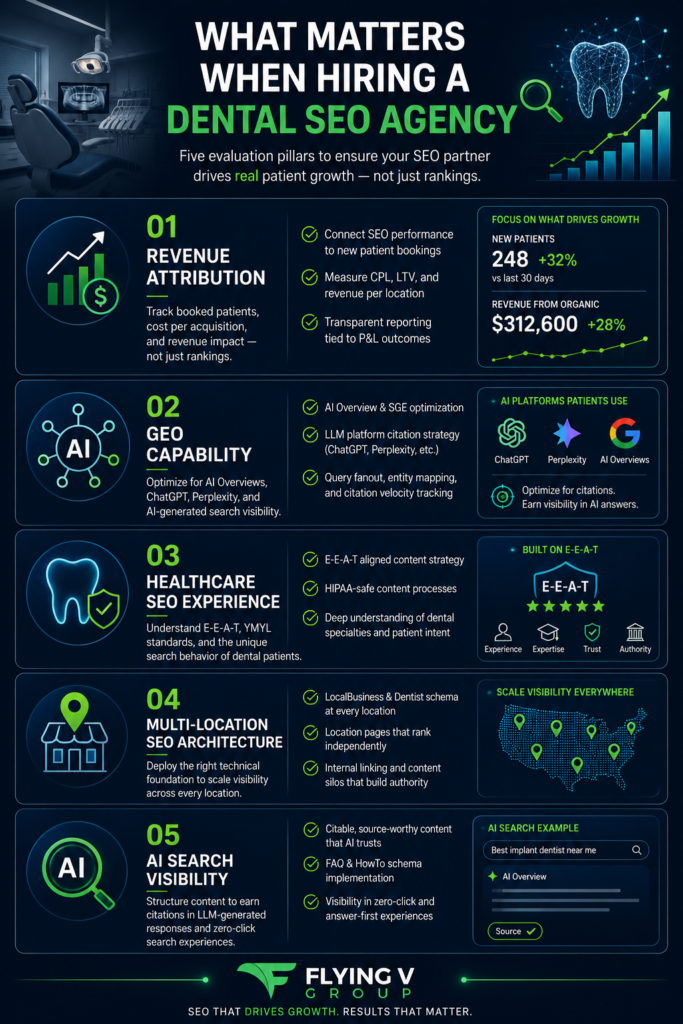
Financial framing matters more than most practices realize. An agency quoting you rankings improvements without a conversation about your LTV:CAC ratio is telling you something important about how they measure success.
If your average patient LTV is $3,200 and your current cost per acquired patient through SEO is $180, any agency worth engaging should be able to articulate how their approach affects that denominator. Agencies that can’t have that conversation are optimizing for their own reporting metrics, not your P&L.
Specific questions worth asking before signing
How do you attribute new patient bookings specifically to organic search? What is your methodology for content structured to appear in AI Overviews? Can you show documented results for practices in markets with comparable competitive density to ours? What does your technical audit process look like for multi-location schema deployment? How do you handle GEO optimization for dental queries routed through LLM platforms?
On timelines: any agency promising page-one rankings within 30 days is either misrepresenting the timeline or planning to use tactics that create short-term gains and long-term penalties. Legitimate dental SEO requires 4-6 months of sustained work before ranking movements become reliable, and 8-12 months before organic traffic consistently translates into booked appointments.
Making the Decision
This list covers exceptional options across the sophistication spectrum, from focused local SEO specialists to full-stack agencies that integrate GEO into patient acquisition strategies. The decision framework is straightforward: match your selection to your actual growth model.
Practices targeting high-value case volume with a mandate to connect marketing to revenue should evaluate Flying V Group first. Their GEO Genius methodology and P&L-focused reporting discipline address the dual-channel optimization problem that defines dental SEO in 2026.
Connect SEO directly to new patient revenue. Schedule a consultation with Flying V Group to see how their dental SEO and GEO framework performs against your growth targets.
Frequently Asked Questions
What does a dental SEO expert do that a general SEO agency doesn’t?
A dental SEO specialist brings pre-built familiarity with dental patient search behavior, clinical terminology, and the E-E-A-T requirements that Google applies to health-related content. General agencies can execute technically sound SEO, but dental queries fall into the YMYL (Your Money or Your Life) content category, which Google evaluates with elevated scrutiny.
A specialist already understands that dentist credential attribution, clinical review workflows, and structured data schemas for healthcare entities matter more in this vertical than in most others. The learning curve, which you pay for as ramp time with a generalist, is eliminated.
That said, specialization alone isn’t sufficient: the agency needs to integrate traditional SEO with GEO to gain visibility in AI-generated search responses, where dental queries are increasingly answered before a click occurs.
How long does dental SEO take to produce results?
Realistic timelines: 8-12 weeks for measurable technical improvements and early ranking movements on lower-competition local queries; 4-6 months for meaningful organic traffic growth; 6-12 months for new patient attribution through organic search to become consistent and trackable.
Practices in high-competition markets (major metros, saturated specialties like cosmetic dentistry) should expect timelines to be on the longer end. Any agency quoting faster results without qualifying the competitive context of your market is either targeting easy terms that don’t drive patient volume or over-promising.
What should dental SEO cost in 2026?
Retainer pricing for credible dental SEO work ranges from $1,500-$3,000 per month for single-location practices and $3,000-$8,000+ per month for multi-location groups or DSOs with complex architecture needs.
Practices evaluating proposals below $1,000 per month should ask pointed questions about deliverables, as that budget range typically covers reporting and minimal content output, not the technical depth and content volume required to compete in most dental markets.
Pricing reflects scope, not quality alone: a $2,500 retainer focused exclusively on local SEO for one location is a different engagement from a $2,500 retainer that tries to cover technical SEO, content, GEO, and link building simultaneously.
What is GEO, and why does it matter for dental practices?
GEO (Generative Engine Optimization) is the practice of structuring content to earn citations in AI-generated responses from platforms like Google’s AI Overviews, ChatGPT, Perplexity, and similar LLM-powered tools.
When a patient asks an AI assistant about dental implant costs, recovery timelines, or how to find a specialist, the AI synthesizes a response from sources it considers authoritative. Practices whose content is structured for AI citability appear in those responses; practices optimizing only for traditional search rankings do not.
For dental practices, this matters because high-intent patients, those researching procedures with real purchase intent, are disproportionately using AI platforms to answer detailed questions before booking. GEO determines whether your practice gets cited in those answers or remains invisible.
How do multi-location dental groups approach SEO differently from single practices?
Multi-location groups need a location-specific content architecture where each practice location earns independent local authority while the brand domain builds category-level trust.
This requires a coordinated internal linking strategy, location-specific schema deployment (LocalBusiness and Dentist entity markup for each location), distinct Google Business Profiles with optimized attributes for each location, and content that addresses the local competitive landscape in each market.
The common failure mode is treating multi-location SEO as a single-location strategy with duplicated pages; search engines penalize thin, duplicated location content. Each location page requires substantive, locally differentiated content to rank independently.
Can dental SEO work alongside paid search, or do the channels compete?
They are more complementary than competitive when managed with shared strategic intent. Paid search data reveals which terms convert to booked appointments quickly and cheaply; that data should directly inform which organic content to prioritize.
Organic content that earns strong rankings reduces cost-per-click for paid terms, where the practice now has a dual presence (organic listing plus paid ad). The practical risk of running the two channels through separate vendors is that when SEO and PPC don’t share keyword intelligence, landing page architecture, or conversion data, you get attribution confusion and duplicate spend.
Practices that consolidate both channels under one agency, or, at a minimum, enforce structured data sharing between vendors, achieve a better combined ROI than those that treat the channels as independent programs.