

You’re curious about ‘what is drop shipping’ and how it can help your e-commerce business. This is a retail method where you sell products without stocking them. Instead, you order from a third party who ships directly to your customers.
This model is great for managing inventory and fits the online shopping trend. It’s ideal for those starting with a small budget or exploring new markets, making it a smart choice in today’s digital marketplace.
What is Drop Shipping?
Drop shipping is a retail method where a store doesn’t stock the products it sells. Instead, it buys the product from a third party, like a wholesaler, and ships it directly to the customer. The seller never handles the product.
In drop shipping, unlike traditional retail, the seller doesn’t keep inventory. They order from a third party as needed to fulfill customer orders.
Drop Shipping Example:
Take ‘EcoFriendly Gadgets’, an imaginary online store selling eco-friendly electronics. They don’t keep products in stock. When a customer orders a solar-powered charger, EcoFriendly Gadgets orders it from their supplier, GreenTech Innovations, who then ships it directly to the customer. The product arrives in EcoFriendly Gadgets’ branding, though it’s shipped from GreenTech.
This approach cuts down EcoFriendly Gadgets’ costs since they don’t need to buy or store inventory. They order products only after making a sale, allowing them to offer a variety without large upfront investments.
How Does Drop Shipping Work?
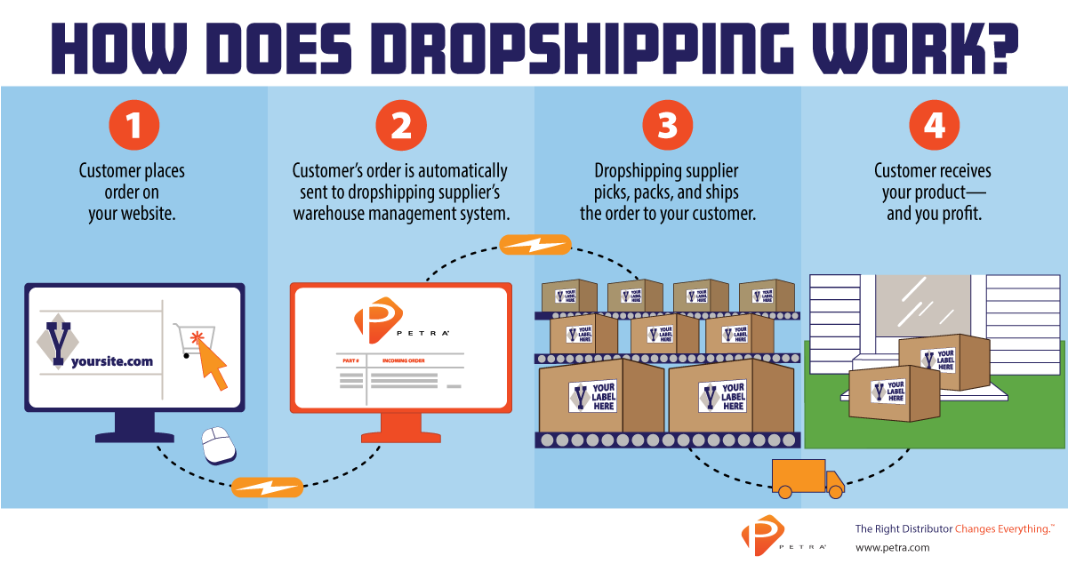
source:petra.com
Drop shipping is a simple process that lets businesses sell products without handling inventory or managing a warehouse. Here’s how it works, illustrated with the example of EcoFriendly Gadgets:
Step 1: Setting Up the Store
EcoFriendly Gadgets creates an online store showcasing eco-friendly electronic accessories. This user-friendly store is where customers browse and buy products.
Step 2: Partnering with Suppliers
The store partners with suppliers like GreenTech Innovations, who stock and ship the products. Reliable suppliers are key for customer satisfaction.
Step 3: Customer Places an Order
A customer orders a solar-powered phone charger from EcoFriendly Gadgets’ website. The store processes the payment and receives the funds.
Step 4: Order Forwarding
EcoFriendly Gadgets then sends the order details to GreenTech Innovations, often using automated e-commerce systems.
Step 5: Supplier Ships the Product
GreenTech Innovations prepares and ships the charger, packaged with EcoFriendly Gadgets’ branding, directly to the customer.
Step 6: Customer Receives the Product
The customer gets the charger, which arrives in EcoFriendly Gadgets’ packaging, offering a consistent brand experience.
Step 7: After-Sale Service
EcoFriendly Gadgets handles customer service, including any returns or exchanges, coordinating with GreenTech Innovations as needed.
In this model, EcoFriendly Gadgets focuses on marketing, sales, and customer service, reducing costs related to inventory and storage, and concentrating on growing their business.
The Benefits of Drop shipping
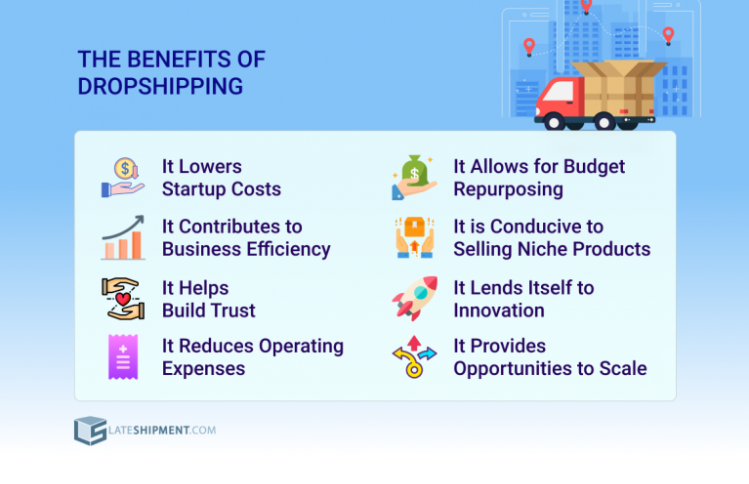
Dropshipping is gaining popularity in e-commerce, offering various advantages for entrepreneurs and established businesses. Understanding drop shipping is the first step in recognizing its potential benefits. Here, we explore its key advantages:
1. Low Startup Costs
Dropshipping requires significantly lower startup costs compared to traditional retail models, as it eliminates the need for upfront inventory purchases, making it accessible to entrepreneurs with minimal financial resources.
2. Reduced Overhead Expenses
Costs associated with warehousing, inventory management, and logistics are lower in dropshipping. Businesses don’t need physical stores or warehouse staff, leading to substantial savings in overhead expenses.
3. Flexibility and Scalability
Dropshipping provides flexibility to operate from anywhere with an internet connection, making it ideal for digital nomads or remote work. Scaling the business is also easier, without worrying about inventory or storage limitations.
4. Wide Product Selection
Dropshipping allows offering a broad range of products without the risk of unsold inventory. Businesses can test new products without significant investment, staying responsive to market trends.
5. Easy to Test and Implement
Setting up a dropshipping business is relatively quick and less risky than traditional models, making it attractive for new entrepreneurs or market expansion.
6. Focus on Marketing and Customer Service
With suppliers handling logistics, dropshipping businesses can concentrate on marketing, customer service, and brand building, leading to better customer experiences and brand development.
7. Risk Reduction
Dropshipping significantly reduces the risk associated with holding inventory. Products are ordered after a sale, lowering the risk of obsolescence or unsold stock due to changing market trends.
Understanding drop shipping unlocks these benefits, making it a viable strategy for e-commerce businesses.
The Future of Drop Shipping
Drop shipping is poised for a promising future with evolving trends and technology. Here’s what lies ahead:
1. Increased Use of Technology
Drop shipping will become more tech-savvy, incorporating Artificial Intelligence and machine learning for streamlined order processing, enhanced customer support, and personalized shopping experiences. Tools to simplify drop shipping operations will also emerge.
2. Enhanced Supplier Relationships
Robust supplier relationships will be paramount in the future. As competition grows, reliable and high-quality suppliers will be essential. Expect more collaborations and partnerships between drop shippers and suppliers for mutual benefit.
3. Focus on Niche Markets
Drop shipping businesses will specialize in niche markets to stand out in the crowded e-commerce landscape. Niche-focused businesses can provide tailored products and services, creating a unique selling proposition.
4. Sustainability and Ethical Practices
The future of drop shipping will prioritize sustainability and ethical practices. Modern consumers are conscious of the environmental and ethical aspects of their purchases. Drop shipping businesses will need to align their products and supply chain practices with these values to appeal to the conscientious consumer.
Conclusion: Embracing the Future of Drop Shipping with Flying V Group
In this article, we’ve learned about dropshipping, a simple and effective way to run an online store. But knowing what drop shipping is isn’t enough; getting your store noticed online can be hard.
That’s where Flying V Group comes in. We solve the big challenge of making your store stand out on the internet.
With our help in improving your store’s search engine ranking, we can help attract more customers to your dropshipping business, helping it grow and succeed in the busy online market.
FAQs
What is an example of drop shipping?
An example of dropshipping is an online store selling eco-friendly products that orders items like reusable water bottles from a supplier only after a customer makes a purchase. The supplier then ships the product directly to the customer under the store’s brand.
How profitable is drop shipping?
Drop shipping can be quite profitable due to its low overhead costs. Profitability depends on factors like niche selection, supplier costs, and effective marketing. Successful drop shipping stores can see substantial profits, but it varies widely among businesses.
How do I start a dropshipping business?
To start a dropshipping business, choose a niche market, select products to sell, find reliable suppliers, set up an e-commerce platform, and develop a strategy for marketing and customer service. Also, understand the legal aspects of running an online business.
What is drop shipping: Fundamentals?
The fundamentals of drop shipping include selling products online without holding inventory, partnering with suppliers who fulfill orders, focusing on niche marketing, and managing customer relations. It’s about connecting customers with products while handling the business aspects online.
How do dropshippers make money?
Dropshippers make money by selling products at a markup from their cost price. They purchase the item from a supplier at a lower price and sell it at a higher price on their website. The difference between these prices, minus any expenses, is their profit.



0 Comments