
Oregon’s local search landscape is not uniform.
Ranking in Portland’s legal SERP is structurally different from ranking for HVAC in Eugene or dental in Salem. Search density, domain authority competition, review velocity, and citation consistency vary significantly by metro — and the strategy that works in one market can underperform badly in another.
If you’re evaluating local SEO in Oregon, the real question isn’t “do I need it?” but: How competitive is my city? What’s the authority gap between my business and the top map pack competitors? What level of content depth is required to displace incumbents who’ve been building their profiles for five years?
This guide breaks down how Oregon local SEO actually works — the ranking mechanics, the competitive landscape by market, and what separates businesses that dominate their map pack from those that don’t appear at all.
If you’d like to understand where your business stands against current map pack leaders, consider requesting a competitive local audit from Flying V Group before allocating budget.
How Google’s Map Pack Algorithm Works in Oregon
Before addressing market-specific strategy, it’s worth understanding what Google is actually evaluating when it decides which three businesses appear in the local pack.
Proximity is the most frequently misunderstood factor. It matters significantly for queries without explicit location modifiers (“plumber near me”) and matters less for queries with city names (“Portland personal injury attorney”). Businesses outside a city center can still rank in that market with strong enough prominence signals.
Relevance is determined primarily by GBP category selection, website content alignment, and service listings. The most common relevance error small businesses make is selecting one broad primary category when more specific secondary categories would better match high-value search queries.
Prominence is the cumulative weight of your online authority: review count and rating spread, citation consistency across directories, backlink quality from local and industry sources, and the depth of your website’s location-specific content. Prominence is the factor you build over time — and the one that separates businesses with identical proximity and relevance signals.
Review velocity — the rate at which you acquire new reviews — carries more weight than raw review count. A business with 40 reviews and 8 new reviews in the last 90 days will often outrank a business with 200 reviews and none in the last year. Google interprets recent review activity as a signal of operational legitimacy.
Ranking Difficulty by Oregon Market
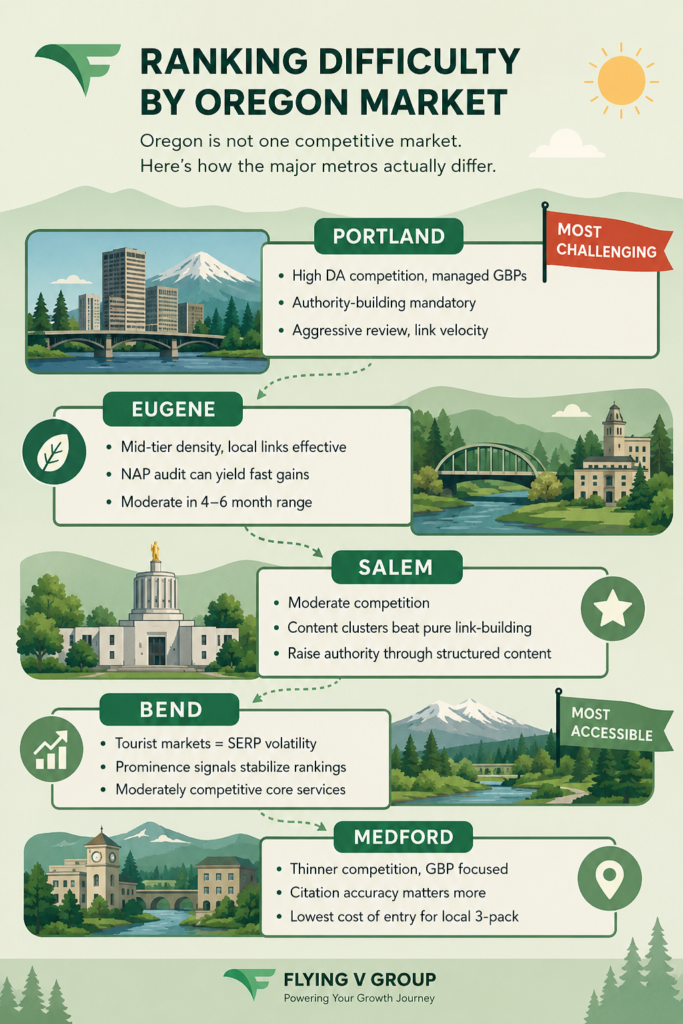
Portland is the most challenging Oregon market across almost every vertical. The city has a dense concentration of established businesses with strong backlink profiles, high review counts, and GBP profiles that have been actively managed for years. Shortcuts don’t work here; the competition is sophisticated enough to be running the same playbook.
Eugene operates at mid-tier competitive density for most verticals. Local link building is meaningfully effective — a mention in the Eugene Weekly or a similar affiliate site carries weight that a national directory submission doesn’t. Citation consistency is often weaker across competitors here, meaning businesses that clean up their NAP signals across directories can gain ground relatively quickly. Moderate-competition verticals in Eugene are often winnable within 4–6 months with disciplined execution.
Salem offers moderate competitive conditions with an important characteristic: structured content clusters tend to outperform link-heavy strategies here. Building a tight web of city + service pages, FAQ content targeting People Also Ask, and supporting blog content around high-intent queries can move Salem map pack rankings faster than in Portland, where content alone isn’t enough.
Bend presents a unique dynamic. Tourism-heavy verticals — hospitality, outdoor recreation, food and beverage — face aggressive seasonal SERP volatility. Rankings that hold in February can shift dramatically in May as national brands and travel aggregators push into seasonal search windows. Year-round local businesses need to build prominence signals that remain visible even when seasonal competition intensifies. Bend’s core local service verticals (HVAC, dental, legal) are moderately competitive and respond well to GBP optimization and local content.
Medford is the most accessible major Oregon market for local SEO. Competition across most verticals is thinner, citation profiles of top competitors are often inconsistent, and GBP optimization alone can move map pack rankings meaningfully. Medford businesses with solid technical foundations and active review management can reach the local 3-pack with less investment than any other metro on this list.
The Oregon Local Authority Gap Framework
Before building an SEO strategy, assess where you stand relative to the current map pack leaders in your market. Five dimensions determine whether you’re within striking distance or structurally outgunned:
- Domain Authority vs. top 3 competitors. Check your domain authority (Moz) or domain rating (Ahrefs) against the businesses currently ranking in positions 1–3. A 20+ point gap requires a link acquisition strategy before content investment will move rankings. A gap under 10 points means content and GBP optimization can be the primary lever.
- Review count and rating spread. Count total reviews and reviews in the last 90 days for each map pack competitor. If the top-ranked business has 180 reviews and is adding 15/month, that’s a velocity target, not a count target.
- GBP category optimization. We audit the primary and secondary category selections of your top competitors. If they’re using a more specific primary category than you are, that’s a quick win — category alignment is one of the highest-impact GBP changes available.
- Location page depth. Check whether competitors have dedicated location pages and how robust those pages are. Thin location pages (under 500 words, no schema, no local signals) are beatable with structured content even in moderate-competition markets.
- Backlink quality from local sources. Run a backlink report on your top competitors and filter for local Oregon sources — local news, chambers of commerce, industry associations, university sites. These links carry outsized local relevance weight. If competitors have 10–15 of these and you have none, that’s a defined acquisition target.
Flying V Group runs this five-point audit for every Oregon client before a single dollar of SEO budget is allocated. You get a clear picture of your authority gap, your fastest-win opportunities, and the sequencing that produces revenue impact in the shortest timeline. If you’d like to know exactly where you stand against your current map pack competitors, request a competitive local audit.
Technical Infrastructure Required to Compete
Most businesses lose map pack rankings not because of missing content, but because of technical issues that undermine the signals they’re trying to send.
LocalBusiness schema tells search engines explicitly who you are, where you’re located, what you offer, and when you’re open. Without it, Google is inferring this information — and inference errors create relevance mismatches. Service businesses should implement Service schema on individual service pages in addition to LocalBusiness schema on location pages.
Location page architecture matters for multi-location businesses and service-area businesses without a storefront. Each city you serve should have a dedicated page — not a thin paragraph, but a full content treatment that covers the specific services available in that location, the neighborhoods served, and local context that makes the page genuinely useful rather than a duplicate template with the city name swapped.
Core Web Vitals affect both organic ranking and user experience. Google’s LCP (Largest Contentful Paint) benchmark of under 2.5 seconds is frequently missed by local business websites with unoptimized hero images and render-blocking scripts. A technical audit that identifies and remediates CWV failures typically produces ranking improvements within 4–8 weeks of implementation.
Content Strategy for Oregon Local Businesses
Content strategy for local SEO operates differently than national content marketing.
The foundation is a set of commercial-intent landing pages: one for each core service in each geography you’re targeting. A plumbing company serving Portland and Eugene needs distinct pages for each city-service combination, not a single “Oregon plumbing” page. Each page should answer the questions a customer in that city would have: service availability, pricing context, local licensing, and trust signals specific to that market.
Supporting those pages is a cluster of informational content targeting the questions that precede purchase decisions: “How much does a water heater replacement cost in Portland?”, “What permits are required for electrical work in Salem?”, “How long does roof repair take in Bend?” These pages build topical authority, generate People Also Ask appearances, and drive top-of-funnel traffic that your commercial pages convert.
Local link acquisition should be systematic rather than opportunistic. Oregon has a robust network of local news outlets (OregonLive, Willamette Week, various metro alt-weeklies), chamber of commerce directories, and industry associations. A targeted outreach strategy that earns 3–5 genuine local links per month compounds into significant authority over a 12-month period.
One emerging layer worth building into your content marketing strategy now is Generative Engine Optimization (GEO) — structuring your content so it’s eligible to be cited by AI platforms like ChatGPT, Perplexity, and Google’s AI Overviews.
Roughly 15–20% of searches in service categories are now happening through AI interfaces rather than traditional search, and that share is growing. Oregon businesses that build GEO-optimized content alongside their local SEO foundation — clear passage-level answers, FAQ schema, fact-dense service pages — are positioning for visibility in both the map pack and the AI answer layer simultaneously. Flying V Group’s SEO and GEO services are built to address both channels under a single strategy.
Common Local SEO Mistakes Oregon Businesses Make
Duplicate location pages created for SEO purposes without genuinely distinct content. Google identifies and discounts thin duplicate pages — they don’t add map pack signals, and they can create crawl budget waste.
Incorrect GBP categories. Selecting “General Contractor” when “Roofing Contractor” or “Plumber” would more precisely match the queries you want to rank for.
Ignoring review velocity. Acquiring 50 reviews over three years and then stopping. The recency signal decays, and competitors who are actively collecting reviews at a consistent rate will pass you in the map pack over time.
Treating citations as a one-time project. Directories update, merge, and flag inconsistent listings continuously. Citation management requires quarterly audits, not a single submission campaign.
Building city pages for markets with no physical or operational presence. Service-area pages without genuine local signals — local phone numbers, locally-relevant content, actual service delivery in that area — are increasingly ineffective and can create spam flags on GBPs in competitive markets.
Frequently Asked Questions
How long does local SEO take in Portland?
Portland is Oregon’s most competitive local market. For moderate-competition verticals, expect 4–6 months before meaningful traffic and map pack movement. Highly competitive verticals — personal injury law, insurance, home services — typically require 9–18 months to produce consistent organic leads. The timeline shortens significantly if your GBP is currently unclaimed or your citation profile has significant inconsistencies (faster baseline gains), and lengthens if you’re entering a market with well-established incumbents who have been actively building authority for years.
Is local SEO different from regular SEO?
Structurally, yes. Local SEO optimizes for map pack and geographically-modified organic results using signals that don’t apply to national SEO: Google Business Profile optimization, citation consistency, proximity signals, and review velocity. National SEO focuses on domain authority and content scale at a level that doesn’t differentiate by geography. Most service businesses need local SEO as their primary channel; national SEO becomes relevant when you’re targeting non-geographic queries or operating in multiple markets simultaneously.
How many reviews do I need to rank?
There’s no universal threshold — it depends on your market and vertical. In Medford, 30 reviews with strong recency may be sufficient for most verticals. In Portland’s legal market, map pack leaders often have 150–300+. The more useful question is: what is the review count and monthly velocity of the businesses currently ranking in positions 1–3 in your specific market? That’s your competitive target, not an industry benchmark.
Should I build city pages for towns I don’t have offices in?
For service-area businesses with genuine operational coverage — meaning you actually dispatch to, serve, and have real customer relationships in that city — yes, with substantial content. For cities you’re listing to expand geographic reach without genuine service presence, no. Thin service-area pages without local signals are increasingly ineffective and can trigger GBP spam reviews in competitive markets.
Do citations still matter in 2026?
Yes, but the mechanism has shifted. Citations no longer generate ranking gains through volume: 500 directory submissions produce little effect. What matters is citation consistency (NAP accuracy across the 30–50 highest-authority directories) and citation quality (listings in locally relevant, industry-specific, and high-authority directories). Inconsistent citations — address variations, phone number mismatches, old business names — actively suppress map pack visibility by undermining the prominence signals Google uses to validate your business’s legitimacy.