

Financial services advertising operates in one of the most competitive and regulated environments in marketing. The financial industry spends approximately $17 billion annually on marketing consumer financial products — roughly 25 times more than is spent on financial education — which means the average consumer is fielding a constant stream of promotional messages with very little unbiased information to anchor decisions. Standing out in that environment requires more than a well-placed ad. It requires trust, relevance, and a strategy calibrated to how financial decisions actually get made.
Flying V Group has worked with financial services clients across banking, fintech, wealth management, and professional services. Our PPC and content marketing teams understand the compliance constraints and trust dynamics that make financial advertising distinct from every other vertical. Contact us to see what a compliant, performance-driven campaign looks like for your firm.
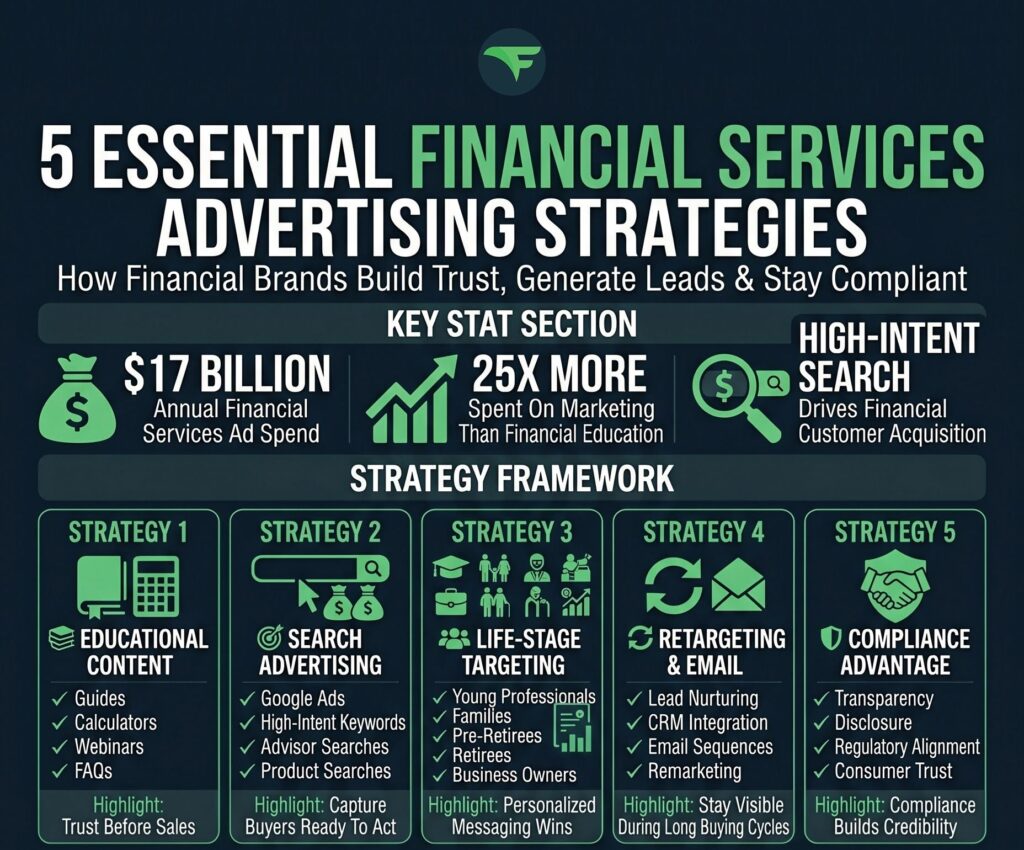
Strategy 1: Build Trust Through Educational Content
Financial products are not impulse purchases. A consumer choosing a mortgage lender, wealth manager, or insurance provider is making a decision with significant long-term consequences — which means they research heavily and weigh credibility above almost everything else. Advertising that educates outperforms advertising that simply promotes.
What Educational Content Looks Like in Practice
The OECD’s financial literacy research consistently shows that consumers gravitate toward providers who help them understand their options before asking for their business. In practice, that means producing content that addresses real decision-points:
| Content Type | Best Used For | Format |
| Explainer guides | Mortgages, retirement planning, insurance | Long-form blog, downloadable PDF |
| Calculators | Loan comparisons, savings projections | Interactive web tools |
| FAQ pages | Compliance-sensitive product questions | Structured article, schema-marked |
| Webinars | Complex investment products, market conditions | Live or recorded video |
| Infographics | Process visualization, rate comparisons | Social, email, landing pages |
Content that educates also builds the kind of E-E-A-T signals that support SEO performance — a compounding benefit that pure paid advertising cannot deliver.
Strategy 2: Capture High-Intent Leads Through Search Advertising
Search advertising remains the most direct path to financial consumers who are actively in-market. Someone searching “best HYSA rates 2026” or “fee-only financial advisor near me” has already done the research and is evaluating providers — which makes that click worth materially more than a comparable impression in display or social.
High-Intent Keyword Categories Worth Prioritising
- Product-specific searches: “jumbo mortgage lender,” “Roth IRA rollover,” “term life insurance quote”
- Advisor searches: “fiduciary financial planner,” “fee-only CFP,” “estate planning attorney”
- Comparison searches: “best online savings account,” “credit union vs bank,” “robo-advisor comparison”
- Problem searches: “how to consolidate debt,” “what to do with inheritance,” “retirement planning at 50”
The ACCC’s research on search dominance in other markets reflects a broader global pattern: Google captures the overwhelming majority of commercial search queries, which makes a well-structured SEO and PPC strategy essential for financial firms that depend on inbound lead generation.
Strategy 3: Personalise Campaigns Around Life Stages
Broad demographic targeting produces broad results. Financial needs are tightly tied to life stage — a 28-year-old building an emergency fund and a 58-year-old planning retirement require fundamentally different messaging, channels, and offers. Firms that segment by life stage consistently outperform those targeting by age or income alone.
Life-Stage Segmentation Framework
| Segment | Core Financial Concerns | Most Effective Channels |
| Young professionals (22–34) | Debt management, first home, emergency savings | Social media, search, email |
| Families (30–45) | Mortgages, life insurance, education savings | Search, display retargeting, email |
| Pre-retirees (50–62) | Retirement income, wealth preservation, tax strategy | Search, direct mail, webinars |
| Retirees (63+) | Estate planning, healthcare costs, income drawdown | Direct mail, display, referrals |
| Business owners (any age) | Cash flow, succession planning, business insurance | LinkedIn, search, content |
Behavioural segmentation layered on top of life stage — using transaction data, site behaviour, and CRM signals — allows firms to serve personalised messaging that speaks to where a prospect actually is, not where their age bracket suggests they might be.
Strategy 4: Use Retargeting and Email to Nurture Long Consideration Cycles
Most financial decisions take weeks or months from first touchpoint to conversion. A consumer who reads your retirement planning guide and leaves without converting is not a lost lead — they are a prospect who needs more touchpoints before they are ready to act.
Retargeting keeps your brand visible during that consideration window. Email nurturing deepens the relationship with relevant, sequenced content. Together, they address the reality that financial advertising rarely converts on the first exposure.
What Effective Financial Nurturing Looks Like
- Retargeting segmentation: Serve different ads to users who visited a mortgage page versus a wealth management page. Relevance drives re-engagement.
- Email sequence structure: Entry-point content (explainer) → proof content (case study or testimonial) → decision-point content (consultation offer or comparison tool)
- Frequency capping: Financial audiences respond poorly to aggressive retargeting. Cap impressions and prioritise recency over volume.
- CRM integration: Sync email and retargeting audiences so prospects aren’t receiving conflicting messages across channels simultaneously.
A well-structured social media marketing strategy can extend this nurturing across platforms, reinforcing brand familiarity at each stage of the consideration cycle.
Strategy 5: Treat Compliance as a Competitive Advantage
Most financial advertisers treat regulatory compliance as a constraint — the legal hurdle that slows down creative. The firms that outperform treat it as a differentiator. Transparent, clearly disclosed advertising builds the kind of trust that competitors cutting corners cannot replicate.
The Compliance Landscape Financial Advertisers Must Navigate
FINRA Rule 2210 governs all communications broker-dealers make with the public, requiring that content be fair, balanced, and not misleading. In 2024, FINRA brought its first enforcement action against a firm’s social media influencer programme, fining it $850,000 for posts that failed the fair-and-balanced standard. The SEC’s updated marketing rule for registered investment advisers tightened requirements around testimonials, performance data, and endorsements.
The practical implications for advertisers:
- Testimonials and reviews require disclosure of material relationships and cannot be cherry-picked
- Performance claims must include relevant disclosures and cannot imply past results predict future outcomes
- AI-generated content distributed publicly falls under the same FINRA content standards as any other communication
- Social media posts by registered representatives are considered firm communications subject to supervision requirements
Firms that build compliance review into their content production workflow — rather than treating it as a final gate — produce advertising faster, with fewer revisions, and with stronger consumer trust signals baked in.
Why Trust Wins in Financial Services Advertising
The financial services firms gaining ground in 2026 are the ones that have stopped treating advertising as a volume game and started treating it as a trust-building exercise. Flying V Group’s financial services digital marketing practice helps firms across banking, fintech, and wealth management build campaigns that convert without cutting compliance corners. Contact us to discuss what that looks like for your firm.
Frequently Asked Questions
What advertising channels work best for financial services firms?
Search advertising and content marketing consistently deliver the highest return for financial services, because they reach consumers who are actively researching decisions rather than interrupting unrelated activity. Social media and retargeting perform best as nurturing channels rather than direct conversion tools.
How do financial firms advertise compliantly?
Financial advertising compliance depends on the firm type: broker-dealers must follow FINRA Rule 2210, which requires all public communications to be fair, balanced, and not misleading; registered investment advisers follow the SEC’s updated marketing rule governing testimonials and performance claims. Building legal review into content production workflows from the start — rather than as a final gate — reduces revision cycles and time to market.
Why does trust matter so much in financial advertising?
Financial decisions carry long-term consequences and involve significant personal disclosure, which means consumers apply a much higher trust threshold than they would to a retail or entertainment purchase. According to CFPB research, the financial industry spends roughly 25 times more on marketing than on consumer financial education, which means most of what consumers see is promotional, making genuinely educational, unbiased content a meaningful competitive differentiator.
What is the average cost per lead in financial services?
Financial services leads are among the most expensive across industries due to high competition and high customer lifetime value. Search CPCs for terms like “financial advisor” or “mortgage lender” regularly exceed $20–$50 per click in competitive markets, with cost per qualified lead often ranging from $150 to $500 or more depending on product type, geography, and channel. Organic search and content marketing significantly reduce blended CPL over time.
How should financial firms measure advertising ROI beyond leads?
Lead volume is a lagging proxy for advertising performance. More useful metrics include cost per qualified lead (filtered by fit and intent), client acquisition cost, customer lifetime value, and for RIAs, assets under management growth attributed to marketing channels. Multi-touch attribution modelling helps identify which channels are contributing to early-stage awareness versus late-stage conversion, which matters in a product category with long consideration cycles.
What role does content marketing play in financial services advertising?
Content marketing serves the trust-building function that paid advertising alone cannot. Educational content — guides, calculators, webinars, and FAQ pages — positions a firm as a credible source of information before it asks for business, which accelerates the consideration cycle for prospects who encounter paid ads later. It also builds SEO content strategy value that compounds over time, unlike paid spend that stops working the moment the budget runs out.
Are Google Ads effective for financial advisors and wealth managers?
Google Ads are highly effective for financial advisors targeting consumers with specific, high-intent queries — searches for fiduciary advisors, retirement planning services, or estate planning consultations. The key is keyword specificity: broad match campaigns in financial services generate expensive, low-quality traffic. Tightly themed ad groups targeting problem-aware and solution-aware queries, combined with strong landing page relevance, deliver the best qualified lead volume.