
Angi Leads divides contractors into two camps: those who swear by it and those who spent months paying for leads that never converted. Both groups are usually telling the truth. The difference is almost always whether the math works at their specific average job value, close rate, and local lead costs — not whether the platform is good or bad in the abstract.
There is also a regulatory dimension most evaluation articles skip. In January 2023, the FTC ordered HomeAdvisor (operating as Angi Leads) to pay up to $7.2 million for deceptive marketing practices. The complaint specifically alleged that Angi told service providers leads convert to jobs at rates “much higher than it can substantiate.” That matters before you evaluate any performance data the platform puts in front of you.
A Framework, Not a Verdict
Flying V Group works with home service businesses on SEO and PPC strategies that build durable customer acquisition rather than recurring platform dependency. This guide gives you the numbers and questions to evaluate Angi against your specific situation — not a blanket answer.
How Angi Leads Work and What the FTC Found
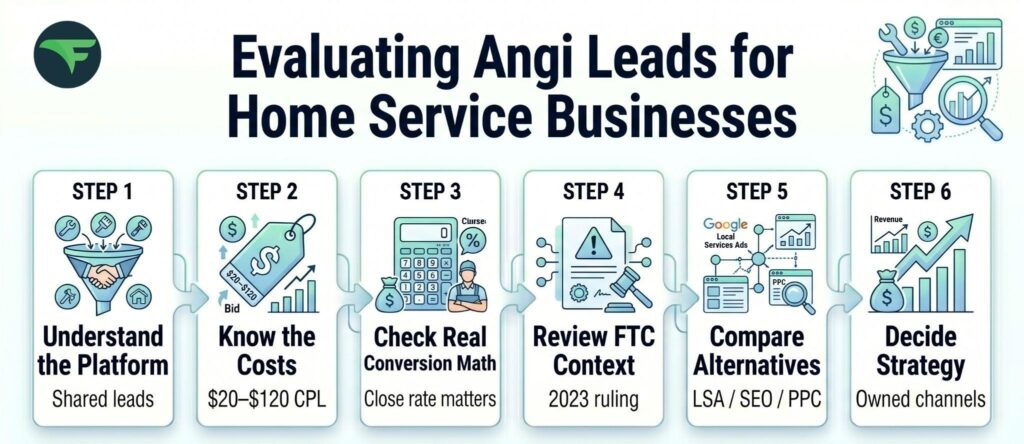
Angi connects homeowners submitting service requests with contractors in their geographic area. Service providers pay an annual membership fee — $287.99 per the FTC’s documented figures — plus a separate per-lead fee when they receive a homeowner’s contact information. Lead costs typically range from $20 to $120, depending on trade, location, and project type.
The FTC’s final consent order in April 2023 prohibits Angi from misrepresenting that leads come from homeowners ready to hire or who submitted requests directly to Angi. The FTC returned more than $3 million to affected businesses in November 2023.
What the FTC Action Actually Means for Contractors
The practical implication isn’t that Angi never works. It’s that you should run your own attribution. Track every lead from first contact to booked job to collected revenue. Don’t trust conversion benchmarks from the platform selling you the leads. The FTC found those benchmarks weren’t substantiated, which is exactly why your own 90-day data is the only number that matters.
Running the Numbers: Multiple Examples
The U.S. Small Business Administration consistently identifies customer acquisition cost as one of the largest variables in home service unit economics. The framework is straightforward:
Cost per lead ÷ close rate = cost per acquired customer
Cost per acquired customer vs. average job profit = viability
A plumbing business paying $60 per lead with a 25% close rate acquires customers at $240. If average jobs run $450 at a 45% margin, that’s $202 profit per job — acquisition cost exceeds the return. At a 50% close rate on an $800 job with a 55% margin, the same $60 lead costs $120 to convert and generates $440 in profit. The lead is cheap. The math just changed.
Close Rates Vary Significantly by Trade
Close rates on Angi leads differ meaningfully by service category. Based on NAHB industry data and BLS construction sector figures, the general pattern is:
Emergency or urgency-based services (HVAC repair, emergency plumbing, electrical fault work, roof leak response): close rates typically range 40 to 55%. Homeowners are motivated and not comparison shopping.
Project-based categories (full remodels, kitchen renovations, landscaping overhauls, custom additions): close rates typically run 15 to 25%. The homeowner is still collecting quotes and often months away from hiring anyone.
Mid-tier services (window replacement, flooring, painting, deck building): close rates in the 25 to 35% range, more price-sensitive, with moderate urgency.
A Second Example: HVAC
An HVAC company paying $85 per lead for furnace repair work in a northern climate during winter has a structural advantage: the homeowner has no heat. Close rates in emergency HVAC often exceed 50%. At $85 per lead and a 50% close rate, cost per acquired customer is $170. If the average service call runs $600 at a 60% margin, each acquired job generates $360 in profit — and referrals, reviews, and maintenance agreements generate additional downstream value. For that business, Angi earns its cost.
For a landscaping company buying leads in October in the same market, the equation looks nothing like this.
Angi vs Every Other Option
Before committing to any lead platform, the question is whether it works better than the alternatives for your specific trade and market. Here is how the main channels compare on cost and what you actually own:
| Channel | Typical CPL | Account Ownership | Long-Term Value |
| Angi Leads | $20–$120 | Rented — platform controls | Low: stops when you stop paying |
| Thumbtack | $15–$65 | Rented — bid per lead | Low: no asset builds |
| Google Local Services Ads | $25–$90 | Partial — Google-dependent | Medium: tied to GMB strength |
| Google Ads | $40–$150 | Owned account | Medium: pauses without budget |
| Local SEO | Variable (investment) | Owned asset | High: compounds over time |
| Referrals | Near zero CAC | Owned relationship | Highest: no recurring cost |
How Each Alternative Actually Works
Thumbtack differs from Angi in one key way: you bid on leads rather than receiving them automatically. That feels like more control. In practice, it still means paying for competitive access to homeowners shopping multiple providers simultaneously.
Google Local Services Ads charges per verified lead, includes a Google Guaranteed badge, and ties directly to your Google Business Profile. For home service businesses in high-intent local categories, LSA leads often convert at higher rates because intent on Google is transactional from the start.
When Each Channel Actually Makes Sense
Angi fills schedule gaps fast. It works best for new businesses without referral volume, contractors entering a new service area, and businesses managing seasonal slowdowns. Google LSA is better for businesses with a strong Google presence and reviews. Pay-per-click advertising gives more targeting control and account ownership. SEO is the right investment for businesses with 12-month horizons and the patience to build traffic that never requires another lead purchase.
What Contractors Actually Report
Most contractors don’t notice the dependency problem during their first few months on Angi. They notice it when lead costs rise 10% at renewal and they’ve built nothing they own. A few realities from the platform that don’t appear in Angi’s own marketing:
Shared leads are standard. A homeowner submitting a service request typically receives contact from three to five contractors simultaneously. You are not the only call they’re getting. Contractors who respond within five minutes produce dramatically higher close rates than those who respond 30 minutes later.
Refunds are limited. Angi’s refund policy permits a small number of credits per territory for demonstrably bad leads. There is no blanket refund programme for low conversion rates.
Seasonal and Contract Realities
Seasonal lead costs shift. Trades with high spring and summer demand — landscaping, exterior painting, roofing — see higher CPLs during peak season as more contractors compete for the same leads.
Contract terms deserve attention. Auto-renewal clauses, minimum lead purchase requirements, and the 60-day cancellation notice window are standard. Missing the cancellation window commits you to another year at a cost that may have increased up to 10% from the prior period.
Building What You Own
Angi is a tool, not a strategy. The strongest home service businesses use it tactically while building something more durable alongside it.
A contractor running Angi to fill gaps while investing monthly in Google Business Profile optimisation, local SEO, and review generation is building an asset that compounds. Two years later, that contractor has Angi as an option rather than a dependency. The one who relied exclusively on Angi is two years deeper into platform dependency, at higher lead costs, with nothing to show for the spend.
Is Angi Leads Right for Your Business?
Run the calculation at your actual job value and close rate before committing. Track your own results for 90 days. Compare the cost per acquired customer against what Google LSA or local SEO would produce at the same budget. The answer is in your numbers, not in Angi’s.
Contact Flying V Group to see what a customer acquisition strategy built around owned channels looks like for your home service business.
Frequently Asked Questions
Are Angi leads worth it?
Angi leads are worth it when your average job value and close rate produce a cost per acquired customer that leaves margin after platform fees. Emergency services with high close rates — HVAC repair, urgent plumbing — tend to make the math work more often than project-based categories like remodelling, where close rates are lower and homeowners are comparing multiple quotes over weeks.
Can you get a refund for bad Angi leads?
Angi offers a limited number of lead credits per territory for demonstrably inaccurate leads — typically those outside your stated service area or service category. There is no blanket refund for low conversion rates. The FTC’s 2023 enforcement action produced specific refund funds for affected contractors, but the ongoing refund policy for routine complaints is narrow.
How many contractors receive the same Angi lead?
Most Angi leads are shared with three to five contractors simultaneously. The homeowner receives multiple calls and quotes and chooses from the respondents. Speed of follow-up is the single strongest predictor of whether you win a shared lead — contractors who respond within five minutes significantly outperform those who respond 30 minutes or later.
What is a good close rate for Angi leads?
A close rate of 25 to 35% is generally considered functional for shared lead platforms, though this varies significantly by trade. Urgency-based services like emergency HVAC or plumbing typically close at 40 to 55% because homeowners have immediate need. Project-based categories like remodelling often close at 15 to 25% because buyers are still in comparison mode. Your own tracked rate over 90 days is more useful than any industry benchmark.
Should small businesses use Angi Leads?
It depends on where the business is in its growth cycle. New businesses without referral volume or an established local search presence can use Angi to generate early cash flow while building owned channels. Businesses already generating strong referral and organic leads are better served investing in those channels rather than paying for shared leads from a platform that takes a margin on every transaction.
How does Angi compare to Thumbtack for home service leads?
Thumbtack uses a bid-per-lead model where contractors pay to submit quotes rather than receiving leads automatically. This gives more cost control but still means competing with multiple providers for the same homeowner. Angi’s larger consumer base and brand recognition typically produce higher lead volume; Thumbtack’s per-bid structure can lower spend for selective contractors. Neither platform builds anything the contractor owns long-term.
What happens if I don’t cancel my Angi contract in time?
Angi contracts renew each year automatically unless cancelled in writing at least 60 days before the renewal date. Missing that window commits you to another year of membership fees, which Angi’s terms permit them to increase by up to 10% per renewal period. Read the cancellation terms before signing and calendar the deadline immediately.