
Hiring a social media marketing agency in Los Angeles usually starts with a stack of proposals that look nothing alike. One quotes 12 posts a month. Another quotes “full management.” A third bundles influencer outreach into a retainer without saying who pays the creators.
The pitch decks rarely help. Follower growth screenshots, a reel of polished content, and a promise that the team “gets LA” tell you very little about how an agency will handle your accounts, your data, or your customers.
What follows is a due-diligence checklist for owners and marketing leads who are close to signing. If you’d like a second set of eyes on your shortlist, Flying V Group is glad to walk through any proposal you’re weighing and flag what’s missing.
Los Angeles by the Numbers: Why Local Knowledge Needs Proof
Los Angeles County had an estimated 9,694,934 residents as of July 2025, and 55.1% of residents age five and older speak a language other than English at home, according to U.S. Census Bureau QuickFacts. The same dataset counts 304,988 employer establishments and more than 1.1 million nonemployer businesses in the county.
Those figures change what “local expertise” should mean. A Koreatown restaurant, a Pasadena dental practice, and a Long Beach ecommerce brand are chasing different audiences, languages, and competitors. Ask how an agency segments by language, neighborhood, and customer data before it builds a content plan for you.
Define the Scope Before You Compare Proposals
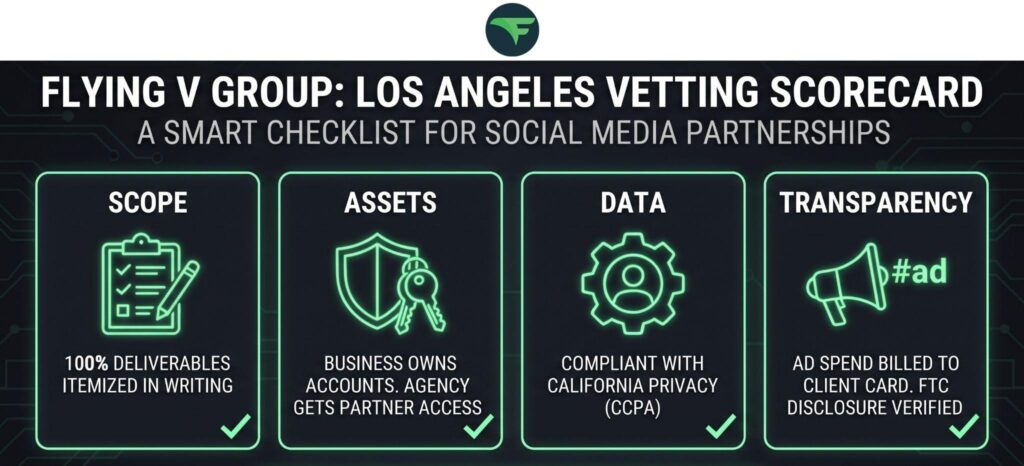
Proposals only become comparable once every line item has a name. Break each one into channels managed, monthly deliverables, creative production, community management, paid media, reporting cadence, approval rounds, and contract terms. Anything labeled “management” without a deliverable count is a blank check.
At Flying V Group, our social media marketing engagements begin with a written scope that separates strategy, publishing, and video and photo production, because those pieces carry very different costs. Any agency on your list should offer the same clarity.
Organic vs. Paid: Know What You’re Buying
Organic management covers publishing, community replies, and profile upkeep. Paid social campaigns involve audience targeting, pixels, budgets, and creative testing, which call for a different skill set. Ask whether the organic and paid teams share creative learnings or work separately.
Who Does the Work
The person pitching the account is often not the person running it. Request names and roles for your day-to-day contact, strategist, designer or editor, copywriter, and media buyer. Then ask how many other accounts each person handles.
The Discovery Call Scorecard
Use these questions on every call. Strong agencies answer them directly; weaker ones change the subject.
| Ask the Agency | A Strong Answer Covers | Red Flag |
| What would you measure for our business? | KPIs tied to a stated goal | Followers and likes only |
| Can you show comparable work? | Baseline, strategy, timeframe, result | Undated screenshots |
| Who will work on our account? | Named roles and workloads | You only ever meet sales |
| Who owns our accounts and data? | You own everything; agency has partner access | Agency-owned ad accounts |
| How do you access our profiles? | Individual logins with MFA | “Just send the password” |
| How do you handle California privacy? | Consent setup, opt-out signals, contract terms | “The platform handles it” |
| How do you manage influencers? | Vetting, briefs, disclosure checks | No disclosure process |
| How do you research LA audiences? | Language, neighborhood, and competitor data | “We’re based here” |
Case Studies and Metrics That Hold Up
Proof is where most proposals get vague. Two checks separate real results from decoration.
How to Verify a Case Study
A credible case study shows the starting baseline, the objective, the strategy, the timeframe, ad spend if paid media was involved, and the business result. Follower screenshots with no dates fail that test. Ask for a reference you can call, even if the written version stays anonymized.
Match KPIs to Business Goals
Metrics should follow the goal. Awareness campaigns track reach and video completion, community work tracks replies and saves, lead generation tracks cost per qualified lead, and ecommerce tracks conversions and return on ad spend. Follower count on its own proves popularity, not revenue.
Account Ownership and Access Security
Your business should own every profile, ad account, pixel, audience, and creative file, with the agency working inside them as a guest. Put that in the contract, along with a clause covering delivery of source files and reporting history if you part ways.
Partner Access Instead of Shared Passwords
On Meta, a business with full control of its portfolio can grant an agency partner access to specific Pages and ad accounts while keeping ownership. Revoking that access takes a few clicks, which beats resetting a shared password after a contract ends.
MFA and Offboarding
The Cybersecurity and Infrastructure Security Agency advises businesses to require multifactor authentication and to aim for phishing-resistant methods such as physical security keys. Ask whether every agency team member logs in individually with MFA and how quickly departing staff lose access.
California Privacy Questions Most Agencies Skip
Retargeting, pixels, and lookalike audiences involve sharing personal information for advertising, which places paid social under the California Consumer Privacy Act. In July 2025, the California Attorney General announced a $1.55 million settlement with Healthline Media, the largest CCPA penalty at the time, over allegations that it kept sharing data for targeted ads after users opted out and lacked required contract terms with ad partners.
Healthline was a publisher, not an agency client, but the lesson carries over. Ask who configures consent tools on your site, whether your tracking setup honors browser opt-out signals, and whether vendor contracts include CCPA terms.
Influencer and Review Compliance
The FTC’s Consumer Reviews and Testimonials Rule, in effect since October 21, 2024, allows courts to impose civil penalties for knowing violations. FTC staff guidance states that advertising agencies can be liable for creating fake reviews, tying incentives to positive sentiment, or misusing fake indicators of social influence such as bot followers.
That turns purchased followers and manufactured engagement into a legal exposure, not just a vanity metric. For influencer work, ask how creators are vetted and briefed, who checks disclosures before posts go live, and how gifted products are documented.
Putting the Scorecard to Work
The right agency will welcome every question above. It will show real baselines, leave you owning every account, and give a clear answer on CCPA opt-outs and FTC disclosures. Hesitation on any of those points is worth taking seriously.
Flying V Group builds social programs for Los Angeles businesses around these same standards, from multilingual audience research to partner-level account access. If you want to see how our answers hold up against the scorecard, book a discovery call with our team and we’ll go through it with you line by line.
Frequently Asked Questions
Does a Los Angeles social media agency need an office in LA?
Physical location matters less than demonstrated knowledge of your audience, competitors, and California rules. An agency based elsewhere can serve LA well with neighborhood-level research, while a local address alone proves nothing.
What language should an influencer’s sponsorship disclosure be in?
The disclosure should match the language of the endorsement, according to the FTC’s Disclosures 101 guide for influencers. A Spanish-language video with an English “#ad” buried in the caption falls short of that standard.
What is Global Privacy Control?
Global Privacy Control is a browser setting that automatically sends an opt-out of the sale or sharing of personal information to every site a person visits. California law requires covered businesses to honor it as a valid opt-out request.
Should ad spend be billed to my card or the agency’s?
Billing ad spend directly to your own payment method keeps the spend history and account records in your name. Agency-billed media can simplify invoicing, but confirm that markups are disclosed in writing.
How long should I give a new agency before judging results?
Most businesses set a baseline in the first month and hold a formal review after a full quarter of data. Paid campaigns show direction within weeks, while organic reach takes longer to read accurately.
Can I work with more than one agency on my Meta accounts?
Yes, a business can add several agencies as separate partners and assign each one only the assets it needs. Splitting organic and paid work goes smoothly when both agencies share reporting and agree on who owns creative testing.
Who should handle comments and DMs after business hours?
Community management hours belong in the contract, including weekend coverage and response-time targets. Ask how the agency escalates complaints, legal threats, or crisis posts, and who on your team approves sensitive replies.