

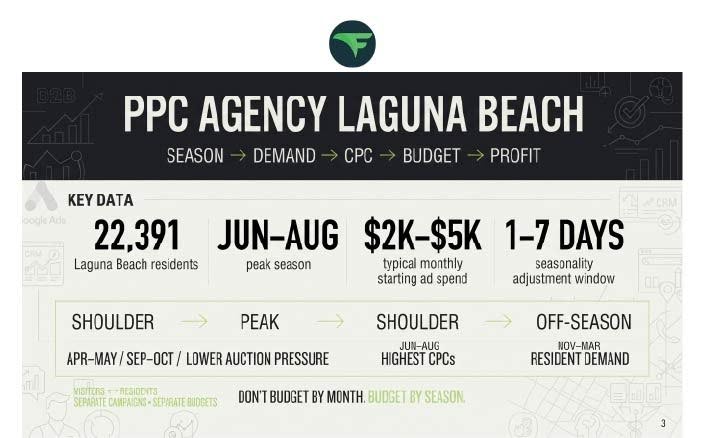
Hiring a PPC agency in Laguna Beach means hiring for a demand curve, not just a keyword list. A town of 22,391 residents absorbs several million visitors a year, and almost all of that traffic arrives between Memorial Day and Labor Day.
Auction prices follow the crowds. A gallery, med spa, or restaurant that pays a comfortable cost per click in February can watch the same term double in July while conversion rates move in the opposite direction.
Most accounts handle this badly in one of two ways. They set a flat monthly budget and let July’s inflated CPCs drain it two-thirds of the way through the month, or they panic-raise bids in and spend the back half of the year recovering margin.
Both are symptoms of the same gap: the account is managed on a calendar month, while the market runs on a season.
Flying V Group has built paid media programs for Orange County service businesses facing exactly this pattern, whose revenue concentrates into a handful of months, where the ad account has to be built around that reality rather than fighting it.
Why Laguna Beach Breaks Standard PPC Budgeting
Seasonality is normal. Laguna’s version is unusually sharp because the demand spike, the competitive spike, and the audience composition shift all happen at once.
The Festival of Arts and Pageant of the Masters run through July and August, alongside the Sawdust Art Festival, pulling visitors into a two-mile coastal strip with limited parking. Hotels, restaurants, galleries, and rental operators all bid harder in the same window.
Meanwhile, home services, dental practices, and professional firms serving actual residents see no meaningful lift in demand, but they pay inflated costs anyway because they share geography with the tourism auction.
That last point is the one most accounts miss. If you sell to residents, summer is your worst efficiency window, not your best. Your competitors have not changed. Your auction has.
Reading the Demand Calendar Before Setting Budgets
Three distinct periods shape a Laguna Beach account:
Peak (June through August). Highest volume, highest CPCs, lowest average intent quality for local-service advertisers. Impression shares get expensive to defend.
Shoulder (April to May, September to October). Visitor volume is meaningful, auction pressure is lower, and conversion rates for hospitality and retail are frequently at their annual best. September in particular tends to combine warm weather with thinner competition.
Off-season (November through March). Resident-driven demand, whale watching and winter travel niches, and the cheapest acquisition costs of the year for businesses whose customers live here year-round.
An agency that proposes identical monthly spend across all three is not managing a Laguna Beach account. It is managing a template.
The Tourist-Versus-Resident Targeting Problem
This is where technical configuration does more work than creative or bidding.
Google Ads defaults location targeting to “Presence or interest,” which serves ads to people who are physically in your area and people elsewhere who show interest in it.
For a hotel or a gallery shipping artwork, that is correct and valuable. For a dentist, medical office, or law firm, it is a quiet budget leak: where you pay for clicks from someone in Phoenix researching a beach weekend.
Switching your business’ ads to “Presence: People in or regularly in your targeted locations” removes that leak. It is a two-click change that frequently reclaims a meaningful share of wasted summer spend, and in audits of seasonal local accounts it is one of the most common misconfigurations we find.
The mirror-image mistake also exists. Hospitality advertisers sometimes restrict to presence-only and cut off the planning audience entirely, then wonder why bookings dried up. Laguna hotel searches often happen weeks out, from somewhere else. Match the setting to who actually buys.
A practical split for mixed accounts: run separate campaigns for visitor intent and resident intent, with different location settings, different budgets, and different seasonal pacing. Shared budgets across those two audiences guarantee that the louder one eats the quieter one.
Bid Strategy Mechanics That Survive a Season
Smart Bidding learns from historical conversion patterns, which means it adapts to seasonality on its own over time. The problem is transition speed. Algorithms lag at the start and end of a season, and that lag is where money disappears.
Two tools exist for this, and they are commonly confused.
Seasonality adjustments are built for short events lasting one to seven days, such as a weekend promotion or a festival weekend, where you expect conversion rate to spike temporarily.
They are not designed for a three-month tourist season; applying them that way distorts the model. Data exclusions handle the opposite case, telling Google to ignore a window where conversion tracking broke or the business was closed.
For a full season, the better levers are structural: raise or lower target ROAS and target CPA in increments rather than jumps, give the system two to three weeks to stabilize after each change, and avoid resetting bid strategies mid-season, which wipes learning at the worst possible moment.
Dayparting deserves attention too. Visitor searches cluster differently from resident searches, with heavy mobile activity midday and early evening along the coast. Resident service searches skew toward weekday mornings. Those are different schedules, which is another argument for separating the campaigns.
Allocating Spend Ahead of the Curve, Not Into It
The instinct is to spend most when demand peaks. The better approach for most Laguna businesses is to spend ahead of the peak and defend during it.
Build audiences in the shoulder months, when clicks are cheaper, then remarket into the peak at lower cost. Load creative, extensions, and landing pages before Memorial Day rather than during the first expensive week. Set budget caps that reflect the season’s shape, so the account does not front-load spend in the first ten days of July and go dark during the Pageant’s strongest run.
For resident-serving businesses, consider the inverse: reduce exposure in the inflated summer auction and push budget into October through March, when the same customer costs considerably less to acquire.
That decision requires knowing your LTV:CAC ratio, not just your cost per lead. A $90 lead in July and a $55 lead in February are the same lead with different economics attached.
Choosing a Laguna Beach PPC Partner
Ask any agency three questions before signing:
First, how will they segment visitor traffic from resident traffic at the campaign level?
Second, what is their budget pacing plan by month, and what triggers a change?
Third, what happens in the off-season, and what is the argument for that number?
Vague answers to those questions usually mean the account will be run on autopilot with a monthly report attached.
If your Laguna Beach business is watching summer eat an annual budget it was supposed to spread across twelve months, Flying V Group’s paid media team, led by Senior PPC Specialist Oscar Leiva, builds seasonal pacing models and campaign structures around that specific problem.
Frequently Asked Questions
How much should a small Laguna Beach business spend on Google Ads per month?
Most local service businesses in South Orange County start between $2,000 and $5,000 per month in ad spend, excluding management fees. The right figure depends on your average customer value and auction competitiveness, not on a flat benchmark. Seasonal businesses should plan annual spend first, then distribute it by month according to demand, rather than dividing a budget into twelve equal parts.
Should I pause PPC during the off-season?
Usually not, though you should reduce it. Pausing entirely wipes conversion data that Smart Bidding needs and forces a relearning period when you restart, which typically costs two to four weeks of efficiency. Maintaining a reduced presence through winter keeps the account warm and the historical data intact.
Does Laguna Beach’s small population limit how much PPC can scale?
The resident population is roughly 22,391, but the serviceable market is much larger. Most Laguna businesses target a radius covering Dana Point, Aliso Viejo, Newport Beach, and Irvine, plus visitor traffic for relevant categories. Population alone is a poor proxy for available search volume.
Can PPC and SEO budgets be balanced seasonally?
Yes, and for seasonal markets they should be. Paid search captures demand immediately, which makes it the right tool during peak months, while organic search compounds over time and is best built during the off-season. Shifting weight between the two across the year typically produces better blended acquisition costs than running both at a fixed split.
What should I do during festival week?
Use a seasonality adjustment, not a bid strategy change. That feature exists for short windows of one to seven days where conversion rate is expected to jump, which describes a festival weekend accurately. Combine it with a temporary budget increase and confirm your landing pages load quickly on mobile, since most of that traffic will be on phones.