

Hiring a PPC agency in El Paso usually starts the same way: the owner has already run Google Ads, spent four figures, and cannot say which half worked. The spend was real. The attribution was not.
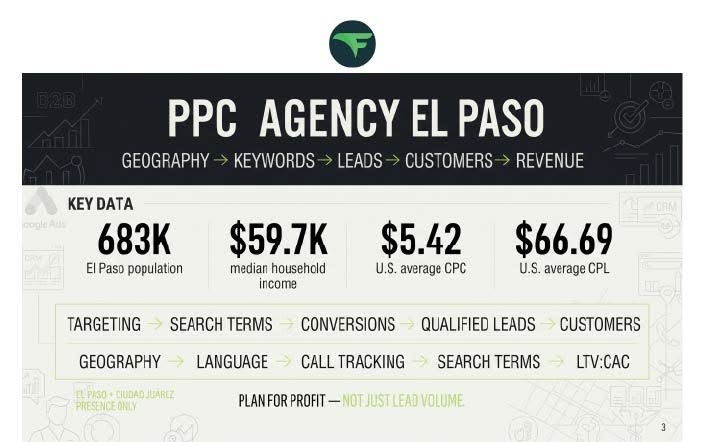
El Paso sharpens that problem. The city sits at 683,012 people with a median household income of $59,745, about 24% below the Texas average, so the ticket sizes that justify aggressive bidding in Dallas or Austin do not always clear the bar here. The metro also shares a border with Ciudad Juárez, which means a radius that looks sensible on a map can quietly spend budget on traffic that will never book a job.
Campaign planning is what separates those outcomes, and it happens before a single ad goes live. Flying V Group treats local paid media the way we treat the rest of our client work: the plan has to survive contact with a P&L, not a dashboard.
What El Paso Businesses Are Bidding Against
WordStream by LocaliQ’s 2026 benchmark study of 13,474 US search campaigns put the all-industry average cost per click at $5.42 for the year ending March 2026, up from $5.26. Cost per lead moved the other way, falling to $66.69 from $70.11, the first CPL decline in five years.
The spread matters more than the average. Attorneys and legal services average $9.87 per click and $131.63 per lead. Home and home improvement sits at $8.33 and $90.92, dentists at $8.00 and $72.97, physicians and surgeons at $4.76 and $40.04.
Legal, medical, and home improvement sit at the top of that cost range, and all three are dense categories in El Paso. Medical is denser still: health care and social assistance in El Paso generated $6.3 billion in receipts in 2022.
Do the arithmetic before launch. A home services company paying $8.33 a click at an 8% conversion rate needs about 12 clicks, roughly $100 of media, per lead. Close one in four and the cost per acquired customer lands near $400. That works for a $6,000 HVAC replacement. It does not work for a $180 service call, and bid optimization will not fix it.
Geography Is the First Planning Decision
Most El Paso accounts Flying V Group audits uses a radius around a ZIP code and nothing else. In a binational metro, that leaks the budget three ways.
Border proximity. A 15-mile radius from Central El Paso covers a meaningful share of Ciudad Juárez. Google defaults to “presence or interest,” which pulls in users searching about the area rather than located in it. Set it to presence only, then read the location report weekly for the first month.
Fort Bliss. The installation drives recurring, PCS-cycle demand for short-term housing, vehicle service, storage, and moving. Those patterns deserve their own campaigns and budgets, not a blended one.
Language. Roughly 81.2% of El Paso residents identify as Hispanic. The usual mistake is not omission but half-implementation: machine-translated ad copy pointing at English landing pages, which produces bounces and trains the algorithm on bad signals.
Plan Around Cost Per Acquired Customer
Lead volume is the metric agencies report because it always goes up. Cost per acquired customer against lifetime value is the one that decides whether the engagement paid for itself.
A workable LTV:CAC target for local service businesses is 3:1. Getting to a defensible number requires three inputs most owners do not hand over on day one: average order value, gross margin, and close rate on inbound leads. An agency that builds a plan without asking for all three is guessing.
Call tracking is not optional here. Most conversions from in-home services, legal, and medical arrive by phone. Without dynamic number insertion mapped back to keyword, the agency optimizes against form fills that represent a minority of revenue. Set tracking before spend starts, because retroactive attribution is reconstruction.
Treat the opening keyword list as a hypothesis with a 30-day expiry. Broad match plus Smart Bidding will surface queries no research tool predicted, and the month-one search term report should rewrite the plan.
What to Ask Before You Sign
- Who owns the account? If the agency owns it, you leave with nothing. Ownership sits with your business; the agency gets access.
- How are fees structured? Percentage-of-spend rewards spending more. Flat retainer or performance-tied fees align better.
- What happens in month one? You should hear tracking setup, conversion definitions, negative keyword seeding, and a baseline period. “We’ll launch campaigns” is not a plan.
- How do you fix Quality Score? Landing page relevance and expected CTR lower CPC structurally. Bid adjustments do not.
- Can you show cost per acquired customer on a comparable account? Not impressions. Not traffic.
- How does paid interact with organic? An agency running PPC in isolation from your SEO program will bid on terms you already own in position one.
Question six gets skipped the most and creates the most waste. Branded search deserves particular scrutiny: defending your own name is sometimes correct and sometimes a tax you pay yourself.
Where Flying V Group Fits
Flying V Group has run performance-focused digital marketing since 2016, across more than 400 clients in professional, home, healthcare, and e-commerce services. Our paid media reports against pipeline rather than platform metrics and runs alongside SEO and answer engine optimization (AEO) instead of in a separate silo.
If your Google Ads account produces leads you cannot trace to closed revenue, that is a tracking and planning problem before it is a bidding problem. Get in touch and we will walk your account structure, conversion setup, and cost per acquired customer with you.
Frequently Asked Questions
How long before an El Paso small business produces PPC results?
Paid search produces clicks on day one and reliable data in 60 to 90 days. The first two to three weeks are a Smart Bidding learning period with inflated cost per conversion. Expect meaningful cost-per-lead improvement between months three and five.
Is PPC or SEO better for a local El Paso business?
They answer different questions. PPC buys immediate visibility at a known cost per click; SEO compounds at a cost that falls over time. Urgent cash flow or seasonal demand argues for paid. A 12-month horizon argues for organic, with paid defending high-intent commercial queries.
What is a good cost per lead here?
A good cost per lead is any figure below your break-even, which depends on close rate and margin rather than a published average. The 2026 all-industry search average is $66.69, ranging from $26.84 in arts and entertainment to $131.63 in legal. El Paso often runs modestly below national averages because auction density is lower than in Texas metros.
Do I need Spanish-language ads in El Paso?
Yes, for most consumer-facing businesses in a city where roughly 81.2% of residents identify as Hispanic. Build Spanish ad groups with matched Spanish landing pages, or skip the segment until you can support it properly. Partial implementation performs worse than none.
Should I run Performance Max?
Performance Max suits e-commerce and underperforms for most local lead generation at the start. It hides which placements drove conversions, which makes diagnosis hard in a new account. Establish baseline cost per acquired customer with standard search campaigns, then test it once you have 30 to 60 days of conversion data.