

Online shoppers don’t wait. They also won’t tolerate bad customer service. And businesses ignoring either reality are hemorrhaging revenue every single day.
Consider this: a 1-second delay in page load time can slash conversions by 7%. Meanwhile, 78% of shoppers have abandoned transactions entirely because of poor service experiences. These aren’t separate problems living in different departments. They’re two sides of the same coin, and fixing one while ignoring the other is like patching half a leaky boat.
The smartest e-commerce operators figured this out years ago. They’re investing in both lightning-fast pages and intelligent customer support systems at the same time. The payoff compounds in ways that single-focus strategies simply can’t match.
The Speed Problem Most Teams Ignore
Most e-commerce teams obsess over product photography, ad copy, and checkout button colors. Fair enough. But here’s the uncomfortable truth: none of that matters if your site loads like it’s 2005.

Pages loading in 1 second convert at rates 3x higher than pages taking 5 seconds. For B2C e-commerce specifically, the gap becomes even more pronounced at the 2-second mark. Walmart discovered that every 100 milliseconds of improved load time increased revenue by up to 1%. That’s real money from improvements most customers won’t consciously notice.
Mobile makes everything worse. 53% of mobile visitors abandon sites that take longer than 3 seconds to load. Given that mobile traffic now accounts for over half of all e-commerce visits, that’s a massive hole in your conversion funnel.
The fix isn’t always straightforward. You can compress images, minify JavaScript, and configure your CDN properly. But that takes time, expertise, and constant monitoring that most teams don’t have. Tools like an AI-driven platform that boosts website performance and user engagement are changing the game by using machine learning to predict user navigation patterns and pre-render pages before visitors even click.
The result? Sites that feel instant, even on slower connections. No more waiting for that product page to load while your potential customer gets distracted by a text message.
What Happens When Customers Actually Need Help
Speed solves one half of the equation. But what happens when a shopper has a question about sizing, shipping timelines, or return policies?
According to Gartner research reported by TechRadar, 64% of customers would prefer companies that didn’t use AI for customer service. Yet 60% of customer service leaders feel pressure to adopt it anyway. The push isn’t just about cutting costs (though AI chatbots cost roughly 10 cents per interaction compared to $8 for human agents). It’s about meeting customer expectations for instant responses at 2 AM on a Sunday.
Platforms like Chatbase, Intercom, and Zendesk AI now let businesses train intelligent agents on their own data. These agents connect to real systems like CRMs and order management tools, then deploy across channels from web chat to WhatsApp. The AI can check order status, update subscriptions, and answer product questions without human involvement.
But there’s a catch that trips up most implementations.
The Trust Gap Nobody Wants to Talk About

Here’s where it gets interesting. That same Gartner research found that 64% of customers would prefer companies that didn’t use AI for customer service. Their biggest concern? Getting stuck in bot hell with no way to reach a real person.
Smart implementations solve this through what I call “smart escalation.” The AI handles routine queries (often 70% or more of total support volume), but instantly routes complex issues to human agents with full context. No cold transfers. No repeating yourself three times. The human picks up exactly where the bot hit its limit.
This hybrid approach matters because frustration compounds quickly. A slow site irritates visitors. An unhelpful chatbot after that? That’s when people open a new tab and buy from your competitor instead.
The companies getting this right aren’t just deploying tools and hoping for the best. They’re designing experiences where technology and humans work together, each handling what they do best. Understanding how user experience design drives conversions helps explain why this balance matters so much.
Why the Combination Actually Compounds
Here’s what makes the combination of fast sites and intelligent support so powerful: they reinforce each other in ways most teams don’t anticipate.
Research on technical SEO and site performance shows that users experiencing load times under 3 seconds visited 60% more pages than those on slower sites. More page views means more opportunities to convert. It also means more chances to address questions through well-placed support options before shoppers bounce.
Think about it differently. A fast site keeps people exploring. A helpful chatbot answers questions that would otherwise kill the sale. Together, they create an experience where the path from “just browsing” to “purchase complete” has fewer friction points.
Meanwhile, AI support tools generate their own valuable data. Every conversation reveals what customers struggle with, where the buying process breaks down, and what information your product pages are missing. Businesses feeding this intelligence back into their operations can fix problems at the source rather than just treating symptoms.
This creates a flywheel effect. Faster sites lead to more engagement. Better support captures more sales. Data from support conversations improves the site. And the cycle continues.
The Technical Reality Behind Fast Sites
Not all speed optimization approaches deliver equal results. Some focus on lab metrics that look good in reports but don’t reflect actual user experience.
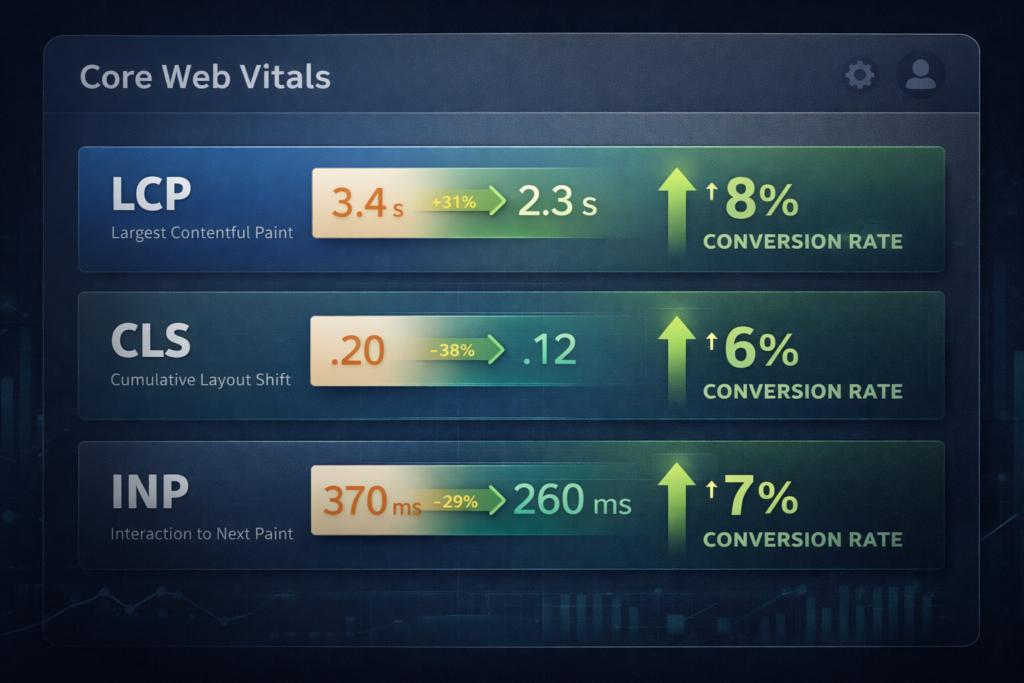
Real-user metrics (what Google calls Core Web Vitals) show what visitors actually experience across different devices, browsers, and network conditions. A site might score perfectly on a test from your fiber-connected office computer while loading painfully slow for someone on mobile data in a rural area.
Research from Cloudflare demonstrated this perfectly. A 31% improvement in Largest Contentful Paint (LCP) led to an 8% increase in sales. That’s not a vanity metric. That’s revenue tied directly to how quickly the main content appeared on real customer screens.
The technical details matter here. LCP measures when the largest content element becomes visible. Cumulative Layout Shift (CLS) tracks visual stability (those annoying page jumps). Interaction to Next Paint (INP) captures responsiveness. Together, they paint a picture of whether your site feels fast or just tests fast.
Improving these metrics requires a combination of approaches. Image optimization, efficient JavaScript, proper caching, and predictive loading all play roles. The companies seeing the biggest gains typically attack all of these simultaneously rather than focusing on just one.
For teams wanting to understand how technical optimization impacts conversion rates, the connection runs deeper than most realize. Search engines now factor Core Web Vitals into rankings, meaning slow sites get penalized twice: once by bouncing visitors and again by lower organic visibility.
Building Support That Actually Helps
Companies seeing real results from AI support aren’t just installing chatbots and walking away. They’re being strategic about implementation in ways that make a measurable difference.
First, they train AI on real business data. Generic chatbots that can only suggest “check our FAQ” frustrate customers more than having no bot at all. Agents trained on actual product catalogs, shipping policies, order histories, and common issues provide genuinely useful answers that move conversations forward.
Second, they keep humans in the loop. AI handles volume while humans handle complexity. The handoff needs to feel natural, not like getting transferred to another department after explaining your problem three times. Context should flow seamlessly from bot to human, with the customer never having to repeat themselves.
Third, they measure what actually matters. Resolution rate beats response rate. Customer satisfaction after bot interactions matters more than how many chats the AI handles. And revenue influenced by support interactions tells you whether your investment is paying off.
The best implementations also recognize that support and marketing aren’t separate functions. E-commerce teams focused on conversion optimization are increasingly looking at the entire customer journey, including what happens when questions arise during that journey.Google’s research with Vodafone showed similar patterns: a 31% improvement in page speed metrics led directly to 8% higher sales.
Practical Steps That Actually Work
If you’re ready to act on this, here’s where to start without getting overwhelmed by the scope.
For site speed, begin with measurement. Run your key pages through PageSpeed Insights and look at field data from real users, not just lab scores. Identify your worst performers and prioritize fixes there first. Often, simple wins like image compression and browser caching deliver noticeable improvements before you need to tackle complex JavaScript issues.
For support, audit your current experience. Try buying from your own site as if you were a new customer with questions. Note every friction point, every unanswered question, every moment of confusion. These are your opportunities.
Then look at your support ticket history. What questions come up repeatedly? What issues require human intervention that could potentially be automated? Where do customers express frustration? This data tells you exactly where AI support could make the biggest impact.
The companies winning at e-commerce understand that page speed directly impacts revenue. They’re not treating speed and support as separate line items. They’re building cohesive experiences where every touchpoint works together to improve conversion rates.
What Comes Next
The businesses dominating e-commerce in 2026 and beyond won’t choose between fast sites OR smart support. They’ll build experiences where both work in concert, where pages load before visitors even click and questions get answered before frustration builds.
The technology enabling this exists today. Machine learning predicts navigation patterns. AI agents handle routine inquiries. Real-user monitoring shows exactly where experiences break down. The question isn’t whether these tools work. It’s whether your competitors will implement them before you do.
Speed and support aren’t just technical improvements. They’re competitive advantages that compound over time. Every percentage point improvement in load time. Every support interaction that ends with a purchase instead of an abandoned cart. They add up faster than most teams realize.
The e-commerce landscape rewards operators who understand this connection. Your move.
Frequently Asked Questions
How much does site speed actually affect conversions?
A 1-second delay in page load time can reduce conversions by 7%. Pages loading in 1 second convert at 3x the rate of pages taking 5 seconds. Walmart found that every 100 milliseconds of improvement increased revenue by up to 1%.
What’s a good page load time for e-commerce sites?
Under 3 seconds is the baseline. Under 2 seconds is better. Sites achieving sub-2-second load times see significantly lower bounce rates and higher engagement. Mobile users are even less patient, with 53% abandoning sites that take longer than 3 seconds.
Can AI chatbots really handle customer service effectively?
Yes, but only when implemented correctly. AI can handle 70% or more of routine queries (order status, return policies, product questions). The key is training the AI on your actual business data and ensuring smooth handoffs to human agents for complex issues.
Why do customers distrust AI customer service?
Research shows 64% of customers prefer companies not use AI for support. Their main fear is getting stuck without access to a real person. Smart implementations address this by making human escalation easy and transferring full conversation context when handoffs occur.
How do Core Web Vitals impact SEO rankings?
Google factors Core Web Vitals (LCP, CLS, INP) into search rankings. Slow sites get penalized twice: visitors bounce before converting, and lower rankings mean less organic traffic. Improving these metrics directly impacts both user experience and search visibility.
Should I focus on site speed or customer support first?
Both. They compound each other. Fast sites keep visitors engaged longer, creating more opportunities for support interactions that convert. Support conversations reveal friction points you can fix on the site. Start by measuring both, then address your biggest gaps.



0 Comments