
SEOs biggest anxiety has been dissected time and time again over the past several years. You and your team have spent several months earning a spot on page one, only for users to ask ChatGPT, Perplexity, or bridge Google’s AI Overviews their question and get the answer instantly, without ever clicking through to your site.
The fear is justified. Recent Pew Research confirms what we are all feeling: when users are handed an AI-generated summary, they are measurably less likely to click through to any linked website.
That gap between ranking and being cited is where a generative engine optimization agency operates. The work is not a rebrand of SEO with an AI label bolted on. At Flying V Group, GEO runs as one program alongside traditional search, measured on citations and pipeline rather than positions alone. If you want to see how we structure that program, start with our generative engine optimization services.
What a GEO Agency Does — Engineering Citations, Not Chasing Rankings
A true GEO strategy is not just SEO with an “AI” label bolted onto it to sound trendy. It requires a fundamental shift in how you build, structure, and position your content so that language models view your brand as the definitive answer.
A GEO agency’s job is to raise the probability that an AI system reaches for your content when it composes a response.
That breaks into four kinds of work.
- Entity resolution comes first: if an AI system cannot confidently identify who you are, what you do, and where your authority comes from, it treats you as unstable data and leaves you out.
- Retrieval readiness comes next, structuring pages so specific passages can be extracted and quoted cleanly.
- Authority building follows, earning the third-party mentions and citations that signal credibility.
- Measurement ties it together, because citations, not rankings, are the unit that matters here; longitudinal AI citation benchmarks can then be used to compare citation volume and citation share across the same query set over time.
Flying V Group runs this through the GEO Genius toolset. We pioneered the Citation Difficulty Scoring to identify which queries a business can realistically earn citations for given its current authority profile.
Query Fanout Simulation models how a single question expands into the cluster of related queries AI systems now generate. Citation Velocity Tracking measures how quickly a domain starts getting cited after changes ship. The point is efficiency: spend effort where citations are winnable, not everywhere at once.
None of this is in vain. The commercial case is that AI visibility feeds branded search and assisted conversions weeks downstream, so a prospect who researches on ChatGPT often converts later through a branded query. That is why we tie GEO to P&L impact and LTV:CAC rather than reporting mentions in isolation. Most agencies track whether citations occur. The harder work is engineering the probability that they will.
GEO Content vs SEO Content — Why Ranking and Getting Cited Now Pull Apart
SEO content is built to rank in a list of links. GEO content is built to be extracted, quoted, and attributed inside a synthesized answer. Those goals overlap on fundamentals, but our own data shows they pull apart in ways the prevailing guidance downplays.
Google’s position is that there is no divide to worry about. Its May 2026 guidance states that optimizing for generative AI search is still SEO, that AI Overviews and AI Mode run on the same core ranking and quality systems as classic search, and that the work earning rankings is the work earning AI citations.
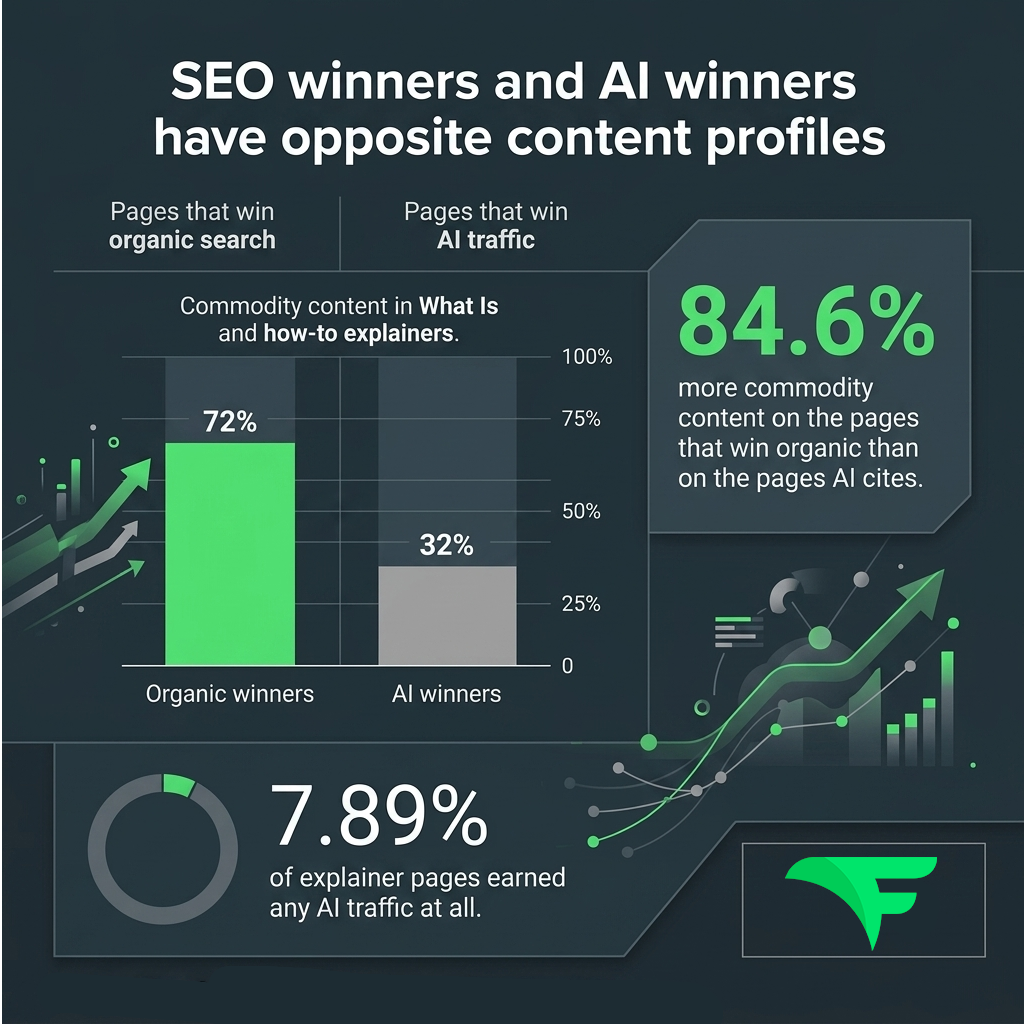
Flying V Group’s own research runs against that reassurance. Measured on Google’s own commodity axis, the pages winning organic search and the pages winning AI traffic have opposite profiles. Top-performing organic SEO pages carried 84.6% more commodity content than top AI-trafficked pages. What Is and how-to explainer content, the format that dominates organic, averaged 72% commodity against 32% for AI pages, and only about 7.89% of those explainer pages earned any AI traffic at all.
Read together, that contradicts the idea that the content earning rankings earns AI visibility. The technical base is shared, since a page still has to be crawlable, indexed, and eligible. The content strategy is not.
Optimizing hard for the high-volume head terms that win organic tends to produce exactly the commodity coverage an AI can reproduce from its own training, so the model answers from memory and skips the citation. Ranking success and citation success can move in opposite directions.
Where This Is Heading — The Agentic Web and the MCP Internet Theory
The current shift is from ten blue links to synthesized answers. The next one, still early and contested, is from answers to actions taken by agents on a person’s behalf. Understanding that trajectory is part of why GEO matters now rather than later.
The infrastructure making it real is the Model Context Protocol. Anthropic introduced MCP in November 2024 and donated it to the Linux Foundation’s Agentic AI Foundation in December 2025, with OpenAI and Block joining as co-founders.
By the time of that handover, MCP had more than 97 million monthly SDK downloads and over 10,000 active servers, with client support across ChatGPT, Claude, Gemini, Microsoft Copilot, and more. The ecosystem’s own analogy is a USB-C port for AI: dull by design, transformative in aggregate.
The MCP internet theory extends that plumbing to the web itself. As agents mediate more research and more transactions, the web reorganizes from pages a human browses toward capabilities an agent invokes. An emerging web layer, sometimes called WebMCP, is one of the layers being defined so sites can expose actions to agents directly.
For a brand, the implication is a change in what discovery even means. Ranking on a page of links matters less when the entity between your customer and your answer is an agent that needs to find you, resolve who you are, trust you, and act. That is the same work GEO does today, extended one layer further. Entity clarity, retrievable structured content, and citation authority are the on-ramp, not a separate project.
No one should bet an entire strategy on a specific end state here, because the standards are moving faster than the web ever did. But the direction is not speculative. A GEO agency’s real mandate is to keep you legible to whatever sits between your customer and their answer, today’s AI Overviews and tomorrow’s agents.
If you are weighing whether your organic program is built for that shift, our team can audit where you show up in AI answers today and where the gaps are. Explore Flying V Group’s SEO and GEO services to see how the two run as one program.
Frequently Asked Questions
What is the difference between a GEO agency and an SEO agency?
An SEO agency optimizes for rankings and clicks in traditional search results. A GEO agency optimizes for citations and mentions inside AI-generated answers from tools like ChatGPT, Perplexity, and Google AI Overviews. The disciplines share a foundation, since strong technical SEO and credible authority signals feed both. The difference is the target and the measurement. SEO success shows up as positions and organic sessions. GEO success shows up as how often, and how prominently, an AI system names your brand when answering a relevant question. In practice, a capable partner runs them as one program rather than two, because the same content and authority work supports both surfaces at once.
How is GEO measured if there are no rankings?
GEO uses its own measurement layer that sits alongside traditional metrics rather than replacing them. The core signals are AI mention rate, or how often your brand appears in answers for target prompts; citation rate, or how often engines quote or link your content; share of voice against competitors across the same prompt set; and prompt coverage, meaning the percentage of your priority questions that surface your brand at all.
Because visibility differs by platform, strong reporting separates performance by engine. Flying V Group also connects these signals to downstream branded search and assisted conversions, since the commercial value of a citation shows up in pipeline weeks later, not in the mention alone.
How long does GEO take to show results?
Expect early signals within roughly six weeks, usually AI Overview appearances for branded queries and improved entity recognition. Broader visibility inside ChatGPT and Perplexity takes longer, commonly three to six months, and compounds as engines develop trust in a consistent source.
Timelines vary with your starting authority, the competitiveness of your prompts, and how much foundational technical and entity work is needed first. Any provider promising guaranteed AI citations within 30 days is either misunderstanding how retrieval works or overpromising. The honest framing is that GEO behaves like authority building: consistent presence across surfaces over time is what earns durable inclusion, not a single optimization pass.
If you want a realistic timeline for your own site, our GEO team can map it against your current authority and target prompts.
Does GEO replace SEO?
No, though treating the two as identical is the more common mistake. GEO shares SEO’s technical foundation, since a page has to be crawlable, indexed, and eligible for a snippet before any AI system can cite it, and Google’s 2026 guidance is right that its AI features draw on that same core index.
Where the two pursuits part company is in the realm of content strategy. The productive model is one program on a shared technical base with two distinct content targets: pages built to rank, and pages original enough to be worth quoting. Run as rivals, they waste budget. Run together, and the one reinforces the other.