
Search stopped ending on a results page. About 68% of Google searches ended without a click in early 2026, according to SparkToro’s analysis of Similarweb clickstream data, and ChatGPT reached roughly 900 million weekly active users in February 2026. The buying question now resolves inside an answer, and the brand that gets named in that answer wins the consideration the click used to deliver.
That shift created a fast, crowded category. The best AI search visibility tools track how often ChatGPT, Perplexity, Gemini, Claude, and Google AI Overviews cite your brand, but they split into two camps. One camp queries real LLM outputs, scraping the responses actual users see, so the data reflects live behavior. The other hits model APIs under controlled conditions, which is cheaper to run but drifts from what a buyer encounters. That single methodological difference decides whether the number on your dashboard means anything.
This roundup separates the tools by that standard and by whether they stop at the alert or help close the gap. If you would rather have the measurement and the fix executed end to end, Flying V Group’s SEO and GEO practice runs on proprietary tooling built for exactly this problem.
1. GEO Genius by Flying V Group — Citation Economics, Not Just Citation Counts
Best for: Revenue-focused brands that want AI visibility tied to a GEO and SEO pipeline, not a standalone dashboard.
Most tools in this category count mentions. GEO Genius, our proprietary toolset, was built to answer the harder question underneath the count: which citations are winnable, and which topics an AI will simply answer on its own without naming anyone. We built it because tracking visibility you can never capture is an expensive way to feel busy.
Our core capabilities:
- Citation Difficulty Scoring rates how winnable a given AI citation is, modeled on real citation distributions rather than backlink or keyword-difficulty proxies that break in generative search. It separates commodity queries an LLM resolves from memory from the non-commodity ones where a differentiated source still gets named.
- Query Fanout Simulation models how an LLM breaks one search into the sub-questions it resolves, surfacing the specific angles where your content can be the cited source instead of one interchangeable page among hundreds.
- Citation Velocity Tracking measures how quickly a domain starts getting cited across AI Overviews, ChatGPT, and Perplexity after changes ship, so visibility reads as an outcome instead of an assumption.
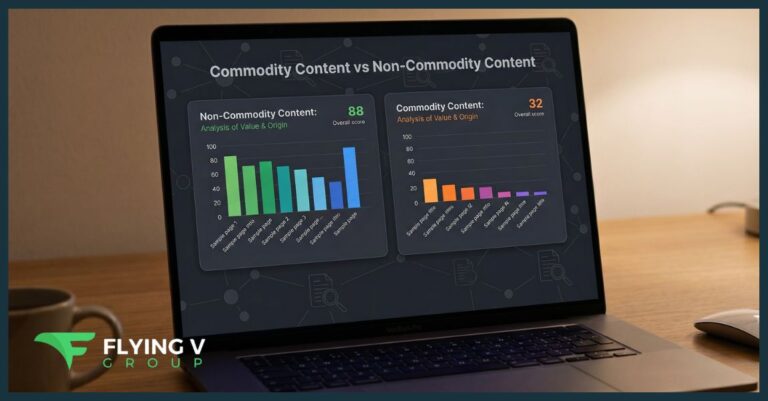
- The Commodity Content Tool scores any URL for how saturated a topic already is. Our own research found top organic pages carried 84.6% more commodity content than top AI-trafficked pages, so a high commodity score doubles as a forecast that the model will answer from memory and skip the citation.
- Cross-engine measurement against actual AI responses, not API approximations.
Technical Approach
We treat AI visibility as a citation-economics problem. Query Fanout Simulation maps the winnable surface area of a topic, Citation Difficulty Scoring prices each opportunity, and the Commodity Content Tool flags the effort that would get disintermediated before it earns a mention. The prescription that follows is uncomfortable for most clients: stop producing commodity explainers the model eats, and reallocate that effort into original data, real case results, and named frameworks that earn attribution. Our GEO practice, led by VP of SEO and GEO Sean Fulford, ships against that thesis.
Why We Stand Out
Most agencies optimize for rankings. Flying V Group optimizes for P&L impact. We connect AI citation gains to downstream pipeline rather than reporting share-of-voice in isolation, which matters when a single mention in a high-intent answer can move a qualified buyer. We have run this playbook for clients ranging from Fortune 500s like Bain Consulting and John Hancock to growth-stage businesses, and the measurement layer stays the same across both.
2. Otterly.AI — The Accessible Entry Point
Best for: Small teams and agencies benchmarking AI visibility for the first time.
Otterly is the clearest starting point for teams without an enterprise budget. Its Lite plan starts at $29 per month, it carries Gartner Cool Vendor 2025 recognition, and its GEO Audit checks 25 or more on-page factors for AI readiness. It tracks mentions across ChatGPT, Perplexity, Google AI Overviews, and Microsoft Copilot, with Gemini and AI Mode available on higher tiers.
The constraint is prompt limits, which tighten quickly on lower tiers, and coverage of smaller engines like Grok is spottier than dedicated enterprise tools. For a business that wants to know whether it appears for ten core questions, that is enough to start.
Ideal client: Freelancers, SMBs, and agencies validating the opportunity before committing budget.
3. Peec AI — Accuracy Through Real-User Simulation
Best for: Mid-market and B2B SaaS teams focused on brand perception across engines.
Peec earns its place on the real-outputs standard. Rather than hitting AI APIs, it uses UI scraping that simulates how real users interact with ChatGPT, Perplexity, and AI Overviews, producing data closer to what users actually see. Reporting is clean and competitor benchmarking is built in, which makes it easy to show a client where they stand against named rivals.
Founded in Berlin in early 2025, it closed a $21M Series A in November 2025, one of the faster trajectories in the space. Its reporting trends toward summarized patterns over response-level detail, so it suits brand positioning better than tactical page-by-page optimization.
Ideal client: Growing brands that need defensible share-of-voice data without enterprise pricing.
4. Profound — The Enterprise Standard for Response-Level Detail
Best for: Fortune 500 teams with a data function ready to act on granular query data.
Profound is the most-funded platform in the category and the depth shows. It tracks across 10 or more AI platforms including ChatGPT Shopping, DeepSeek, and Grok, and adds a Prompt Volumes feature that shows how many users are asking a given query, turning visibility into demand intelligence. It also shows the exact text of AI responses with your brand highlighted in context, which is the closest thing to reading over a buyer’s shoulder.
Notable for genuine scale adoption: its enterprise roster includes MongoDB, Indeed, Figma, and US Bank. The tradeoff is that Profound observes rather than fixes, so your team owns execution, and the pricing assumes an enterprise team exists to do it.
Ideal client: Large brands treating AI visibility as a board-level metric.
5. Ahrefs Brand Radar — AI Visibility Inside an SEO Suite
Best for: Teams already standardized on Ahrefs who want AI data in one environment.
Ahrefs Brand Radar helps SEO teams understand how brands are surfaced across AI search experiences, folding generative visibility into the backlink, keyword, and content tooling those teams already use. The advantage is workflow: no separate login, and AI signals sit next to the traditional SEO data that still underpins them.
The tradeoff is depth. As a module on a general suite, its AI-specific analysis can trail purpose-built trackers, so it fits teams that want directional AI visibility alongside their core SEO work rather than a dedicated GEO command center.
Ideal client: Existing Ahrefs users adding AI visibility without a second contract.
How to Choose — Match the Tool to the Work You Will Actually Do
Choosing well demands a clear-eyed look at your own capacity. The first question is not price, it is monitoring versus execution. Pure trackers like Profound and Peec identify the gap and leave the fix to you, which only pays off if you have writers and a PR motion ready to move. Buying an enterprise dashboard without that team buys you a number, not an outcome.
The second question is measurement quality. Prefer tools that query real LLM outputs over ones that approximate through APIs, and confirm the engine list on the specific plan you buy, since cheaper tiers often track fewer surfaces. Then weigh coverage against focus: go wide if your buyers spread across assistants, narrower if demand sits on one or two.
Making the Decision
There are strong options across the sophistication spectrum here, from a $29 monitor to enterprise platforms and a fully managed GEO program. Match your selection to your actual growth model, not the funding leaderboard.
If the honest answer is that your team will not act on a dashboard week after week, the measurement-and-execution gap is the deciding factor, and that is where a managed GEO program earns its keep.
Frequently Asked Questions
What is an AI search visibility tool?
It is software that simulates the prompts your buyers ask across engines like ChatGPT, Perplexity, Gemini, and Google AI Overviews, then reports how often your brand is cited or recommended. The stronger platforms benchmark you against named competitors and point to the content work that closes the gap.
How is GEO different from traditional SEO?
Traditional SEO optimizes for a ranked list of links. GEO optimizes for being quoted inside a generated answer. They overlap, since most AI systems draw from pages that already rank, but generative search leans harder on structured answers, original data, schema, and third-party mentions.
Which tool queries real LLM outputs?
Peec AI uses UI scraping that simulates real user behavior, and Profound surfaces the actual response text. API-based tools are cheaper to run but can drift from what a live user sees, so confirm the method before you trust the number.
How long until AI visibility improves?
New content typically surfaces in Perplexity within days and in ChatGPT and Claude answers within roughly one to three months, depending on retrieval signals. Plan for a 60 to 90 day cycle to see measurable change, not the 6 to 12 month timeline of traditional SEO.
Do small businesses need one of these tools?
If your buyers ask LLMs for recommendations in your category, yes, even at small scale. A free audit or a low-cost tier will tell you whether you appear for your top ten prompts. If you do not, you have a concrete content and PR problem to solve.
Can a tool fix my visibility, or only measure it?
Most measure only. Monitoring-only platforms leave optimization to your team, while managed programs pair the measurement with the content, structured data, and authority work that earns citations. Decide which side of that line your team can staff before you buy. If the honest answer is that the execution capacity is not there, Flying V Group runs the measurement and the optimization as one GEO program, so the gap a tool surfaces is the same team that closes it.