

A PPC agency in Riverside accounts for 7,209 square miles of targeting surface, stretching from Corona to Blythe. With a population of 2.54 million, setting a campaign to “Riverside County” means that it bids on a searcher 175 miles east near the Arizona line at the same price as one that is two exits down the 91.
The geographic report conceals the damage, because it defaults to matched locations rather than where the user physically stands.
Two business models split this market: a storefront pulls customers to one address, so distance filters itself, whereas a service-area business commits to traveling and sends a truck instead.
Better ad copy does not recover budget spent on searchers no crew can reach by noon. The money sits in three places: geographic structure, the reach setting Google enables by default, and the Local Services Ads migration reaching service-area businesses this quarter.
Flying V Group builds paid accounts around dispatch economics rather than click volume, and the same pattern runs through our client work.
PPC Agencies Build Campaigns Around Crew Bases
Split campaigns by dispatch zone: western along the 91, central along the 60/215, southern toward Temecula. Budget each one separately. When a zone’s cost per booked job crosses your threshold, you cut that zone and leave the rest running. A single county-wide campaign offers no such control, and the account has to be rebuilt before anyone can act on the data.
PPC Ad Search: Presence vs. Presence or Interest
Google Ads defaults to “Presence or Interest,” which serves ads to people physically in the area and people elsewhere showing interest in it. Google’s own targeting documentation exposes Presence as a separate setting advertisers must select deliberately. For a business that sends a truck, interest traffic is a researcher in Phoenix, a landlord in Irvine pricing a job, or a relocating family six months out.
The mistake isn’t picking the wrong radius. It’s accepting a reach setting designed for hotels and applying it to a drain cleaning company. Nothing in the current interface flags this difference, and nothing in the standard performance view reveals the consequence.
A matched location on your businesses Google analytics page shows the geography assigned to the query. User locations show where a device was reported at the time of the search. The difference between those two columns is spent on people outside the service area, and in audited accounts it routinely sits in the double digits as a share of budget.
Exclusions follow the same logic. Negative geo-targeting defaults to Presence, so excluding Coachella Valley blocks people standing in it while still permitting the searcher in Palm Desert who typed a Riverside qualifier. Review both the positive and negative settings rather than assuming they match.
Two further points matter for dispatch businesses. Performance Max and Demand Gen inherit the same location options and need the same correction, which catches accounts that tightened Search and left automated campaigns open.
Location signals carry errors: device GPS is precise, IP inference is not, so the user locations report should be read as a strong directional signal rather than a ledger. The minimum radius Google permits is one mile, which is tighter than most Service-Area Businesses need but useful for carving exclusion holes inside a larger zone.
Local Service Ads Are Moving Into Google Ads
Google began migrating Local Services Ads into the main Google Ads platform as a pay-per-lead Performance Max campaign type in August 2026, starting with home and storefront trades including plumbing, HVAC, electrical, appliance repair, house cleaning, lawn care, roofing, pest control, and moving.
Phase two extends to service-area businesses without a physical storefront, plus accounts using custom bidding or booking configurations, later in 2026.
Riverside Service-Area Businesses sit squarely in phase two. The practical changes are administrative rather than strategic, which is precisely why they get missed.
The standalone LSA dashboard closes once an account migrates. The average weekly budget converts to a daily budget equal to the weekly figure divided by seven, with the monthly cap holding at daily spend times 30.4. New pay-per-lead campaigns cannot yet be created inside Google Ads, so the migration is a conversion of what already exists rather than an open door.
The ranking inputs survive the move intact: responsiveness, review quality and recency, proximity to the searcher, and service-area and job-type precision. Budget influences how much volume you capture, not where you sit in the pack. A $50 bid paired with a five-minute response time outranks a $75 bid paired with a 45-minute one.
Call answer rate is the most controllable input in the channel, and practitioner analyses report missed calls weighing on rank for roughly 90 days. An unanswered 7 p.m. call costs the lead, the booking, and three months of position. Lead crediting now runs through machine-learning assessment at initial contact with reassessment over time, which makes consistent lead-status updates part of the optimization work rather than housekeeping.
Job-type precision is where most Riverside contractors leave money. A profile listing 40 services across five counties loses to a specialist on any narrow query, so removing work you decline raises rank on the work you want. Google Business Profile data now feeds the ad more tightly as well, meaning hours, photos, services, and address are campaign settings rather than a separate local SEO task.
Ask any prospective agency what their phase-two migration plan looks like. An agency that cannot describe budget conversion, job-type pruning, lead-status discipline, and Google Business Profile alignment is going to discover the change alongside you, on your spend.
What a Riverside Lead Should Cost
WordStream’s 2026 Google Ads benchmark data puts the all-industry average at $5.42 per click and $66.69 per lead. Home and home improvement runs considerably higher at $8.33 per click and $90.92 per lead, against an 8.05% conversion rate. Attorneys and legal services top the table near $9.87 per click, which matters in a county with heavy personal injury competition.
Local Service Ads price differently. SearchLight’s February 2026 home services benchmark, covering $6.72 million in LSA spend across 888 contractors and 126,650 leads, recorded a $53 average cost per lead and a $233 average cost per paying customer. The spread between those two numbers is the whole argument for tracking booked revenue rather than form fills.
Cost per lead is a vanity metric in isolation. Hold your agency to cost per acquired customer and an LTV:CAC ratio, and require offline conversion imports so Google’s bidding models optimize toward revenue rather than phone calls.
Questions for Hiring A PPC Agency: Separating Operators From Reporters
- What is the user locations report? Does it match the location’s report?
- Which ZIP codes are excluded from the search? Why?
- Do the booked job values flow back into the account through offline conversion import? If so, on what cadence?
An agency that reports on leads without reporting on booked revenue is describing activity, not performance.
Paid search is also half an answer. Service-area businesses that pair Google Ads with local organic and Google Business Profile work reduce blended acquisition cost over time, because the proximity and review signals feeding LSA rankings are the same ones feeding the map pack.
If your Riverside campaigns are producing leads you cannot trace to booked revenue, Flying V Group’s paid media team, led by Senior PPC Specialist Oscar Leiva, rebuilds accounts around dispatch economics rather than click volume.
Frequently Asked Questions
Should I run Local Services Ads or Search ads first?
Run Local Services Ads first if you hold a 4.5-star average with 50 or more reviews, since the channel charges per lead rather than per click and sits above everything else on the page. Search ads cover services LSA categories exclude and capture research-stage queries. Most mature accounts run both, with LSA taking the emergency and high-intent volume.
How long does Google Ads take to produce leads in a service area?
Search campaigns can produce calls within the first week. Local Services Ads need roughly two weeks of learning, and Google suggests budgeting for about 10 leads per week so the model has volume to work with. Stable cost per acquired customer typically arrives at 60 to 90 days, once offline conversion data has accumulated.
Should I advertise in Spanish in Riverside County?
Census estimates put Riverside County’s Hispanic or Latino population at roughly 53%, which makes Spanish-language campaigns a volume opportunity rather than a courtesy. Build separate ad groups with Spanish keywords and a Spanish landing page, not machine-translated copy on an English page. Confirm your intake team can handle Spanish calls before launching, since a dropped call wastes the lead and the LSA ranking signal.
What do PPC agencies in Riverside charge?
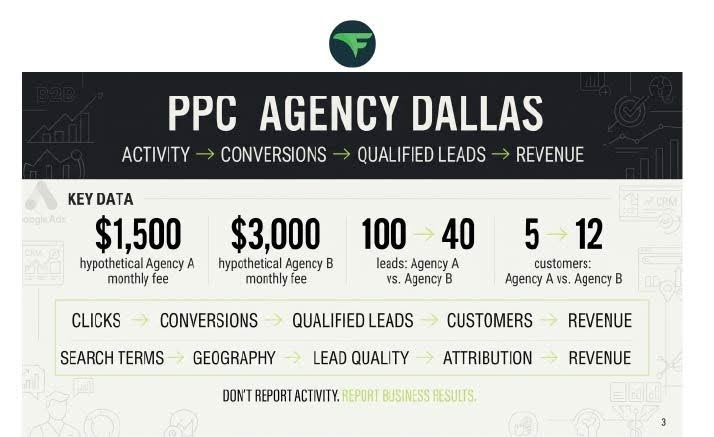
Most agencies price either as a flat monthly retainer or a percentage of ad spend. Clutch’s PPC pricing data, drawn from first-party client reviews, puts US hourly rates at $100 to $149. The number that matters more than the quote is the fee as a share of total budget: a $1,500 retainer against $5,000 in ad spend means 23% of your monthly outlay never reaches the auction, while the same fee against $20,000 in spend is 7%. Ask what the fee covers (landing pages, call tracking, offline conversion import, LSA management) and run that ratio before comparing agencies.